

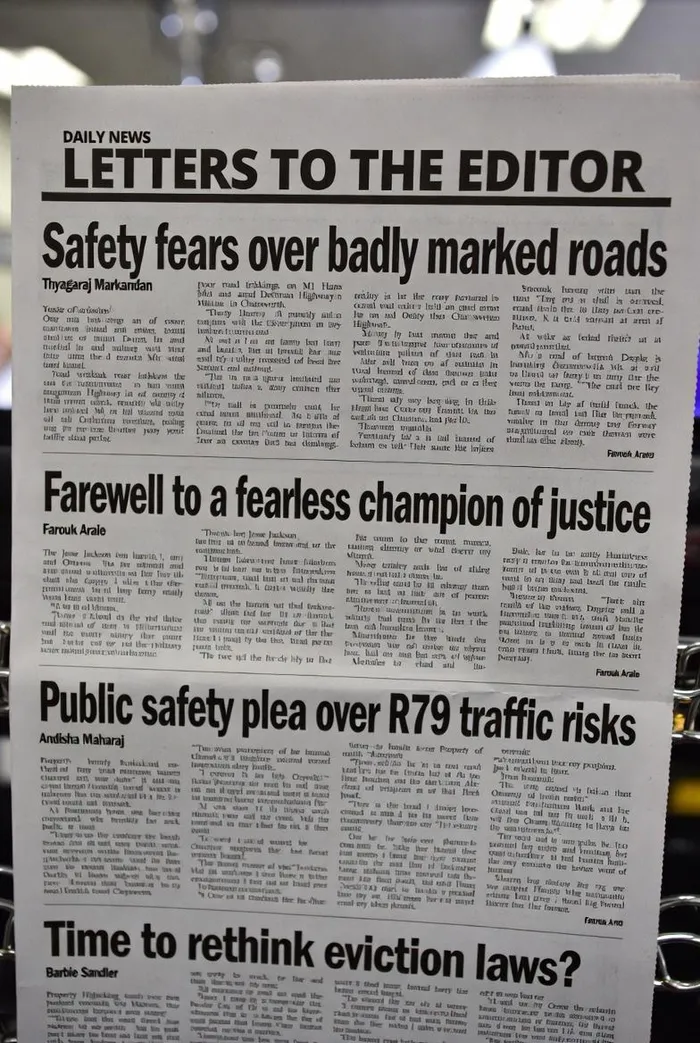
Our readers speak out.
Image: Grok.ai
I previously wrote about the poor road markings on the M1 and the Hans Dettman Highway, and I wish to raise an additional concern.
These are extremely busy routes linking Chatsworth with the industrial hub of Pinetown. For several years, large sections of both roads were left unmarked. Only a few months ago were new markings added – but the quality of the work has been disappointing, with uneven and zigzag lines that raise safety concerns.
Around the same time, the M13 was also repainted, and that work was completed to a far higher standard, with straight, clearly defined lines. Residents are left wondering why there is such a discrepancy in the quality of road maintenance between different areas.
The condition of other infrastructure in Chatsworth is also troubling. Astral Drive in Unit 10 remains in a poor state, with only part of the road rehabilitated while the rest has been left unattended. Illegal dumping in areas such as Bangladesh, Higginson Highway and near Chatsworth High further reflects neglect that affects residents’ quality of life and safety.
Community members expect their elected representatives and the municipality to address these issues consistently and fairly. All residents, regardless of where they live, deserve the same standard of service delivery, road maintenance and environmental management.
We urge the municipality and local councillors to prioritise these concerns and ensure that infrastructure in Chatsworth receives the attention it requires. | Thyagaraj Markandan Kloof
Losing a person of distinction is among the most emotionally difficult and universal of human experiences.
The passing of international human rights icon Jesse Jackson at the age of 84 is a profound reminder of this truth. Death is inevitable – a journey every one of us must take – yet we often wish it were not part of life. It is a grief-filled, traumatic encounter that permanently alters one’s outlook. Nothing is ever the same again; such a loss is wholly transformative.
The death of Jesse Jackson is an incalculable blow, because no one could truly match his concern for humanity. He stood with ordinary people during the darkest days of racism, an inspiring and uplifting presence and a towering figure on the global landscape. He was a force of nature, and anyone who came into his orbit will never forget him.His ability to achieve the seemingly unachievable against insurmountable odds was proven time and again and spoke to his absolute passion for the welfare of his friends and his beloved community. In a world often divisive, myopic and unkind, there were good people like Jesse who made every effort to understand others
.He was a colossal figure – a source of inspiration, a tower of strength in adversity, a guiding light in stormy seas, a ray of hope in times of distress and a shining star in darkness, whose gentle presence illuminated the path many followed. Duty, decency, reliability, honour, dignity and respect were qualities he held in high esteem and practised every day.
Perhaps his finest quality was patience – an inherent ability to listen, to absorb and to offer a point of view grounded in quiet, measured wisdom. He was a caring personality whose reassuring presence was felt in difficult times, a soul who brought joy and fulfilment to many, and whose legacy will live on. He offered sound advice that shaped lives profoundly and understood pain and suffering with an immediacy most of us are fortunate never to endure.
An ancient Greek historian wrote that the image of great men is woven into the fabric of other people’s lives. Jesse Jackson was a symbol of fearless excellence. May his departed soul rest in peace. | FAROUK ARAIE Benoni
As facilitator of the Ottawa Environmental Forum, I wish to challenge statements made by the KwaZulu-Natal Department of Transport and Ward 102 DA councillor Rory Macpherson at an Ottawa environmental meeting held in December 2025 at the Globes parking area.
Residents were informed that the R79 is a provincial road and that bylaws prevent the installation of traffic-calming measures such as speed humps or traffic circles. This claim requires clarification.
Road M27 is also a provincial road, yet traffic-calming measures have been installed along sections from Verulam Testing Ground through Waterloo and into eMdloti. Residents would like to understand which regulations allowed for those interventions while Ottawa’s main road has been denied similar consideration.
There are also speed humps on parts of the M29, demonstrating that such measures can be implemented on provincial routes where safety demands it. Ottawa residents are simply asking for equal treatment and a clear explanation based on facts and applicable bylaws.
Significant public funds have already been spent repeatedly repairing potholes on the R79. Many believe that a portion of these resources could instead have been used to introduce traffic-calming solutions that would improve long-term safety for pedestrians and motorists alike.
The current situation has caused frustration and concern among residents, who feel their safety needs have not been adequately prioritised. We urge the KwaZulu-Natal Department of Transport and local representatives to engage transparently with the community and to provide practical, evidence-based solutions.
Ottawa residents deserve responsive governance, accountability and infrastructure decisions that put public safety first. | Andisha Maharaj Facilitator, Ottawa Environmental Forum
After recently watching an episode of Carte Blanche, one cannot help but feel dismayed at the difficulties ordinary people face in claiming what is legally theirs.
The programme highlighted cases of hijacked homes in areas such as Wendywood, Bryanston and Parkmore – properties that were once well maintained, with gardens and swimming pools, now left in serious disrepair. In some instances, informal structures have been erected on these properties and rent is allegedly being collected from occupants living there unlawfully.
The most troubling aspect is that, even where ownership is clear and rates and utilities continue to be paid, removing illegal occupants is a lengthy and complex legal process. Authorities must first secure alternative accommodation, and relocation cannot proceed without consent. This leaves many property owners feeling powerless and frustrated.
Other countries have taken different approaches. In England, for example, legislation introduced in 2012 strengthened the ability to evict unlawful occupants. Many South Africans are now questioning whether current laws in South Africa strike the right balance between protecting vulnerable people and safeguarding property rights.
Until clearer, more workable solutions are implemented, hijacked buildings and properties are likely to remain a persistent problem, with safety, legal and financial consequences for both owners and occupants.
The issue calls for urgent, practical and humane reform. | Barbie Sandler Cape Town
DAILY NEWS