

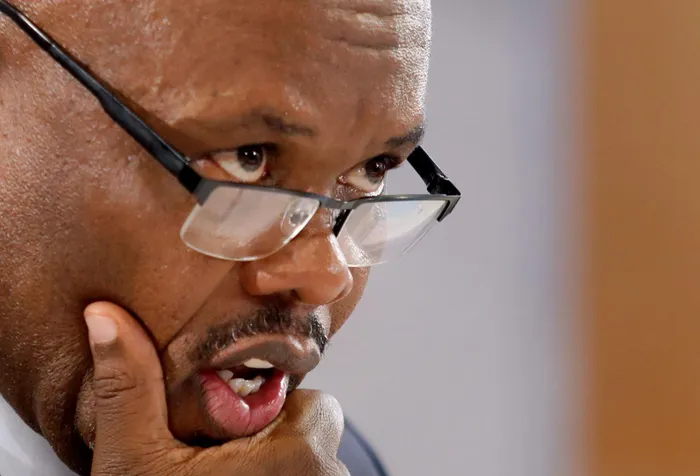
Suspended Deputy National Commissioner Shadrack Sibiya has denied involvement in transferring politically sensitive dockets, distancing himself from the allegations.
Image: Oupa Mokoena/Independent Newspapers
Suspended Deputy National Commissioner Shadrack Sibiya has denied involvement in the transfer of 121 case dockets related to politically motivated killings from KwaZulu-Natal (KZN) to his Pretoria office, contradicting allegations made by KZN police chief Nhlanhla Mkhwanazi.
He told the Madlanga Commission of Inquiry on Wednesday that it was the Political Killings Task Team (PKTT) head Lieutenant General Dumisani Khumalo who issued an instruction that the dockets be moved from KZN to Gauteng.
Sibiya testified that he was not involved when the 121 dockets were handed over and were under SAPS head office control for three months.
He vehemently denied that the dockets were kept in his office, saying: "We didn't take the dockets, store them at the head office and they are gathering dust somewhere in my office. I have never seen even a single docket, to date. I have not seen even one. They have never been in my office. I don't have a safe in my office nor an archive."
He told the commission that attempts were made to return the dockets to KZN but Mkhwanazi rejected the offer.
“The fact that Mkhwanazi rejected those dockets, on its own, should not have been allowed," he said.
Mkhwanazi had claimed that at the time of the dockets removal from KZN five of the removed dockets had instructions to arrest suspects, but no action was taken while they were under Sibiya's control.
Sibiya accused Mkhwanazi of attempting to tarnish his reputation, saying most PKTT dockets were "already stagnant" at the time of their removal from KZN. He dismissed Mkhwanazi's testimony as a bid to shape a narrative against him.
He presented a worrying picture of the investigation of dockets, saying only 18% of them were recorded on the last day of investigation in 2025. A further 21% were last investigated in 2024, while 22% date back to 2023.
He said it was “a lie” that the PKTT was effective in its work, citing an example of a docket that took five years to conclude, despite a two-year target.
Sibiya criticised Mkhwanazi’s claim about swift arrests made within a week of the dockets being returned to KwaZulu-Natal last year, labelling the assertion as "incongruous and unimpressive".
He pointed out that the PKTT failed to obtain signed J50 forms to make arrests for more than three years.
Sibiya has been accused of advocating for the disbandment of the PKTT and his alleged links with the criminal cartel previously came under scrutiny.
“I have never been involved in a drug cartel and I have never been involved in drugs,” he said.
Sibiya dismissed Mkhwanazi's testimony, criticising its reliance on WhatsApp messages allegedly from a phone taken from alleged crime mastermind Vusimuzi "Cat" Matlala, saying the evidence contained unverified references to him.
He strongly denied being a close friend of Matlala, labelling any such claims as false.
He said he was introduced to Matlala as one of SAPS service providers. Matlala was awarded a R360 million tender through his company called Medicare24 to render a medical service to SAPS Pretoria College.
“The suggestion that I am a close friend of Matlala is untenable, given that I only met him for the first time in January 2024,” he said.
Sibiya dismissed Masemola's concerns about his continued oversight of the investigation into the kidnapping of Matlala's friend and a Gauteng-based businessman Jerry Boshoga in 2024.
He explained that he got involved in the investigation after Boshoga’s family member requested his help, citing slow progress.
Earlier on Sibiya told the commission that he was unaware suspended Police Minister Senzo Mchunu would disband PKTT on December 31, 2024, but was not surprised by the decision.
According to him, SAPS National Commissioner Fannie Masemola did not oppose the PKTT disbandment because the subject of disbandment formed part of a meeting of November 1, 2025, which was one of the consultative meetings.
Sibiya told the commission that existing task team structures, including the 2018 PKTT, were set to be replaced by provincial robbery and murder units, according to a study group's recommendations.
This corroborated Mchunu’s testimony two months ago that if Masemola had approved the new organisational structure based on the 2019 work study, the PKTT would have been dissolved back in March 2024.
Mchunu had stated that the PKTT was not adding value to the policing work, but Mkhwanazi testified that Mchunu’s conclusion “was misplaced”.
Masemola told the commission last year that he deemed as “unlawful” a directive by Mchunu to disband the PKTT, saying he reached out to President Cyril Ramaphosa for intervention.
Sibiya told the commission that his role in the disbandment of the PKTT was “undertaken solely in the course of and instructions issued to me by the national commissioner”.
He testified that Professor May de Haas lodged a complaint with Mchunu on October 31, 2024, alleging PKTT was abusive and wasted resources, with these issues arising under Mkhwanazi's leadership. De Haas called for PKTT's disbandment and a judicial probe into its operations.
Sibiya also testified the Public Protector's (PP) 2020 probe cleared him of wrongdoing in his Group Forensics and Investigation Services (GFIS) appointment at the City of Joburg (CoJ) but Al-Jama-ah's Thapelo Amad continued to question his legitimacy, despite the report.
The PP found his appointment and salary adjustments complied with CoJ's legal framework.
Sibiya addressed allegations by Gauteng ex-Hawks head Prince Mokotedi, who claimed he was implicated in high treason and espionage, adding the claims stemmed from a dubious "Top Secret Intelligence Report" Mokotedi allegedly received in April 2016.
“The report allegedly implicated me, Mr Paul O’ Sullivan, Mr Robert McBride, Ms Candice Coetzee and other unidentified persons said to be associated with AfriForum and the Democratic Alliance. The intelligence report concerned was highly questionable,” he said.