

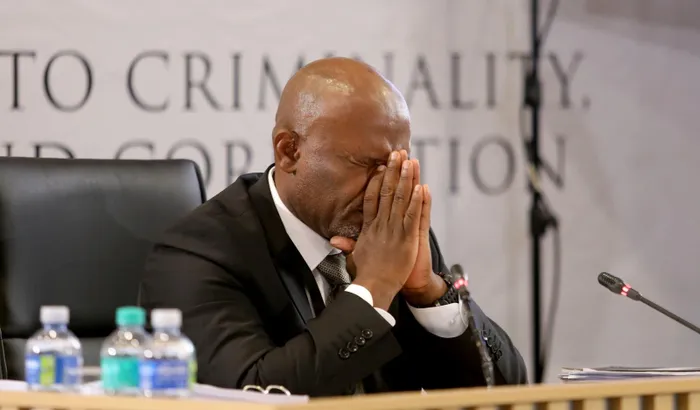
The Madlanga Judicial Commission of Inquiry continues to hear the evidence of Deputy National Police Commissioner Lieutenant-General Shadrack Sibiya.
Image: Oupa Mokoena / Independent Newspapers
Suspended Deputy National Police Commissioner for Crime Detection Lieutenant-General Shadrack Sibiya has continued to defend the decision to disband the Political Killings Task Team (PKTT) at the Madlanga Judicial Commission of Inquiry.
On Friday, Sibiya told the judicial commission of inquiry into criminality, political interference, and corruption in the criminal justice system, chaired by retired Constitutional Court Justice Mbuyiseli Madlanga, that he used his discretion as the police’s top detective to issue the instruction to disband the PKTT.
Senzo Mchunu, the police minister now on special leave, did not direct that the 125 case dockets be transferred to the SA Police Service’s (SAPS’s) head office in Tshwane, as Sibiya has repeatedly claimed he was directed and instructed to do so.
Instead, Mchunu, who informed National Police Commissioner General Fannie Masemola of his decision to disband the task team on New Year’s Eve in 2024, said the 60 politically-related cases, 46 related to traditional leadership, 16 parallel cases, two linked to the University of Fort Hare, and one ad hoc case must be transferred to the component Serious and Violent Crimes (Murder and Robbery Unit) within Division: Detection and Forensic Services.
The beleaguered minister said the remaining PKTT members would oversee the 114 dockets on the court roll and continue with outstanding investigations in preparation for trials.
In Mchunu’s plan, newly reported cases linked with the PKTT’s mandate would be referred to the KwaZulu-Natal Serious and Violent Crimes Unit (within the Murder and Robbery Unit).
However, after Masemola forwarded Mchunu’s directive to Sibiya, he instructed that court-going dockets be transferred to the head office.
Sibiya insisted that this was part of his move to capacitate the Murder and Robbery Unit, but this was contrary to the plan approved by Mchunu.
Asked by evidence leader Adila Hassim SC whether he accepted that he was not acting in terms of the minister or the national commissioner’s plan, Sibiya insisted: “I was acting in terms of my mandate as head of the detectives.”
Commissioner Sesi Baloyi SC later asked if Sibiya accepted on the face of correspondence before the inquiry that it does not contain an instruction to implement.
“There are no words that say implement the deactivation of the PKTT,” Baloyi asked Sibiya, whose response was that he accepted no such instruction existed.
According to evidence presented at the commission, Sibiya presented a plan to Masemola on how to implement the minister’s directive. But Masemola was dissatisfied with the plan to disband the PKTT, but Sibiya insisted that he wanted PKTT’s disbandment to be similar to how the Scorpions were disbanded.
The National Prosecuting Authority’s directorate of special operations, commonly known as the Scorpions, was established in 1999 and later disbanded a decade later following a resolution of the ANC’s national conference in December 2007.
Sibiya apparently told Masemola that members of the Scorpions were individually called into the office with their dockets, signed for their handing over, and management signed for receiving the dockets, and officers received new deployments.
Masemola felt it would be irresponsible and advised Sibiya to consult with the SAPS Head of Strategic Management, Major-General Leon Rabie, to assist with a phase-out plan.
Sibiya then presented an amended plan in which he wanted the immediate closure of the PKTT and handing over of dockets, but Masemola felt there should be a gradual wind-down of the PKTT’s operations and was not prepared to sign for approval, as this would have a detrimental effect on investigations of the cases.
Sibiya said the same plan Masemola rejected came from his office.
“The same plan that the national commissioner says he rejected, it is still his own plan because it comes from his office,” he maintained.
Sibiya disagreed that Masemola raised any concerns that he could not summarily close the task team like that, and that this never happened.
Instead, he said Masemola told him: “I understand, I think you can sign it, it’s operational.”
The commission continues.