

Our readers' forthright views.
Image: Grok.ai
Dear Editor,
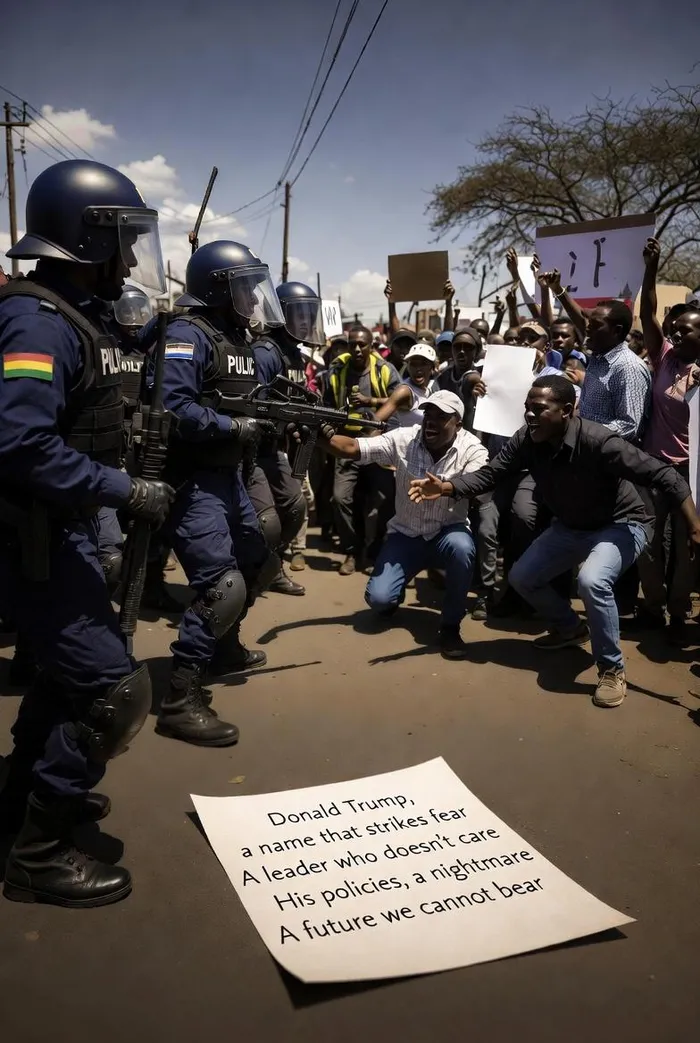
A poem for you:
Mister Trump
Gives me
The hump.
| Harry Wiggett Pinelands
The recent decision by Amathole District municipal authorities to deploy the Public Order Police against desperate residents protesting the lack of water is not just poor governance; it is a violation of basic human dignity.
When communities cry out for something as fundamental as water, the response of a caring government should be dialogue, accountability, and urgent intervention, not rubber bullets, intimidation, and harassment.
Reports that community leaders who organised peaceful marches are now being harassed in their own homes add a deeply troubling dimension to this crisis. Residents allege that individuals leading demonstrations against dry taps have faced late-night visits, threats, and attempts to silence them.
This is not law enforcement, but a political intimidation. In a constitutional democracy, citizens must be free to organise, speak, and protest without fear of retaliation inside their own homes. Criminalising community activism only confirms that the municipality has chosen coercion over compassion.
For over a week, many residents across the Amathole District Municipality have been left without water, with some communities such as Lower Blinkwater suffering intermittent supply since last year. Yet instead of municipal officials coming out to engage with residents, understand their grievances, and present credible solutions, force was used to silence legitimate frustration.
This approach reflects a governing culture that treats communities as subjects to be controlled, not citizens to be served.
Water is not a privilege; it is a constitutional right. When that right is denied, communities have every reason to protest. Responding with rubber bullets and alleged house-to-house intimidation communicates a dangerous message: that the voices of the poor are less important than the comfort of those in power. While residents queue with buckets, the municipality proudly hosts a two-day “institutional strategic planning session.”
Such sessions mean little when taps are dry and livelihoods are disrupted. Strategic planning without basic service delivery is simply political theatre. It exposes a leadership more concerned with internal processes than with the lived reality of the people they were elected to serve.qually troubling is how the issuing of water tankers and infrastructure tenders has allegedly become a feeding trough for politically connected individuals. Instead of building sustainable water infrastructure, emergency water provision is repeatedly outsourced, allowing cadres to award lucrative tenders to aligned associates. This cycle of crisis and tender allocation entrenches dependency, inflates costs, and delays long-term solutions, all while public funds are siphoned away from real development.
Communities in KwaMaqoma, Adelaide, Bedford, Balfour, Alice, and Middledrift know this pattern too well: promises during elections, neglect after votes are counted, and repression when people demand accountability. The result is decaying infrastructure, unreliable water supply, and deepening poverty.
This is why the upcoming Local Government Elections are not just routine political exercises; they are a lifeline for communities who have been ignored for too long. Registration is the first act of reclaiming power. Your vote is not merely symbolic it is the most direct instrument to stop the decay and force a change in priorities within local governance.
A responsive municipality listens before crises erupt, plans before infrastructure collapses, and invests in sustainable delivery rather than emergency tenders. It treats citizens as partners, not adversaries.
The current trajectory shows an uncaring administration that reacts to suffering with force, allegedly intimidates community leaders in their own homes, and shields itself with meetings while communities endure the consequences.If residents want a municipality that prioritizes service delivery, financial accountability, and respectful engagement with communities, then voter registration is critical. Participation in the electoral process is the peaceful and democratic way to hold leadership accountable and redirect governance towards people-centred development.
The choice facing residents is clear: continue under an administration that meets protests with rubber bullets and intimidation, or use the ballot to demand competent, compassionate, and transparent governance.
By registering correctly and voting for CHANGE, communities can send a decisive message that human rights violations, harassment of activists, neglect, and tender-driven governance will no longer be tolerated. Your vote can rescue local towns from decline. Your vote can end the politics of indifference.
Most importantly, your vote can restore dignity by ensuring that when communities ask for water, they receive solutions not rubber bullets, raids, or threats at their own doorsteps. | Thulani Dasa KwaMaqoma
Currencies are being debased, crisis conditions are worsening, democracy is being undermined, and social justice appears increasingly absent.
The ongoing global financial drama, some believe, reflects a coordinated system that transfers vast wealth away from developing countries.
Many fear that a future world order could lead to supranational authorities regulating global commerce and industry. History reminds us that wars are often justified through narratives that later prove misleading, while political leaders frequently align themselves with powerful international interests when determining allies and enemies.
Critics argue that international institutions, including the UN risk becoming enforcement mechanisms for dominant global powers rather than neutral arbiters of peace.
President John F Kennedy warned in 1961 of a “monolithic and ruthless conspiracy” that expanded influence through covert means, infiltration, subversion, and intimidation rather than open democratic processes. His remarks echoed earlier concerns expressed by President Dwight D Eisenhower about the growing influence of the military-industrial complex.Whether one agrees fully with these warnings or not, they raise enduring questions about power, accountability, and transparency in global politics.
Ignoring such concerns, some argue, may come at our peril. | Farouk Araie Benoni
DAILY NEWS