

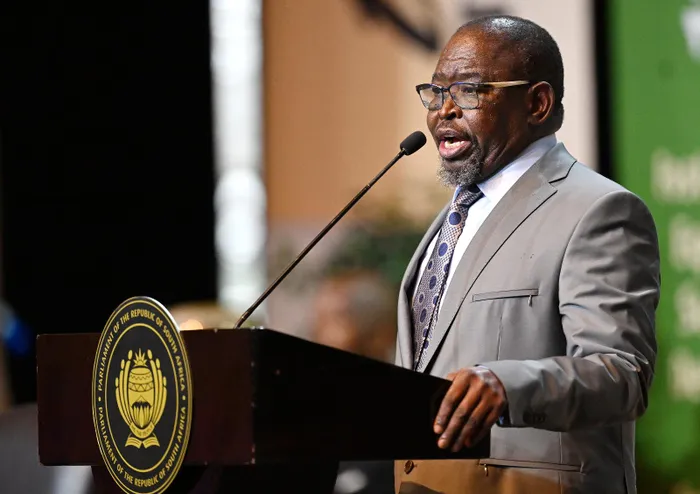
Finance Minister Enoch Godongwana's budget speech has sparked varied reactions in KwaZulu-Natal.
Image: Phando Jikelo/ Parliament of SA
Tuesday’s Budget Speech delivered by Finance Minister Enoch Godongwana has stirred mixed reactions among various stakeholders in KwaZulu-Natal.
On the minister’s long list of focus areas were municipal affairs, including reforms to the Municipal Infrastructure Grant (MIG), aimed at tackling persistent underspending, misuse of funds and capacity constraints. The move received approval in some quarters.
The MIG is designed to eradicate municipal infrastructure backlogs in poor communities, ensuring the provision of basic services such as water, sanitation, roads and community lighting. The Department of Cooperative Governance is responsible for managing and transferring MIG disbursements and provides support to provinces and municipalities in implementing MIG projects.
However, others who spoke to the Daily News raised serious concerns about ongoing service delivery failures and the management of municipal revenue.
During his address, Godongwana introduced a new split-delivery model for municipal funds. The model aims to ensure that municipalities with proven capacity to manage their finances effectively continue to receive funding directly from National Treasury, while those hampered by governance deficiencies will face an indirect funding approach.
The minister said: “Capable district municipalities and other accredited implementing agencies will be involved in the infrastructure delivery suite, with the intention of protecting citizens from persistent municipal dysfunctions that have long undermined effective service delivery.”
Anthony Waldhausen, CEO of the Msunduzi Ratepayers Association, welcomed the minister’s speech but cautioned against the potential misuse of funds intended for upgrading and repairing vital infrastructure.
“The challenge we have in Msunduzi is corruption,” said Waldhausen. “As soon as the money comes in, we worry that it will not be used properly.”
On the other hand, Mdu Nkosi, an eThekwini Municipality councillor and EXCO member, expressed mixed sentiments. While he accepted the budget framework, he believes the funds currently allocated for Durban’s water and sanitation infrastructure fall far short of what is required.
Nkosi had hoped for a greater injection of funding to improve that aspect of the city’s infrastructure.
With an estimated R10 billion needed to address post-flood damages alone, Nkosi said: “We understand that Durban was most affected by floods, so we must rebuild the infrastructure that was damaged. The money will never be sufficient, but we welcome every single cent we receive.”
He also noted that the municipality is currently compliant with its MIG grants, confirming: “We are doing well on that front, and all our money is accounted for.”
The minister also announced hikes in fuel levies, a decision that has not been well received.
Nhlanhla Mazibuko, a long-distance taxi driver operating between Durban and Johannesburg, expressed frustration, accusing the minister of placing additional strain on citizens.
“By virtue of increasing the fuel price, everything else will go up — transport costs, food and other essential goods ordinary people rely on,” Mazibuko said.
“We are just being made fools here; we will pay more for things we can’t afford, as earnings don’t increase, but everything else does.”
The fuel levy increase amounts to a 21-cent rise per litre, broken down across various levies. The general fuel levy will increase by 9 cents per litre for petrol and 8 cents for diesel, while the carbon fuel levy and the Road Accident Fund levy will also rise.
Keyuren Maharaj, chairperson of the Glenwood Bulwer Ratepayers and Residents Association, expressed concern about the fuel hikes. While National Treasury has framed them as necessary for revenue sustainability, they present a further burden on already stretched household budgets.
“In this context, it becomes even more critical that fuel tax revenue is visibly reinvested into infrastructure, better roads, safer transport networks and reliable services,” Maharaj said.
DAILY NEWS