

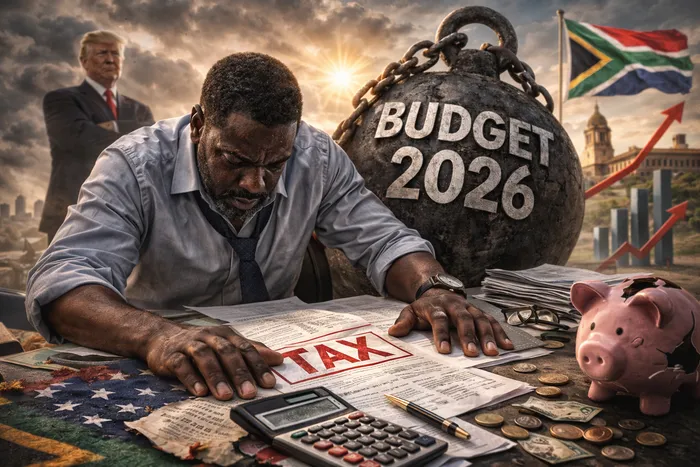
Will there be tax relief or will the burden get bigger?
Image: ChatGPT
Donald Trump’s half-hearted condolences following the passing of political figure and human rights activist Rev Jesse Jackson deserve nothing but contempt.
It is insincerity personified and nothing short of political theatre designed to shore up his dwindling popularity base, now standing at just 37% according to US polls. The remarks serve as a stark reminder that the same voice previously described Africa as a “s***h***” and Somalians as “filthy, dirty garbage”.
Trump has played his cards, and his sudden display of sympathy reads as a failed comeback attempt after blatant right-wing racist outbursts targeting Africa and Somalia.
As the mid-term elections in November approach, American voters will decide whether to turn their backs on the man many believe brought shame to a once-proud nation and restore a sense of decency to the United States. | Colin Bosman Newlands
South African taxpayers are stretched to breaking point.
Finance Minister Enoch Godongwana will deliver his 2026/2027 Budget speech tomorrow, and citizens desperate for relief will be watching closely to see whether he answers mounting calls for lower taxes. Godongwana endured a turbulent 2025, most notably when his proposed two-percentage-point VAT increase collapsed after the DA refused to support the Budget in Parliament. Following months of political manoeuvring, the VAT hike was scrapped and the Budget passed only on a third attempt in May.
Although criticism of the DA’s participation in the Government of National Unity remains common, its resistance to the VAT increase marked a defining moment, demonstrating the internal opposition many voters expected it to provide against ANC excesses. Notably, however, the resistance appeared stronger within Parliament than inside Cabinet itself.
When Godongwana presented his Medium-Term Budget Policy Statement in November, the tone shifted. He projected the consolidated budget deficit declining from 4.8% to 4.5% and forecast a primary budget surplus of 0.9%. While debt levels were expected to remain high at 77.9%, he argued that the overall burden had stabilised. The so-called mini-Budget received widespread praise, yet optimism has since faded as taxpayers continue carrying an overwhelming fiscal load.
According to SARS data, South Africa had 27 million registered individual taxpayers in 2024, but only 7.7 million were assessed. Of these, just 19.6% earned above R500 000 annually, yet this small group contributed 77% of all assessed personal income tax and roughly a quarter of total state revenue. Meanwhile, Statistics South Africa reported unemployment easing slightly from 31.9% to 31.4% in late 2025, leaving 7.8 million unemployed people – more than the number of assessed taxpayers supporting the system.
More than 28 million welfare grants are now distributed monthly, including 8.7 million Social Relief of Distress grants introduced during the Covid-19 pandemic. Parliamentary applause often accompanies announcements of expanding grants, less out of altruism than because welfare dependency secures political loyalty. Poverty and unemployment, critics argue, are the direct consequences of long-standing policy failures, with social grants functioning only as temporary relief rather than structural solutions.
Government success in balancing the books has relied heavily on aggressive revenue collection by SARS, frequently praised as a “world-class” institution. Yet many taxpayers feel less admiration as compliance demands intensify, refunds are delayed, and extensive documentation is required from already burdened citizens. Taxation extends into nearly every aspect of life – transfer duties on homes, capital gains tax on investments, estate duties on inheritance, sin taxes on alcohol and tobacco, and fuel levies funding a struggling Road Accident Fund.
To many, the state resembles a relentless, tax-guzzling machine whose appetite is never satisfied. Despite growing frustration, few political parties appear willing to champion meaningful tax relief. One exception is Electricity and Energy Minister Kgosientsho Ramokgopa, who has proposed suspending South Africa’s carbon tax, arguing that the country should not sacrifice its coal advantage to what he views as a misguided Net Zero agenda.
If reform rhetoric is to carry credibility, substantive tax relief must emerge from this year’s Budget. South African taxpayers’ patience is wearing thin – and today they will discover whether relief is finally on the horizon. | David Ansara Free Market Foundation
DAILY NEWS