

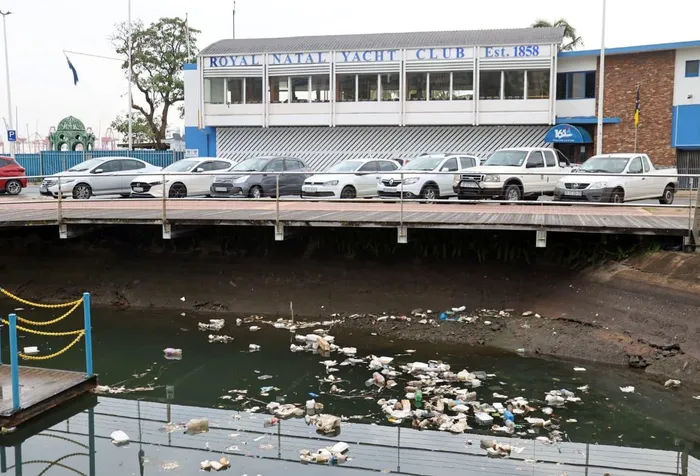
Recent heavy rainfall in Durban has led to significant pollution in the Beach Area of Wilson’s Wharf harbour, prompting local businesses and environmental activists to call for urgent action to address the ongoing crisis.
Image: Tumi Pakkies
Recent heavy rains over Durban have left the bay at Wilson’s Wharf strewn with litter and debris, prompting urgent calls to action from the local business community and environmental activists.
The once picturesque harbour has become an unsightly scene and, according to some stakeholders, a no-go zone. The degradation over the years continues to raise concerns about marine pollution and the safety of aquatic life.
Local businesses, including MH Performance Sailing NPC, have reported a significant drop in customer numbers due to the deteriorating conditions.
Nicolene Henkeman, co-founder of the sailing organisation, shared her concerns during an interview with the Daily News. She highlighted not only the visible pollution but also the brownish hue of the water.
“We have actually lost business because of this. We had a customer who recently cancelled their membership due to the water conditions,” she said.
Henkeman added that the situation had become dire and was compounded by years of leaking sewage into the bay in close proximity to their operations.
She said that although the eThekwini Municipality had made attempts to address water quality issues in the area, but recurring floods had exacerbated the pollution problem.
“Every time it rains, we encounter the same problem; the water is still in a terrible state,” she said.
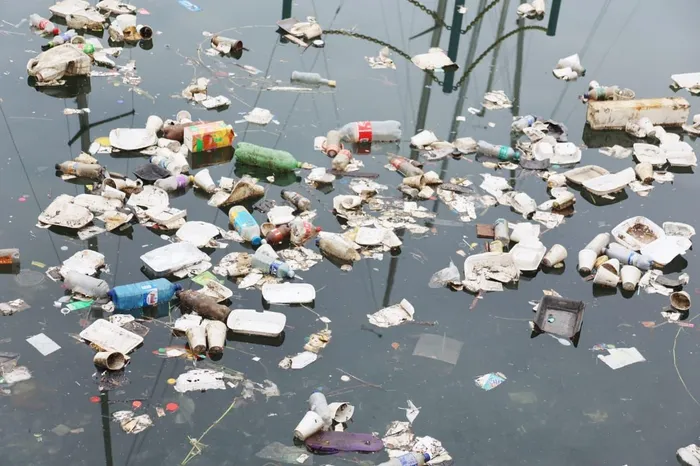
Recent heavy rainfall in Durban has led to significant pollution in the Beach Area of Wilson’s Wharf harbour, prompting local businesses and environmental activists to call for urgent action to address the ongoing crisis.
Image: Tumi Pakkies
Community leader Michael Apelgreen also raised concerns and pledged to escalate the matter with the municipality and port authorities.
“There is a team that normally responds to clean-ups after heavy rains, but we need a more robust, long-term anti-litter campaign and an adequately maintained sewage system to ensure the water quality improves,” he said.
Environmental activist Desmond D’Sa from the South Durban Community Environmental Alliance (SDCEA) expressed frustration at what he described as ongoing negligence at the harbour.
“We need a meeting convened by senior port management and the mayor to find a lasting solution to these problems. We must identify the issues and hold responsible parties accountable,” he said.
D’Sa called for proactive measures, including the installation of secure grilles to prevent debris from entering the harbour.
He emphasised the need for community involvement, referencing projects such as Grunter Gulley, where local fishermen and volunteers have participated in efforts to keep the area clean.
“If regular clean-ups are held and waste is managed properly, we can make a significant impact,” he said.
eThekwini councillor Sharmaine Sewshunker said dealing with litter in the bay was a joint effort and not solely the city’s responsibility.
Sewshunker assured the business community that teams were on the ground daily conducting clean-ups, but said residents, visitors and tourists also had a role to play.
“Bins are provided all over the city. We need to get into a culture of putting litter in those bins.
“Debris flowing into the ocean is mainly due to blocked stormwater drains. We have approximately 18,000 homeless people in the city. Some store their belongings in stormwater manholes, blocking the free flow of water. The excess water then flows into the ocean and harbour carrying garbage from the city,” she said.
Water management expert Professor Anja du Plessis, who has spent more than 12 years researching water quality trends in the greater Durban region, said her findings point to significant deterioration.
Over the years, data has indicated a marked decline in water quality and compliance with required standards, placing aquatic ecosystems under increasing strain.
She said another factor affecting the city’s overall water quality, particularly along the coastline, was the rise in algal blooms that have led to significant fish mortalities, especially in the uMngeni River.
Du Plessis said beach closures were often linked to unsafe water quality, which had become increasingly common.
“About 80% of the pollution in the sea originates on land,” she said, referring to contaminants such as chemicals, nutrients, litter, heavy metals and other toxic substances introduced into waterways through land-use activities.
These include farming, industrial operations and urban runoff, which ultimately flow into the ocean through rivers and streams.
She said the implications of such pollution were severe, and that due to the scale and frequency of contamination, many rivers and coastal waters had become unsafe for human interaction and recreational activities.
Du Plessis warned that ecological damage beneath the surface was less visible but equally significant, resulting in underwater biodiversity loss and fish deaths.
She said the situation in the eThekwini Municipality underscored the consequences of weak water governance, adding that increasing sewage pollution, chemical spills and inadequate management practices had contributed to widespread environmental damage and potential human health risks.
Both Transnet, the local port authority, and the municipality had not responded to Daily News' questions at the time of publication.
DAILY NEWS