

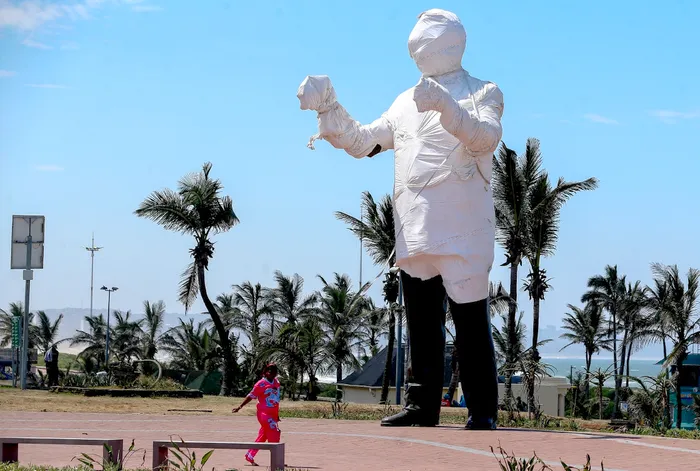
Oliver Tambo Statue The R22-million statue of Oliver Tambo in Durban has faced intense public scrutiny for being "exposed" as a symbol of perceived municipal mismanagement and misplaced priorities.
Image: LeonLestrade
Durban residents facing water shortages and collapsing infrastructure deserve urgent service delivery, not expensive statues.
I have written to President Cyril Ramaphosa, challenging him to use his visit to eThekwini next month to unveil new and desperately needed service infrastructure that delivers water and sewer services rather than statues.
The municipality has announced that during his visit to the city on March 3 he will unveil two statues costing ratepayers R22 million. At a time when Durban faces profound service delivery challenges, this allocation of scarce public resources is inappropriate and understandably frustrating for residents already burdened by municipal failures.
Durban is in the grip of a severe water crisis. It is estimated that more than 60% of potable water is lost due to ageing infrastructure and prolonged underinvestment in maintenance. Many communities endure extended periods without water supply, and water-shedding measures have been implemented in several major townships.
The city is also grappling with ongoing sewer infrastructure failures, posing serious health and environmental risks. These challenges stem from years of inadequate prioritisation of core infrastructure upgrades. Repeated appeals to city leadership to redirect funding toward essential services have largely been ignored, to the extent that court intervention has been required to compel corrective action.
Despite these urgent needs, substantial public funds continue to be directed to non-essential prestige projects while many residents struggle daily with poor access to water, sanitation, housing and employment opportunities.
Irregular expenditure by eThekwini, which stood at about R700 million four years ago, has now escalated to over R4 billion, a clear indication of deteriorating financial governance.
The DA has written to the President urging him to use his visit to convene the city’s leadership and address the critical service delivery crises confronting residents.
Across the world, statues have a place and a role. They remind us visibly of great achievements that have moved society forward. They should not be downplayed or undermined, but government is about priorities. Next month the President must prioritise the people of eThekwini over vanity. | Haniff Hoosen DA eThekwini Mayoral Candidate
KwaZulu-Natal’s political future hangs precariously on a single seat capable of deciding the province’s direction.
It is a sad state of affairs that the single seat of the NFP determines which coalition rules KZN and whether the province is run by Marxists or by parties committed to a reasonable degree of common-sense economics.
Equally appalling is that in any other circumstances the one-seat NFP would be irrelevant. Yet in the hands of this amalgam of jostling personalities who resort to litigation against each other and squabble over political spoils, the governance of the province is being held hostage.
The NFP, as a splinter breakaway group, has little to recommend it. The ugly reality is that it is willing to align itself with whichever side bestows positions and perks, reflecting the corrupt side of politics experienced worldwide.
If the NFP throws its single seat in with the MKP and EFF, governance of the province could fall into the hands of two parties that struggle to govern themselves. Both are faction-ridden. In the case of the MKP, it is held together by a corrupt octogenarian, while both parties are committed to an ideology best exemplified by the dystopia of Cuba.
With local government elections due at the end of the year, current provincial uncertainty appears to foreshadow hung municipalities across the province. As seen in eThekwini since 2021, small one-seat parties have kept the ANC in power.
Expect a crop of NFP-type opportunists to prevail in municipalities after December 2026. Should the MKP roll back responsible opposition in key areas, parts of KZN could face a Mamdani-type New York City dark-ages future. | Dr Duncan du Bois Bluff
Zimbabwe’s promised democratic renewal continues to face serious doubts amid mounting allegations of repression.
Zimbabwe continues to face growing scrutiny over alleged human rights abuses, with warnings that democratic space is narrowing despite claims of a “new dispensation” following the 2017 transition of power.
The administration of President Emmerson Mnangagwa has supported proposals to amend Zimbabwe’s Constitution in ways that could significantly reshape the political framework.
When he assumed power after Robert Mugabe’s removal, Mnangagwa pledged a break from authoritarian practices and promised political and economic reforms. However, continued arrests, intimidation and contested legal actions suggest meaningful change has yet to be realised.
Journalist Blessed Mhlanga was arrested in 2025 in connection with his professional work, drawing condemnation from media watchdogs and international rights groups. The charges relate directly to the peaceful exercise of freedom of expression and create a chilling effect on independent journalism.
Mhlanga’s case serves as a test of whether Zimbabwe will strengthen its commitment to human rights or continue to face allegations of repression under current leadership.
ZANU-PF appears determined to rule with an iron fist. There has been little change regarding human rights abuses since Mugabe’s removal, and conditions have worsened under Mnangagwa. The world cannot stand by while generations continue to suffer under the ZANU-PF curse. | Michael Tinarwo Warrington
Rising tensions between Iran and the United States raise fears of another devastating conflict shaped by decades of foreign intervention.
As negotiations between Iran and the US collapse, war appears increasingly possible amid an unprecedented American military buildup in the region.
This conflict, it is argued, has less to do with Iran’s nuclear capabilities and more to do with destabilising one of the last sovereign powers in the Middle East capable of challenging US geopolitical and economic interests.
Western involvement in Iran dates back to the early 1900s when Britain secured access to Iranian oil through the Anglo-Persian Oil Company. Since then, Iran has transitioned from the Qajar Dynasty to the Pahlavi Dynasty and ultimately to the Islamic Republic, with each era marked by US and British interference.
In 1953, President Dwight D Eisenhower formally approved Operation Ajax, a CIA-backed coup that overthrew Prime Minister Mohammad Mossadegh at Britain’s urging to regain control over Iranian oil resources.
Following Mossadegh’s fall, Mohammad Reza Pahlavi became one of Washington’s closest Middle Eastern allies, cementing a “security for oil” relationship aimed at containing Soviet influence.
Opposition to the Shah eventually culminated in the Islamic Republic under Supreme Leader Ayatollah Khamenei. Some argue that the US initially supported the Islamic Republic to prevent Iran from drifting toward communism and closer alignment with Russia.
Relations collapsed after Iranian students seized the US embassy, triggering the 444-day hostage crisis that effectively ended Jimmy Carter’s presidency and severely damaged US intelligence credibility.
Should Iran be attacked, the hope expressed is that the country will resist forcefully, ending decades of foreign interference and colonial ambition. | Z Khan Durban
South Africa needs leaders focused on domestic crises rather than international ideological battles.
I refer to the article, Dalindyebo Declares Mandla Mandela No Longer Chief Of Mvezo Community.
It is disappointing that someone with the standing and political potential of Mandla Mandela, owing to his relationship with Madiba, expends energy on international causes such as Palestine and organising controversial flotillas rather than addressing South Africa’s urgent challenges.
Here is a man who could contribute meaningfully to tackling the country’s crises of crime, unemployment, corruption and collapsing municipalities.
South Africa’s greatest crisis is not only political but moral. A nation loses its compass when terrorism is labelled “resistance”, propaganda becomes “truth” and Israel is branded an “apartheid” state while domestic failures mount.
The country risks being drawn into an anti-Israeli agenda that distracts from problems at home. It is easier to chant slogans than to fix crime, corruption, unemployment, failing cities, border control and law enforcement.
A nation unable to protect its own citizens should hesitate before claiming moral authority over Middle Eastern conflicts.
An appeal to Mandla: with your talent, enthusiasm and connection to the House of Madiba, you could help turn South Africa around.
Will the real Mandla please stand up? | Kevin Meineke Summerveld
Restrictive economic policies may hinder growth while freer markets have lifted millions out of poverty elsewhere.
Thami Mazwai’s article on retaining BEE correctly noted that fronting and corruption have undermined efforts to reduce inequality and poverty.
Human ingenuity inevitably finds ways around restrictive legislation, as demonstrated during Covid lockdowns when citizens creatively obtained cigarettes and alcohol despite prohibitions, echoing lessons from US Prohibition laws.
People resist restrictive laws, particularly when perceived as discriminatory. Government policies such as BEE, NHI and EWC have been introduced for ideological reasons without fully considering negative consequences.
Fronting has distorted BEE, the NHI risks creating opportunities for corruption similar to scandals seen at facilities like Tembisa Hospital, and EWC threatens property values and access to bank financing.
Removing restrictive laws and allowing people greater freedom to conduct business could help reduce poverty, as seen in successful Asian economies granted economic freedom.
Democracy allows citizens to work out solutions independently rather than having ideological constraints imposed upon them. | Rob Johnston Tokai
Humanity’s cosmic ambitions may ultimately collide with the unforgiving scale of the universe.
The cosmos appears to send a clear message: look, but do not attempt to travel beyond our reach.
The universe is so vast that visiting exoplanets would require unimaginable time, energy and resources. The nearest star system beyond the Sun, Proxima B, lies 4½ light years away, yet Voyager 1, travelling at 61 000km/h, would need between 75 000 and 85 000 years to reach it.
Even if Earth were destroyed by catastrophe, humanity could not realistically relocate to another habitable world.
When Neil Armstrong first stepped onto the Moon and declared it “one small step for man, one giant leap for mankind”, many believed humanity would rapidly expand into the cosmos. Six decades later, progress beyond our immediate celestial neighbourhood remains limited.
Although humanity has achieved remarkable scientific advances, the universe contains an estimated two trillion galaxies, each with billions of stars and potentially habitable worlds far beyond our technological reach.
The cosmos seems to warn humanity that we are marooned on a cosmic island. Fortunately, Earth already provides everything required for life. | T Markandan Kloof
DAILY NEWS