

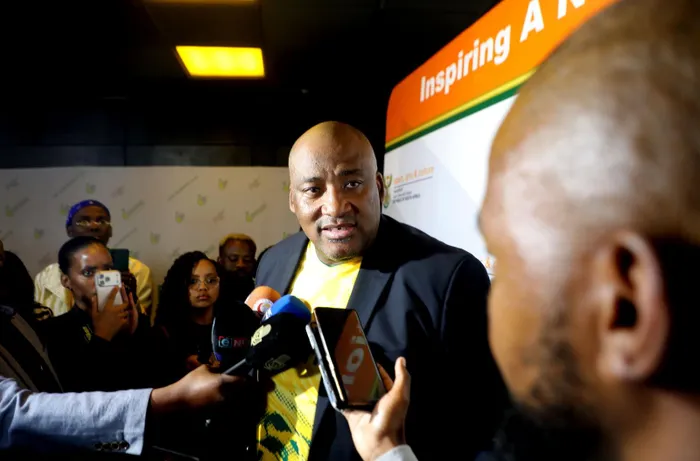
Minister Gayton McKenzie is defending his decision to cut funding to iconic South African festivals, claiming it is time for them to become self-sustainable.
Image: Oupa Mokoena/Independent Newspapers
Minister of Sports, Arts and Culture Gayton McKenzie has justified his department's stance of withholding funding to iconic festivals such as the Cape Town International Jazz Festival (CTIJF) and Makhanda’s National Arts Festival, saying "it was about time they become self-sustainable".
His comment comes amid deep-seated concerns about widespread job losses created by the festivals with organisers warning that defunding these events will have devastating economic consequences.
Other flagship events that stand to suffer a greatly due to lack of funding include Oudtshoorn’s Klein Karoo Nasionale Kunstefees, Aardklop in Potchefstroom, the Cape Town Carnival, Innibos in Mpumalanga, and Vryfees in the Free State.
McKenzie's decision to withhold funding from iconic festivals has sparked controversy, with critics arguing it is a misguided approach.
Festival organisers have expressed concern that the move ignores their events' significant economic and cultural contributions.
For example, the Cape Town International Jazz Festival pumps around R900 million into the Western Cape economy and supports over 5,000 jobs, according to figures recently presented to Parliament.
On the other hand, the Klein Karoo Nasionale Kunstefees (KKNK) also contributes significantly, generating an estimated R72m in direct economic impact for Oudtshoorn and up to R178m across the Western Cape. It attracts over 86,000 attendees and showcases Afrikaans language and culture.
Stellenbosch Woordfees reaches a massive audience, and Suidoosterfees is also a vital part of its local economy, sustaining thousands of jobs and engaging young learners through its junior festival.
When asked why he decided to defund the iconic festivals, McKenzie denounced the notion seemingly harboured by festival organisers that they are entitled to perpetual government funding.
"The problem that we are having in this country is the culture of 'we are going to get money no matter what we do'," he said.
In the same breath, he encouraged the organisers to approach the government in a bid to sort their funding issues instead of opting to publicise them in the media.
"You have to become self-sustainable. We also said to them 'come sit down with us'. Don't run to the media and say 'ah they are not funding us'. It is not your birthright," he said.
He explained that the government was diverting those funds to upcoming events promoters, citing an example of Graaf Reniet, that has a planned function this weekend for the community.
"We can fund people in Soweto. We can fund rural areas. No one has the birthright to be funded by government and say 'I have to be funded for 30 years whether you like it or not'. But we want to talk to them and we want to sort this out with them," he said.
McKenzie reiterated that festival organisers cannot expect to grow old with the government as their "mother and father and your everything" forever.
"What about the new promoters? We are opening up the industry. Luckily for me I don't care what they write about me. That's why they cannot shame me into writing about me. I thrive from bad news," he said.
Other economic powerhouses among festivals include Aardklop, Innibos and Vryfees, which contribute millions to their local economies and showcase incredible talent.
CTIJF owner Dr Iqbal Survé recently said he will write to McKenzie, requesting a review of the decision to defund the festivals.
“We were told last year already that the minister was not going to fund any of the previous festivals that were supported by DAC. Instead the minister said he was going to change the funding to what he called smaller entities throughout the country on the basis of ... empowering new entrants into the industry.
It really doesn’t make any sense what the minister has done,” he said. “We were told last year already that the minister was not going to fund any of the previous festivals that were supported by DAC. Instead the minister said he was going to change the funding to what he called smaller entities throughout the country on the basis of ... empowering new entrants into the industry,” he said.
DA MP Leah Knott also recently slammed the department, saying it is failing its constitutional mandate and being used as a political tool.
Knott stated that festivals, initially promised support, had their funding withdrawn and were then directed to apply to the Mzansi Golden Economy grant funding, only to be rejected.
She made these comments during a mini plenary session in Parliament recently, highlighting concerns over the department's funding allocation process.