

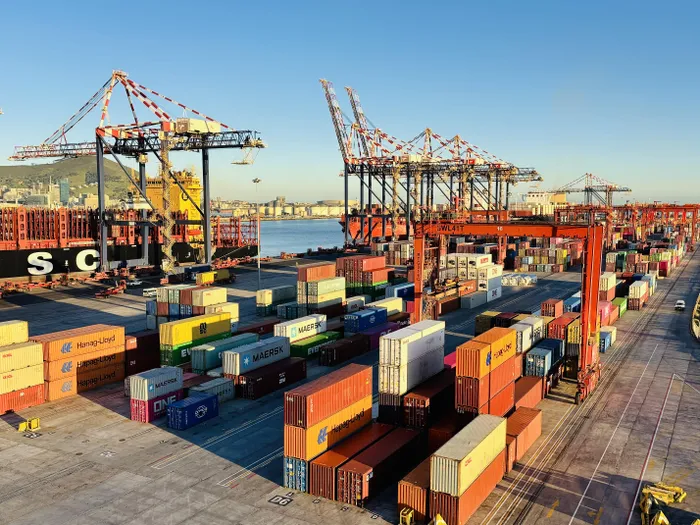
In 2025, despite policy uncertainty, SA’s agricultural exports reached a record $15.1bn, up 10% from 2024
Image: FILE
The United States has launched an investigation into 60 economies — including South Africa — over concerns that goods made with forced labour are entering global markets.
The probe was announced by the Office of the US Trade Representative (USTR) earlier this week.
The move followed a recent ruling by the US Supreme Court that struck down several tariff measures introduced by President Donald Trump as part of his “America First” trade policy.
The tariffs had targeted a wide range of imported goods — particularly from countries such as China — as part of efforts by the administration to protect US industries and reduce what it said were unfair trade practices.
However, the apex court ruled that parts of the tariff programme exceeded the authority granted to the president under US trade law.
The judgment meant the administration could no longer apply some of the tariffs in the way it had planned.
SA had been listed among the economies under investigation by the USTR, alongside major trading partners such as China, India, Japan, Brazil and the European Union.
Several other African and Middle Eastern economies, including Nigeria, Egypt and Saudi Arabia, had also been included in the probe.
Analysts IOL spoke to said the probe had reflected a broader rethink in Washington about its trade ties and which countries benefit from access to the US market.
US Trade Representative Jamieson Greer said governments around the world had not done enough to stop forced-labour goods from entering their markets.
“Despite the international consensus against forced [labour], governments have failed to impose and effectively enforce measures banning goods produced with forced [labour] from entering their markets,” Greer said in a statement announcing the probe.
“For too long, American workers and firms have been forced to compete against foreign producers who may have an artificial cost advantage gained from the scourge of forced [labour].”
He said the probe would also examine whether foreign governments had taken meaningful steps to stop such goods entering their markets.
“These investigations will determine whether foreign governments have taken sufficient steps to prohibit the importation of goods produced with forced [labour] and how the failure to eradicate these abhorrent practices impacts US workers and businesses,” Greer said.
Under Section 301 of the Trade Act, the US could impose trade penalties — such as tariffs or other restrictions — if it found foreign practices had unfairly harmed American commerce.
For SA, the move had been significant because the US remained one of the country’s biggest export markets.
SA exported vehicles, citrus, wine, minerals and manufactured goods to the US.
Much of that trade had benefited from preferential access under the African Growth and Opportunity Act (Agoa).
Agoa is a US trade programme that allows qualifying African countries to export thousands of products to the US duty-free.
The programme had first been introduced in 2000 to boost economic growth and trade between the US and sub-Saharan Africa.
SA had become one of the biggest beneficiaries of Agoa, particularly in the automotive sector.
Public hearings linked to the probe had been scheduled for April 28, while interested parties had until April 15 to submit written comments or request to appear at the hearing.
International relations expert at North-West University Dr Seshupo Mosala said because of the Supreme Court ruling, Trump's administration had to look at other ways to pursue its trade objectives.
“This is where forced labour and modern slavery come into play, where they can claim that a certain country uses modern slavery or forced labour to produce goods, and therefore that undermines US trade,” Mosala said.
“So it is basically doing the same thing, but through a different method or a different way of achieving the same objective.
“The reality is that Trump wants to push this 'America First' agenda, which focuses on the dominance of the US.
“He wants to push back against the multipolar world we are seeing, with the rise of China and other economies.”
Mosala said it was notable that many American multinational corporations had themselves moved production outside the US in search of cheaper labour.
“Many of these corporations moved to China, for example, not because Mexico or other countries produce better goods, but because they could access cheaper labour.
“That has always been part of the system, especially in a liberal economic context where cheap labour is widely used.”
He said this was why multinational corporations operated across countries such as Vietnam, China and Mexico.
“The issue for Trump is reinforcing the 'America First' agenda and maintaining what some call Pax Americana,” Mosala said.
Pax Americana referred to the period of global political and economic dominance exercised by the US after World War II, when Washington played a leading role in shaping international trade, security alliances and global institutions.
“To some extent, however, he has faced one challenge after another,” Mosala said.
“The issue of cheap labour is part and parcel of neoliberalism.
“Most multinational corporations rely on it and see it in SA through the use of undocumented migrants.
“We also see it in other countries where labour in places like Vietnam is paid far less than labour in London or the US.
“This is what we call super-exploitation.”
Mosala said the broader aim of the policy was to ensure that the US remained dominant in the global economy and to counter the rise of other powers.
“At the moment, that objective is under pressure, especially with what is happening in Iran,” he said.
Tensions between the US and Iran have risen sharply in recent months following military confrontations and attacks linked to the ongoing regional conflict involving Iran-backed groups and US allies in the Middle East.
“The US is not necessarily meeting its objectives as far as the Iran conflict is concerned,” Mosala said.
“For SA, the implication is that the country remains a target.
“The narrative about 'white genocide' and attempts to undermine the current leadership have not stopped.
“That rhetoric continues, and it is likely to persist until Trump believes he has achieved the objectives he is pursuing.”
Political analyst Prof André Duvenhage said the US was busy with a reassessment of all the economic relations with states that were its opponents.
"The US is also reassessing states that are in ways aligned to the US historically like for example Britain, Canada, France [and so on]," he said.
"What is clear is that under the MAGA movement, Trump’s first principle is to put America and America’s interests first, and he is acting in accordance with this.
"Therefore, he is checking a number of countries where the US, in terms of trade relations, is losing out and not benefiting."
Without any doubt, he said, SA was targeted because the US, under AGOA — which has now been extended for another year — SA benefited a lot from that trade agreement.
"And if someone benefits on the one side, the other one loses," Duvenhage said.
"At the same time, we know that SA’s relations with the US are at an all-time low.
"I believe we can say that since 1994, since the inauguration of the new democratic dispensation.
"I have no doubt that there will be a critical assessment of SA’s position, and it is clear to me that SA has transgressed these lines in many ways when you take and put American interests first.
"So there is no doubt there is a conflict and that is not to say I am saying right or wrong."
International relations and co-operation spokesperson Chrispin Phiri was approached for comment.
It will be added to the article once received.
IOL