

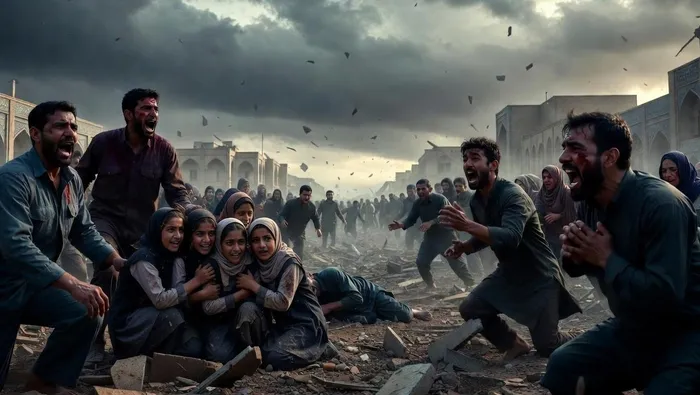
Has the world gone mad?
Image: Grok.com
It is heartbreaking that it took the tragic deaths of 175 innocent schoolgirls, bombed by the US in Iran, to massively jolt the conscience of the world.
Their deaths have become a global symbol – a symbol of how cheap human life has become and of the seeming impotence of the Muslim world in the face of such suffering. The 56 nations that make up the Muslim world appear to be on autopilot during this global crisis. They seem deaf to the cries and agony of Iranian parents. These deaths risk becoming just another statistic. History will immortalise such tragedies for generations to come, and the grim images will remain embedded in our collective memory. In many ways, the entire world shares a measure of moral responsibility for failing to prevent such suffering.
This is a blistering indictment of humanity’s inhumanity to itself. The Organisation of Islamic Cooperation (OIC), some critics argue, risks being seen as ineffective in confronting humanitarian crises affecting Muslim populations if it does not show stronger leadership in defence of human life.
As a global society, we appear to have developed an alarming immunity to tragedy. We seem increasingly unable to fully grasp danger or connect the dots between catastrophic events and their human consequences. Too often we appear disengaged from the suffering of others.
As incredible as it may seem, many people have become almost anaesthetised to the horrors of conflicts such as the brutal war in Syria and the wider instability in the Middle East. It is deeply troubling that heartbreaking tragedies no longer shock the global conscience as they once did. We risk developing a dangerous tolerance for human suffering.
Millions continue to suffer as wars rage across the globe. The horror enters our living rooms daily through news reports, yet many remain emotionally detached because the violence does not affect them directly. Innocent lives are lost, people are maimed, and millions are displaced, yet the global response often feels muted. Little do we realise that such indifference risks pushing humanity towards further instability and destruction.
Humanity must reflect deeply on its moral obligations. Indifference to suffering is a dangerous path. If we fail to care for one another, history will judge us harshly for our complacency. | Farouk Araie Benoni
The recent escalation of tensions involving Israel, the US, and Iran has once again raised serious concerns about the risk of wider conflict and the need for restraint by global powers. Many believe that any military action against a sovereign state must be approached with extreme caution and within the framework of international law.
For decades, Israeli Prime Minister Benjamin Netanyahu has warned about Iran’s nuclear ambitions, often describing them as an imminent threat. However, successive US administrations have differed in their approaches to Iran, balancing diplomacy, sanctions, and military pressure, each with implications for global stability and the world economy.
It is also important to understand that organisations such as Hamas, ISIS, and Al-Qaeda emerged within complex geopolitical environments shaped by decades of conflict, foreign intervention, and regional instability. Hezbollah, for example, was formed in the context of Israel’s involvement in southern Lebanon.
Within this context, debates continue about how such groups should be understood, with some viewing them strictly as terrorist organisations, while others see them through the lens of resistance movements born out of long-running political conflicts.
At the same time, allegations of misinformation and propaganda often accompany conflicts, making it increasingly difficult for ordinary citizens to separate fact from political narrative. This underscores the importance of credible international institutions, independent media, and transparent investigations in helping the public understand events more clearly.
At a time of rising global instability, it is essential that world leaders act with responsibility, honesty, and a genuine commitment to peaceful solutions. Dialogue, diplomacy, and respect for human life must remain the cornerstones of any effort to resolve conflict. | A Akoo
There is a famous scene in The Mummy where a terrifying sandstorm chases the heroes’ small plane. Just as they seem certain to be swallowed by disaster, they escape at the last moment.
My family recently lived through a similar drama when a relative working in Riyadh had to make a sudden decision to leave after regional tensions escalated. Part of a multinational project, she decided to book the first available flight home after security concerns intensified.
After a stressful journey to the airport, including transport delays and a missed flight, she eventually secured a seat on a plane to Addis Ababa just before travel disruptions spread across the region. She was the only South African in her group to leave immediately. Others chose to stay, hoping tensions would ease and mindful of the difficulty of finding work elsewhere. Some even argued that parts of the region still felt safer than crime-affected areas back home.
The question many face in such situations is simple: do you stay or do you go? Fear is often the most powerful weapon in any conflict, and panic can sometimes create more danger than the conflict itself.
South Africa’s Department of International Relations and Cooperation has urged caution while monitoring the situation and advising citizens to remain alert to developments. Meanwhile, South Africans in the region are sharing information on social media and relying on updates from journalists and security experts.
One war correspondent advised that civilians should prioritise their mental health and avoid panic. In many cases, he noted, conflicts are targeted at strategic or military sites rather than civilian spaces, and people should make decisions based on credible information rather than fear.
War is always frightening, but life often continues in many affected countries outside conflict zones. Even in long-running war regions, functioning cities and infrastructure remain a reality for millions.
Ultimately, every person must make their own decision based on risk, responsibility, and personal circumstances. For some, the safest choice is to leave early. For others, staying put may be the more practical option.
As in that movie scene, when the storm seems closest is often when the hardest decisions must be made. Good luck to all South Africans with family, friends, or colleagues caught in conflict zones. | Vivienne Vermaak Rational Standard via Free Market
DAILY NEWS