

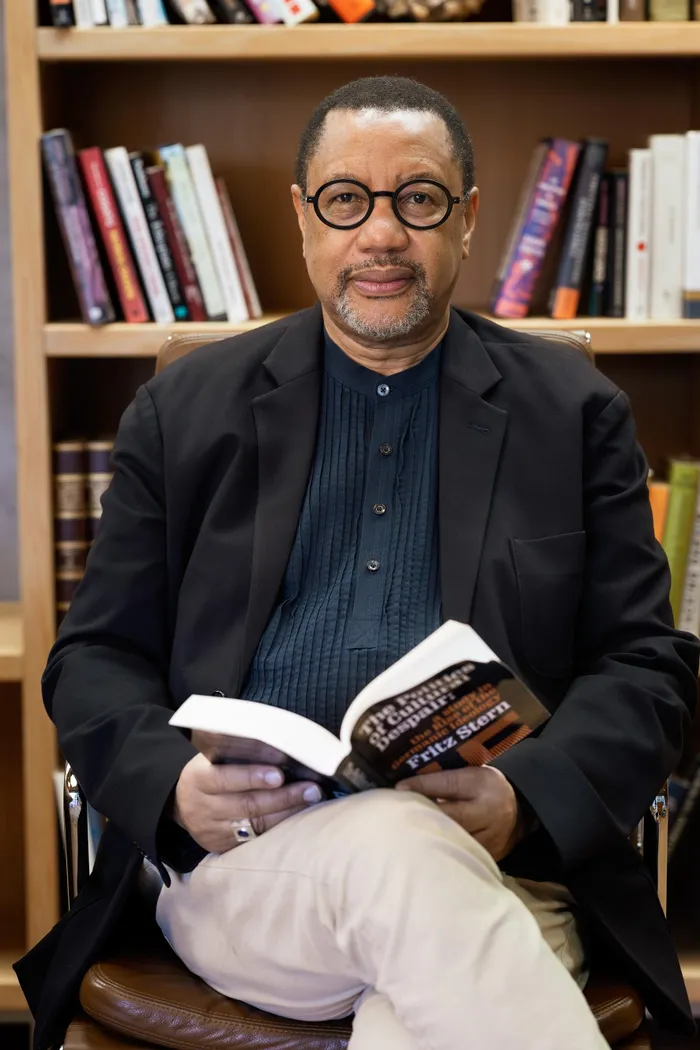
Explore Phuthuma Nhleko's groundbreaking insights in 'The Invisible People,' as he challenges the stereotypes surrounding Africa and outlines a vision for a prosperous future by 2050.
Image: Supplied
For a decade, pundits, writers, and authors, mostly European and Western, have reduced our diverse continent to simplistic stereotypes, often derogatorily labelling it as a “Dark,” “Forgotten,” and “Hopeless” continent.
Some writers have even resorted to describing Africa as “Uncivilised,” “Primitive,” “Sub-Human,” “Without History,” or “Without Civilisation,” perpetuating the notion of the "White Man's Burden" and portraying it as homogeneous and sub-human.
Descendants Achieved Great ThingsIn a new book, The Invisible People: How a Quarter of Humanity Can Thrive in Africa by 2050, Phuthuma Nhleko writes about his research while studying in the United Kingdom and the United States, as well as his travels across the continent. As the Chief Executive Officer and later Chairman of a telecommunications giant, he observed how our descendants achieved great things in a variety of fields for thousands of years, long before colonialism.
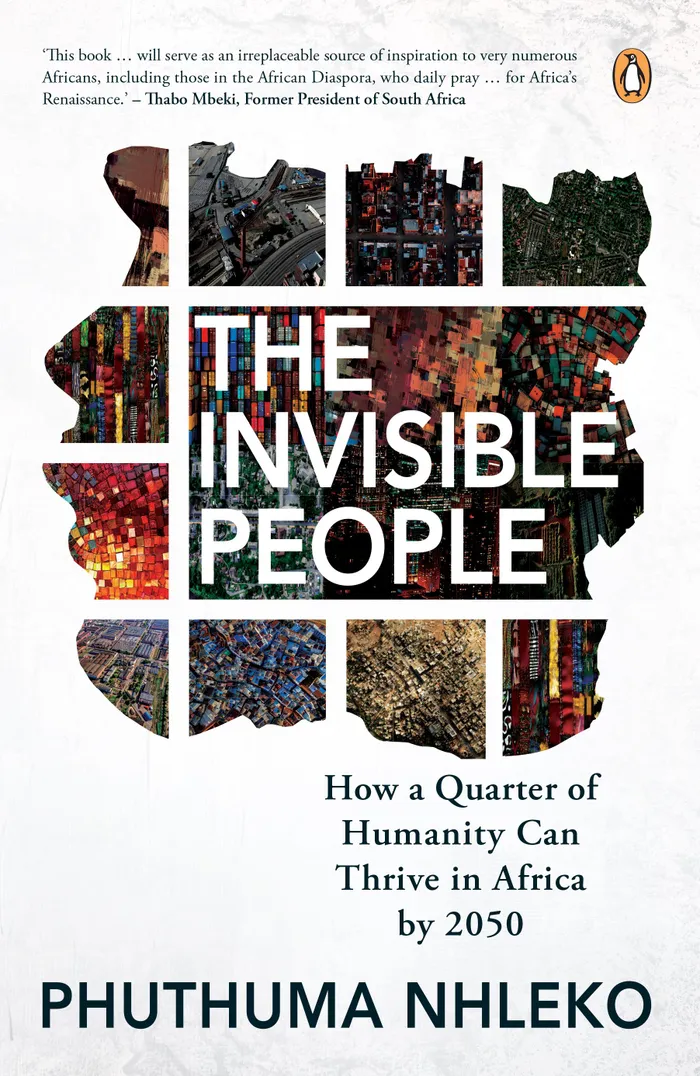
The Invisible People: How a Quarter of Humanity Can Thrive in Africa by 2050
Image: Supplied
Nhleko states that ancient African cultures were responsible for developing entire mathematical systems, charting the sun, and creating calendars. Our ancestors developed tools and techniques that even surpassed Roman technology.
Moreover, our continent has been home to its own empires, as well as enormous libraries and universities.
Today, our leaders and scholars, through organisations such as the African Union, African Development Bank, Southern African Development Community, Economic Community of West African States, East African Community, and many others, are still working to decolonise our continent by salvaging pre-colonial history and reclaiming its diverse identities, as well as promoting economic integration.
In the book, which is set to be launched this month, Nhleko believes that deconstructing the myth that our continent has been and is dark, hopeless, and forgotten is made more difficult by the fact that by 2050, Africa’s population will nearly double to 2.5 billion people, while populations in Europe, the Americas, and parts of Asia decline.
The Route to 2050
So why should this prospect give us all pause? Nhleko answers that if we as Africans maintain the current trajectory, our continent seems ill-prepared to muster the economic and geopolitical power required to sustain and speak for 2.5 billion people.
Failing to do so will push ever-growing numbers of migrants to seek a better life elsewhere—particularly in Europe.
Africa's Position: Peripheral and InvisibleNhleko believes that Africa's position in the world today is not merely peripheral it is largely invisible.
First, our continent’s rich history and substantial contributions to modern civilisation, religion, and culture have been absent from established historical narratives curated by the West for over 600 years.
Additionally, the continent that will soon house a quarter of humanity contributes just 3% to global Gross Domestic Product, while its voice and influence in international affairs, from the United Nations to the International Monetary Fund and the World Bank, remain muted.
This invisibility in global affairs has far-reaching consequences, not only on capital markets, trade, investment flows, and policy formulation, but it also becomes a self-fulfilling prophecy for Africa itself.
The African experience of pillage, plunder, and torment at the hands of outsiders over five centuries has been exacerbated by deep self-inflicted wounds, particularly in the past sixty-five years.
How Can 2.5 Billion Africans in 2050 Create Viable Economies?
So how can the continent transcend its heavy historical baggage and self-inflicted wounds to unleash the kind of renaissance required to successfully embrace its demographic future?
How can 2.5 billion Africans in 2050 almost twice the population of China today create viable economies, sustain themselves, participate more fully in global trade, and contribute to the world at large? In other words, how can a real African Renaissance unfold?
First, Nhleko believes our continent needs a reconstruction of a more assured and confident African identity rooted in its rich history and substantial contributions to modern civilisation, religion, and culture.
Secondly, we need economic development that leverages the continent's vast resources including 30% of global mineral reserves, 65% of the world’s arable land, and 10% of its renewable freshwater as well as its young people, in a context of rapid technological change.
Thirdly, Africa must take its rightful place in global affairs, speaking with a unified and powerful voice for a quarter of humanity to successfully navigate and shape a world order in flux.
Nhleko warns that we must not forget that Africa's assets, commodities, and people have been the cornerstone of economic development and industrialisation elsewhere.
These resources could power Africa's own economic renaissance if leveraged for the continent's benefit rather than exploited through another foreign scramble.African Renaissance
In The Invisible People, Nhleko also believes that the question of identity is central to the renaissance necessary to address Africa’s demographic prospects.
Such a renaissance can succeed only if underpinned by a clear vision of who we are as Africans and what we can accomplish and contribute to the world together.
Only then will the continent be able to redirect its economic trajectory and establish a more central role in world affairs.
Indeed, Africa's most valuable asset is our youth. With a median age of just under 19 years old, the continent’s population is by far the youngest on earth.
What makes this demographic particularly valuable is its worldview the positivity, relevance, and confidence of young Africans.
To successfully leverage all our extraordinary assets, whether economic, cultural, or ethnic identity, we must reject both the extractive economic model of the past and inappropriate foreign “recipes.”
I am not saying that Africa has nothing to learn from other regions’ experiences.
The point is that Africa’s economic model and vision must be specific to, and tailor-made for, Africa.
We must forge a home-grown economic path that repositions Africa’s economies by exporting higher up the value chain, boosting intra-continental trade and integration, and leveraging technology to leapfrog development stages.
An African Renaissance is eminently possible but requires a fundamental shift in how we as Africans see ourselves.
The Invisible People is an excellent futuristic analysis of how the African Renaissance requires two fundamental ingredients that run across the issues of identity, economic development, and geopolitics: a Pan-African approach and leadership.
Only by rallying around a common vision can Africa build the scale necessary to tackle questions of identity, economic development, and global influence.
The Invisible People is set to be launched this month.
*Rich Mkhondo is writer, author and communications expert, who runs The Media and Writers Firm, a content development and reputation management hub.
DAILY NEWS