

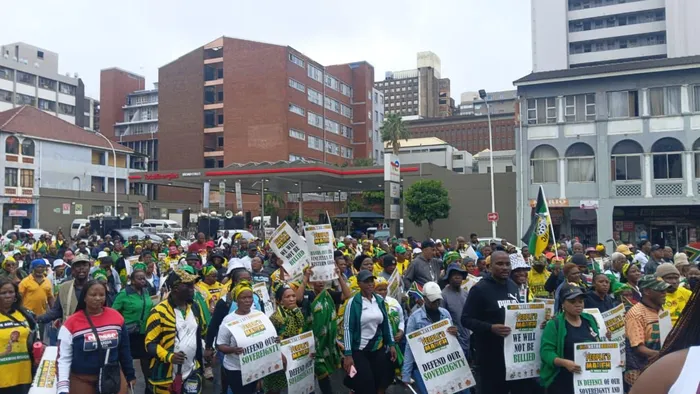
Independent Political Analyst GoodEnough Mashigo examines the South African Communist Party's absence from the ANC People’s March.
Image: Sipho Jack
In a political landscape charged with tension and shifting allegiances, political analyst GoodEnough Mashigo has shed light on the South African Communist Party’s (SACP) absence at the ANC’s “People’s March” in Durban on Saturday.
Mashigo believes the no-show was indicative of deeper ideological rifts between the two parties, as the SACP grapples with its identity and ambitions ahead of the 2026 local government elections.
He argued that the SACP’s decision to withdraw from ANC programmes was not merely an act of defiance but was linked to underlying frustration.
Mashigo suggested that these frustrations stem from dissatisfaction with current electoral dynamics and a perceived indifference by the ANC towards the SACP’s priorities.
“The SACP, while historically linked to the ANC, is facing an existential crisis of its own,” he explained.
“Their absence from ANC events reflects this struggle for relevance within a coalition that is ostensibly growing apart.”
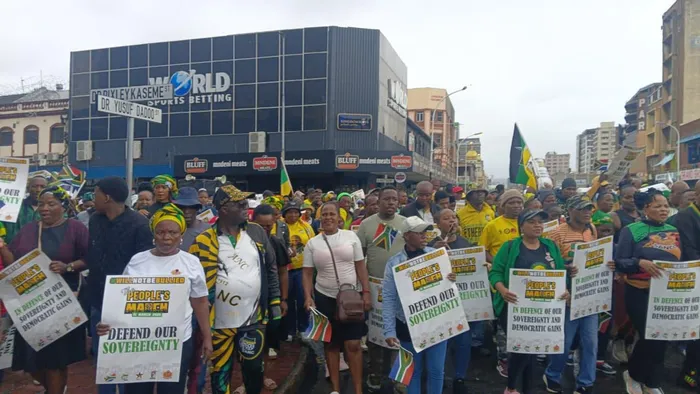
Independent Political Analyst GoodEnough Mashigo examines the South African Communist Party's absence from the ANC People’s March.
Image: Sipho Jack
Despite the ANC’s official invitation to all alliance partners and the inclusion of the SACP logo on promotional material for the weekend’s event, not a single SACP member was sighted at the Durban assembly points.
The ANC had framed the march as a unified stand against external “bullies” and threats to national sovereignty.
However, the SACP’s decision to stay away from the Durban proceedings highlights a growing ideological and strategic fracture within the alliance.
This conspicuous absence follows months of escalating tension.
SACP General Secretary Solly Mapaila has been vocal about the party’s decision to contest the 2026 local government elections independently. The ANC has since labelled this stance as having the potential to fragment the liberation movement’s support base.
The SACP’s absence in Durban is being viewed by some political analysts as a pointed assertion of political independence from the ANC, rather than a rejection of the march’s anti-imperialist themes.
However, SACP provincial spokesperson Mbulelo Madlana downplayed the absence, stating that the party had intended to attend the march.
“We had planned to attend the march; as to why we didn’t attend, I can’t say. This is something we need to investigate.
“We had released a statement that we would participate; it must just have been a failure to organise, but the intention was to attend the march,” Madlana said.
The SACP has long occupied a unique space in South African politics, largely shaped by the ANC’s dominance as the governing party.
However, Mashigo said the party currently finds itself in a precarious position as it prepares to contest the upcoming elections.
“They are keen to assert their identity, but they seem to have limited traction outside their traditional support base,” he said.
Mashigo added that the SACP’s apparent animosity towards the ANC does not necessarily signal a complete severance of ties.
Instead, he described it as a strategic positioning move aimed at strengthening the party’s bargaining power ahead of the elections.
“They want to contest not out of necessity, but from a place of wanting to re-establish positions within the political sphere. It is about opportunity.”
Mashigo further cautioned: “The real political essence seems to be deteriorating. The party has become a stage for those seeking roles, rather than advocating for transformative policies. This is ultimately where the danger lies.”
Another political analyst, Professor Siphamandla Zondi, said the SACP’s absence is consistent with the current state of relations within the alliance.
“The alliance is in tatters, and the party has decided to go it alone where it matters most for the alliance — the contesting of elections. We should expect the party not to be involved in campaigns,” Zondi said.
ANC provincial spokesperson Fanle Sibisi did not respond to requests for comment at the time of publication.
DAILY NEWS