

This is the day that was.
Image: Sora.ChatGPT
I refer to the letter from Mbulelo Mandlana, “Keep revolutionary spirit alive in fight against neoliberalism”, The Mercury, March 23.
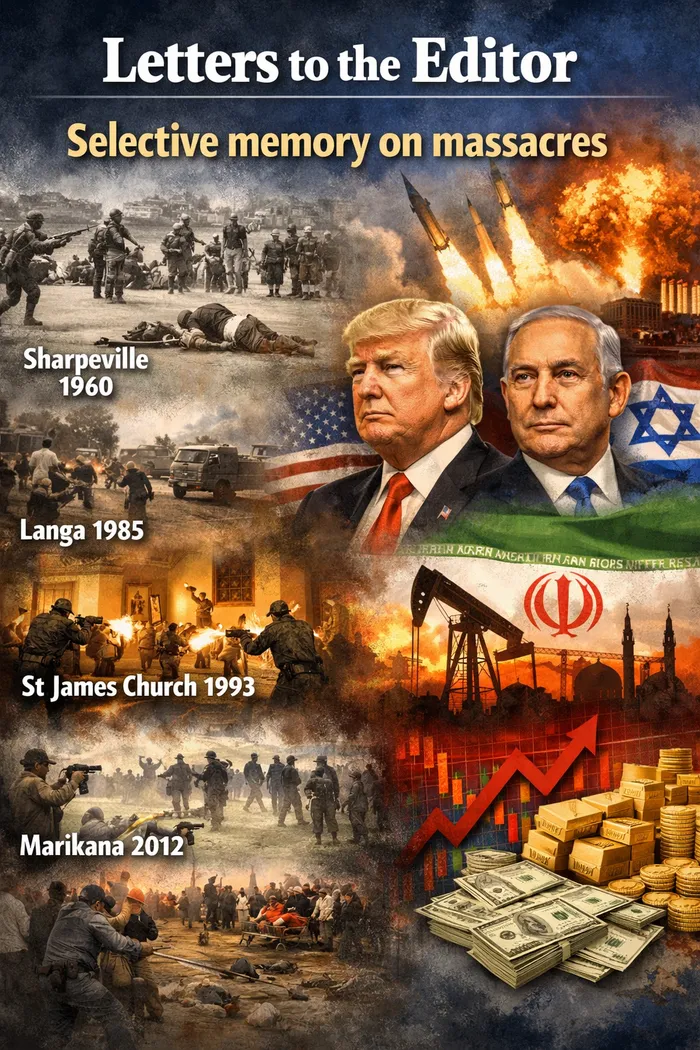
Mandlana highlights two South African massacres, viz. Sharpeville (1960) and Langa (1985), concerning Human Rights Day, and rightly so.
However, no mention is made of the St James Church Massacre (1993) and the Marikana Massacre (2012). It would be interesting to know why the SA Communist Party does not acknowledge these two killings. Surely, the barbarism displayed in all four disasters is equal and thus also falls under the umbrella of Human Rights Day.
Perhaps the Communist Party has subjective memory or the latter two massacres do not fit Communistic ideology! I wonder which? | KEVIN MEINEKE Summerveld
Dear Sir,
Readers in Durban and Overport are reeling with inflated costs of all commodities from January 1 already. Some people in the outer regions like Kharwastan and Phoenix may also have heard of “the war”. Others, mostly “non-non-whites”, and some Indians in Umhlanga and Pretoria will, of course, by rapid fire, be busy cursing Iran for being the “terrorist” state of the East and screaming, playing the blame – game: “Damn these Satans! Want to take over the world! Want to Islamize the world by force. Hope they get wiped off the map … blah blah blah!”
Excuse me! Whoa already!
In case you forgot: this whole thing started a century ago when Britain “permitted” the Jews to occupy Palestine. Booted the locals. Divided the land. Killed off and maimed countless numbers of women, children and innocent youth, as recently as October 8, 2023.
Committed a modern-day genocide. Still busy doing that under the guise of a peace pact, headed by megalomaniac Donald Trump.
And that’s where Iran and your petrol costs come in: Iran just decided to extricate the Zionist principle from the illegal, apartheid state of Israel. Been threatening openly to do so for decades. This idea has made Netanyahu and his company very nervous. So they decided to strike first with the obvious help from the United States. So now you can be the judge of how this thing actually began.
And still curse whoever you like, or hate, for that extra hole in your pocket from next Wednesday. Cheers! | EBRAHIM ESSA Durban
The US president is, quite literally, throwing the world into disarray to the point that the traditional safe-haven asset, gold, has gone from significant gains to double-digit weekly declines. From a peak exceeding $5 600 per troy ounce towards the end of January of this year, it has fallen by more than 20%, the most abrupt – and unimaginable – drop in its history.
As the Greek philosophers said, violence – whose monopoly is claimed by states, creators of wars and all kinds of conflicts – is always contrary to the natural, spontaneous order of the cosmos and, therefore, disruptive.
Given this situation, it is frankly impossible today to predict the outcome of any investment anywhere in the world. Trump began by complicating the entire global economy with his tariffs. And now there’s the war with Iran, which he is obviously losing, to the point that he has just declared that the Strait of Hormuz will be governed by him and the Ayatollah, thus consolidating the authority of the criminal regime in Iran.
In the context of high geopolitical tension, the weakness of gold may seem counterintuitive. However, the market reaction responds more to liquidity and positioning dynamics than to a questioning of its role as a safe-haven asset.
Added to this is the strengthening of the dollar, which is acting as the main safe haven in the current scenario. Furthermore, the market’s focus has shifted towards energy, as tensions in the Strait of Hormuz have driven up oil prices and revived the supposed “inflationary” risk, attracting flows towards energy-related assets at the expense of gold.
Now, this widespread error of confusing inflation with rising CPI figures – which, moreover, are arbitrary calculations depending on who is estimating them and how – leads to negative policies and practices. Inflation is not the rise in prices, but rather the opposite: the depreciation of the currency because of excessive money printing in real time.
The relative movement of prices is a normal and beneficial aspect of the market. In this case, the rise in crude oil prices occurs because supply is tight and, therefore, the increased cost encourages less use and attempts to increase production.
Among the misguided policies that this confusion fosters are the widespread practice among central banks of trying to lower “inflation” – the rise in the CPI, strictly speaking – by increasing benchmark interest rates. This would cause a contraction in the money supply and, consequently, a decrease in overall price increases.
However, this increase, being artificial and not spontaneously induced by the market, causes a disruption in investment and consumption because interest rates in a free market – like any other price – act as arbitrage factors, efficiently directing the supply and demand of funds.
This misconception about interest rates is so widespread that many investors assume that, given the “inflationary expectations” due to rising oil prices, the Fed will raise them, “strengthening” the dollar. It doesn’t strengthen the dollar, but it does make it more profitable, thus reducing the relative attractiveness of gold in the short term.
In short, among other unusual behaviours in the financial markets, a group of “investors” bought $1.5 billion worth of S&P 500 futures contracts – a transaction so large that it caused the entire index to rise instantly by 0.3% – and sold approximately $500 million worth of crude oil, as highlighted by the Financial Times.
A quarter of an hour later, Trump announced “productive talks” with Iran, which turned out to be false, but which immediately caused the stock market index to soar, earning these “investors” $60 million in fifteen minutes. Incidentally, some sceptics suspect that this could be the work of “insiders”, meaning corruption within the US government, because they allegedly used “internal information”. | ALEJANDRO A. TAGLIAVINI Oakland, California
DAILY NEWS