

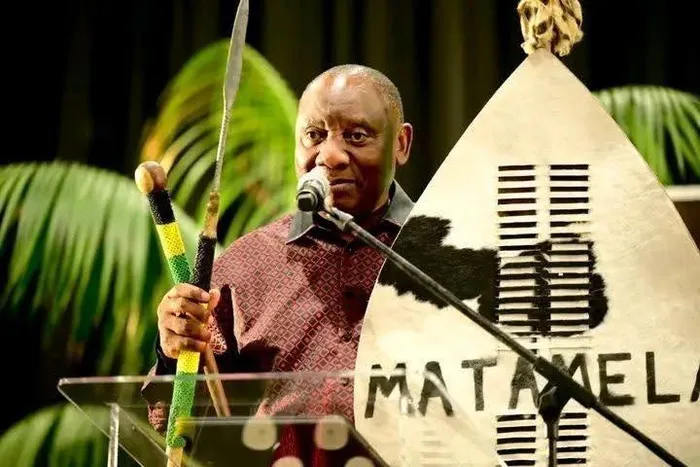
Cyril Ramaphosa addresses party members at a gala dinner in Durban, discussing KwaZulu-Natal's economic potential and the challenges of youth unemployment.
Image: Supplied
Despite the brouhaha over the ANC compelling KwaZulu-Natal municipalities aligned to the party to make costly bids for tables at a gala fundraising dinner in Durban, the event on Saturday achieved its objectives, drawing full attendance.
The party staged the dinner at Durban's International Convention Centre, with President Cyril Ramaphosa lined up to deliver the keynote address.
Those who had the honour of wining and dining with Ramaphosa collectively paid R2 million for the privilege of being at his table. A table hosted by the ANC's deputy president, Paul Mashatile, fetched R1.5 million. Tables hosted by ministers and other ANC leaders were priced at lower rates.
The event sparked debate about the perceived disconnect between the political elite and ordinary South Africans. Critics also pointed to the country’s tough economic conditions, which have left many municipalities struggling to deliver basic services, yet were still expected to contribute significant sums to the fundraiser.
Portraits of former liberation stalwarts such as Oliver Tambo and Winnie Mandela were also auctioned. Tambo's portrait was sold for R150,000.
In spite of the controversy, the event brought together a congregation of former provincial leaders and influential business figures, all dressed to the nines and eager to support the ANC.
The ANC's eThekwini spokesperson, Thinta Cibane, told the Daily News that the dinner was a success and it also highlighted the effectiveness of the party's Progressive Business Forum.
The PBF is regarded as the ANC'S primary fundraising wing.
Cibane said every table at the venue was fully occupied, and that Ramaphosa's address provided significant foresight and insight on a range of issues.
“Yesterday was a success. The president delivered a comprehensive speech on international issues, as well as outlining plans on how to alleviate fuel hikes for South African consumers. He also touched on how best we could grow and sustain the economy during the United States, Israel and Iran war,” said Cibane.
In his address, Ramaphosa offered words of hope and encouragement for the people of KwaZulu-Natal.
He said the province was poised to become a key economic driver in the country, provided it improved governance and administration.
“This province carries both the weight of our history and the promise of our future,” he said in highlighting the strategic importance of KZN in maintaining South Africa’s status as one of the continent’s leading economies.
He also noted that the port of Durban was the busiest in Africa. Therefore, effective governance was essential to unlock the province’s full potential.
The funds raised from the gala dinner were expected to support the ANC's 114th anniversary celebrations and bolster its financial reserves.
Ahead of the ICC event, Ramaphosa launched the Umhlanga Tech Connect initiative, which aims to invest R25 billion and create an estimated 100,000 direct employment opportunities for the country’s youth.
The project was unveiled at FNB’s provincial headquarters in Umhlanga, and marked a significant step towards addressing youth unemployment, which remains a national challenge.
Premier Thami Ntuli also spoke at the event about the state of KwaZulu-Natal’s economy.
Ntuli said he was optimistic about the initiative’s multiplier effect on the local economy.
He noted that large-scale infrastructure and technology investments typically trigger a multiplier effect on outlays, ranging from 2.5 to four times in emerging markets. Ntuli explained that the R25 billion investment could translate into more than R60 billion to R100 billion in total economic activity over time.
Ntuli said that the anticipated economic impact would span construction, material supply chains, engineering services, finance, and digital communication sectors.
“This approach is particularly vital for diversifying the economy beyond traditional sectors like manufacturing and logistics.
“With a projected 100,000 direct jobs, there are expectations of significant indirect employment opportunities, with estimates suggesting an additional 150,000 to 200,000 jobs created through associated suppliers and contractors, alongside induced jobs from increased spending by employed workers.
“Ultimately, the total potential employment impact is projected to range between 250,000 and 300,000 jobs, enhancing household incomes, which in turn boosts consumer spending, supports small and medium enterprises (SMEs), and expands the provincial tax base,” Ntuli added.
DAILY NEWS