

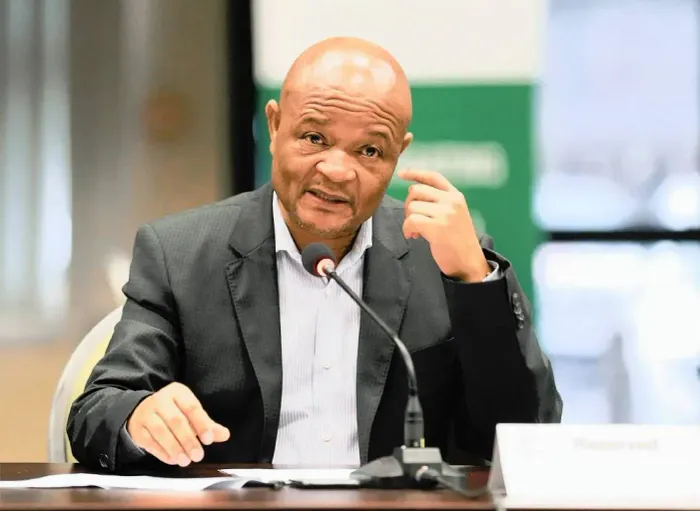
Suspended Police Minister Senzo Mchunu has officially resumed his duties as an ANC National Executive Committee member.
Image: Sibonelo Ngcobo/Independent Media
A political comeback is quietly unfolding within ANC structures as suspended Police Minister Senzo Mchunu re-enters the party’s National Executive Committee (NEC) space while still facing scrutiny over serious governance allegations linked to policing decisions.
Mchunu has returned to active ANC NEC duties after a few months of absence, marking his first public party engagement since stepping aside. His reappearance was marked by his delivery of a eulogy at the funeral of ANC member Bhekabathethwa Mthethwa in Richards Bay.
His return comes against the backdrop of ongoing formal processes in which he has appeared before the Ad Hoc Committee and the Madlanga Commission, where he has been required to account for his role in the disbandment of the Political Killings Task Team (PKTT), as well as respond to allegations of corruption, including alleged links to businessman Vusumusi ‘Cat’ Matlala and claims of interference in policing operations.
The controversy stems from allegations by KwaZulu-Natal Police Commissioner Nhlanhla Mkhwanazi, who accused Mchunu of ordering the disbandment of the PKTT on December 31, 2024 without consultation with national police leadership, and allegedly doing so to shield politically connected individuals.
Ahead of his return, Mchunu formally wrote to the ANC requesting to resume his NEC responsibilities, a move confirmed by his spokesperson Sithembiso Mshengu.
“He voluntarily stepped aside, he wrote to the party to inform the leadership that he was returning to his position, not necessarily seeking permission. You remember that he is not facing any criminal charges to be forced to step-aside. He asked to be excused to protect the image of the ANC after Lieutenant-General Nhlanhla Mkhwanazi’s accusations,” said Mshengu.
The ANC’s step-aside policy requires members who face criminal charges to vacate party and government positions, though Mchunu has not been criminally charged.
Mchunu was previously placed on special leave in July following the emergence of Mkhwanazi’s allegations.
At the same time, President Cyril Ramaphosa has maintained that Mchunu will not be dismissed from Cabinet, responding to parliamentary questions from MK Party MP Vusi Shongwe.
Ramaphosa said the decision to place Mchunu on special leave was intended to allow for proper examination of the allegations.
Shongwe, however, raised concerns that evidence presented before Parliament already implicated Mchunu, questioning whether executive accountability only applies after criminal conviction and whether ethical and governance standards should trigger earlier intervention.
In response, Ramaphosa stressed that the allegations raised serious concerns affecting national security and public safety.
“Following the publication of these allegations, I took the decision to place the Minister of Police on special leave to have the allegations properly ventilated and their veracity determined. I established a Commission of Inquiry into Criminality, Political Interference and Corruption in the Criminal Justice System to investigate the allegations made by Lieutenant-General Mkhwanazi.”
He added that executive accountability is grounded in the Constitution and requires members of the executive to avoid conflicts of interest or misuse of office for personal gain.
Ramaphosa said his actions were guided by constitutional obligations and the principle of legality, including appointing an Acting Minister of Police, placing Mchunu on special leave, and establishing the Commission of Inquiry.
DAILY NEWS