

Readers sound off in their letters to the editor.
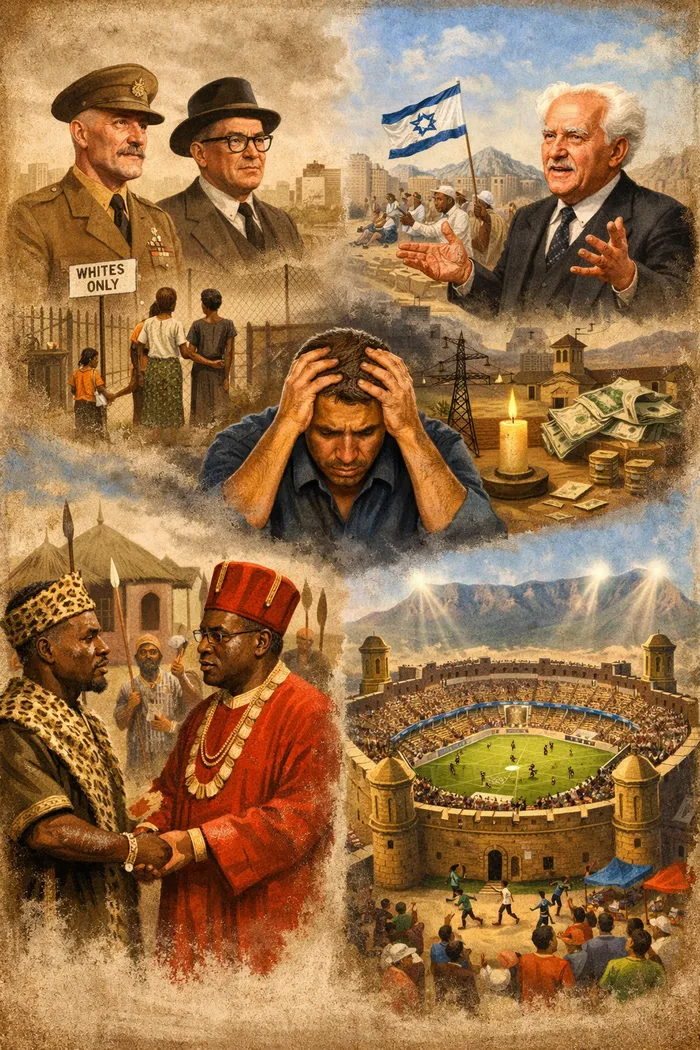
Image: Sora
It is a striking coincidence that the establishment of the state of Israel and the formal introduction of apartheid (“separate development”) in South Africa both took place around the same historical period.
A closer look at history suggests that some of the political thinking behind these systems may have been shaped by interconnected global currents of the time. Historical figures such as Jan Smuts and DF Malan are often discussed in the context of South Africa’s apartheid past, while David Ben-Gurion played a foundational role in Israel’s formation. Whether by coincidence or design, both societies developed systems that critics argued institutionalised separation and inequality. The idea of a “two-state solution” is seen as echoing earlier policies of territorial and political separation that date back decades.
It is somewhat ironic that South Africa dismantled apartheid more than 30 years ago, moving away from a system widely condemned as unjust and oppressive. Yet, in the view of some observers, similar debates about equality, justice, and human rights continue elsewhere in the world today.
The main point of this letter, however, relates to attitudes within our own country. It is clear from some regular contributions to this newspaper that a small minority still views present challenges solely through the lens of criticism of the current government, including on issues such as energy and governance. While accountability is essential in any democracy, it is also worth remembering that corruption and governance failures were not absent from previous administrations either.
While debate and disagreement are part of a healthy society, it is equally important to recognise how far the country has come and to engage constructively with the present, rather than remain stuck in the past. | Ebrahim Essa Durban
The uproar over a Nigerian “Igwe” in East London, renamed Kugompo City, is a masterclass in selective sensitivity.
East London is a metro governed by secular law; treating a diaspora’s cultural title as a threat to sovereignty is mere political theatre. We must challenge the “exclusive” traditional claims used to fuel this outrage. History reminds us that the AbaThembu and Xhosa originated in Natal, migrating south before the Mfengu (Fingo) arrived from the same region during the Mfecane. When we add the original Khoi and San ancestral claims to this mosaic, it becomes clear that the Eastern Cape is a landscape of integrated migrations, not a private kingdom.
The “sovereignty” being defended is often a product of legal compromise. The restoration of kingships via litigation – relying on “history” rather than established royal succession – shows that “tradition” is frequently a negotiated political settlement. If there is no distinct linguistic or ancestral ethos to qualify independence, why the rigidity over a foreign cultural figurehead?
Most tellingly, where was this national outrage when AfriForum successfully “reported” South Africa to Donald Trump to seek sanctions against us? We divide ourselves against fellow Africans over symbolic titles, yet remain silent when our actual sovereignty is undermined by foreign lobbying. As the Great Book warns, a house divided cannot stand. We must stop being “sensitive” to shadows and start being honest about our shared history. | Khotso KD Moleko Bloemfontein
In a move that has stunned urban planners and delighted football fans, Cape Town has announced plans to convert the Castle of Good Hope into a state-of-the-art football stadium.
The decision comes amid growing concerns over the overuse of the DHL Stadium, which has been shared between rugby and football since 2022. With turf degradation, scheduling clashes, and fan fatigue mounting, officials say the Castle offers “a regal solution to a modern sporting crisis.”
Dubbed Castle Stadium, the new venue will retain the original moat and bastions, offering fans a “medieval match-day experience”. The pitch will be laid within the pentagonal walls, with seating built into the ramparts and VIP boxes replacing old barracks.
The proximity to Cape Town Station makes it ideal for public transport, with Metrorail promising “minimal delays and occasional train arrivals”. Floodlights will be installed atop Table Mountain to illuminate night matches. Officials claim this will transform the City Bowl into a 24-hour urban playground, boosting safety, tourism, and insomnia rates.
“Cape Town will no longer sleep,” said a city spokesperson. “It will shimmer, roar, and occasionally echo with vuvuzelas at 2am.” Critics have raised concerns about the impact on heritage, ecology, and sanity. But city planners insist the Castle’s transformation is “reversible, renewable, and really cool.”
Construction begins this winter, with the inaugural match set for April 1, 2027. Tickets will be sold via carrier pigeon and blockchain. | Dudu Derrick Bila Claremont
DAILY NEWS