

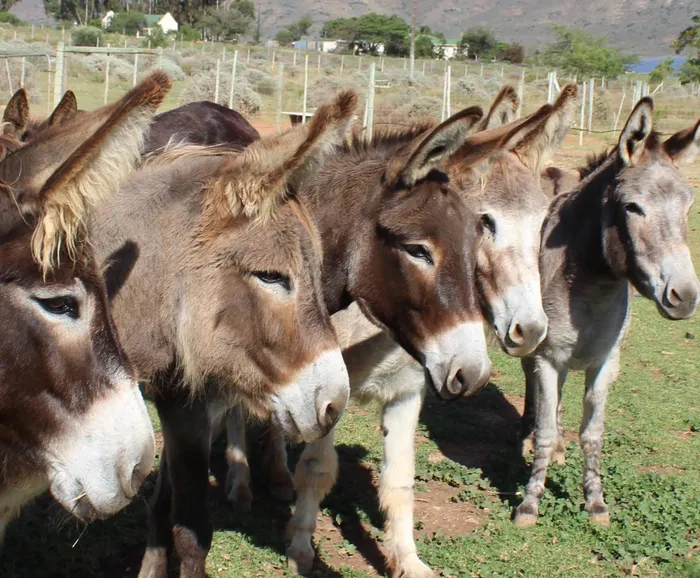
Man's faithful servant, the donkey is getting a raw deal.
Image: supplied
In recent years, South Africans have risen as one man to condemn the illegal killing of rhinos and the subsequent export of their horns and have called for stricter measures to protect the rhino.
To a lesser extent, the trade in lion parts, especially bones and the shameful hunting of “canned” lions has also been condemned. Unfortunately, our government is inconsistent regarding the lion trade. More recently, public awareness of the cruel trade of pangolins has increased. Various organisations are now trying to prevent this trade and save the pangolin from extinction.
There is an insatiable demand in the Far East, particularly in China, for rhino horn, lion bones and pangolin scales, while pangolin meat is a highly prized delicacy.
Sadly, another scourge needs to be exposed in SA, which possibly not too many people are aware of and that is the trade in and export of donkey parts, especially their skins. Donkeys are the latest victims of the trade in animal parts to China. While donkeys have been beasts of burden for thousands of years, often under unsatisfactory conditions, they are lovable, playful and affectionate if given the chance.
While the killing of donkeys is not illegal in SA, to obtain their skins, donkeys are bludgeoned to death or are rendered unconscious and then skinned alive. In other parts of the world, horrific cases of cruelty have been uncovered and criminal cases have been laid.
Donkey skins are boiled to obtain a gelatinous substance called Ejiao.
Ejiao is dissolved in water or alcohol to be used in food, drink and beauty products. It is believed to improve blood circulation, and is used by people who have hypertension, anaemia and reproductive problems. It is also deemed to have anti-ageing properties. All these claims are dubious.. The seemingly unquenchable desire for Ejiao has dramatically increased in recent years and hundreds of thousands of donkeys are being cruelly killed every year, worldwide. Cambridge University says in a study,: “There is a global genocide of donkeys currently taking place, as there is a rush for skins in China.” How tragic!
To their credit, the African Union in February 2024 called for a ban on the donkey skin trade. Unfortunately, due to a lack of regional regulatory unity, corruption, porous borders, sophisticated smuggling methods from organised crime and a lack of political will, the trade continues to flourish. Mahatma Gandhi said, “ The greatness of a nation can be judged by the way its animals are treated.” What about SA? Sadly, the trade in donkey parts is alive and well, with Lesotho believed to be the epicentre.
What can we do about this awful industry? Let us approach our Members of Parliament ( if you are lucky enough to know who they are) to bring the matter before Parliament and request that it be declared illegal. How about supporting, cash or in kind, our donkey sanctuaries that are at the forefront of this fight against the skin trade? These are in George, Greyton, McGregor and De Rust. The famous theologian, Albert Schweitzer, said: “We must never allow the voice of humanity within us to be silenced. It is humanity’s sympathy with all creatures that first makes us truly human.” Donkeys are special animals and should be treated as such. Let us consider this verse from the famous poem by GK Chesterton about donkeys:
“Fools, for I also had my hour,
One far fierce hour and sweet,
There was a shout about my ears
And palms before my feet.”
Let us be responsible citizens and raise our voices against this donkey trade, in the same way as we did about the poaching of the rhinoceros.
“Evil will triumph if good men are silent.” Let us not be silent on this issue. The donkey trade is both evil and cruel. Let us be counted amongst those who tried to put a stop to this awful and pitiless slaughter of donkeys. | Kevin Meinek, Summerveld
DAILY NEWS