

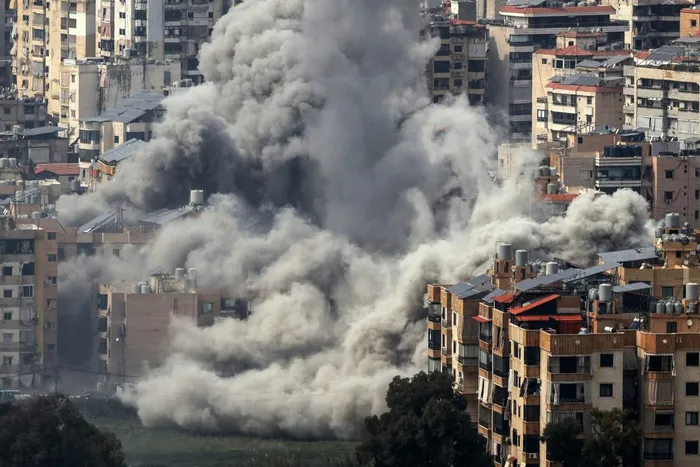
At least 182 people were killed and nearly 900 wounded on Wednesday, the Lebanese Health Ministry said.
Image: AFP
A just and lasting peace in the Middle East cannot be achieved without confronting the realities of Palestinian occupation, dispossession, ethnic cleansing, and grievances.
When these issues remain unaddressed, cycles of violence, militarisation, and instability are likely to persist.
Justice must extend beyond procedural measures such as ceasefires. It requires that Palestinians realise their fundamental human rights, including equality, dignity, the ability to determine their future, and freedom from occupation and imperialism.
The occupation of Palestine remains central to understanding the current conflict and broader Middle East dynamics, and it has become costly in its forms. For decades, it has shaped regional tensions and political alignments. Analyses that overlook this dimension risk being incomplete, while those that engage with it are better positioned to identify pathways towards peace.
At its core, a just resolution depends on frameworks that prioritise mutual recognition of Palestine over Zionist agendas of expansionism, occupation, and settler colonialism. Conditions that foster fairness and a shared sense of humanity make coexistence more achievable.
Despite enduring hardship, Palestinians continue to demonstrate resilience. History often shows that legitimacy and persistence can outlast overwhelming force, as evidenced during apartheid in South Africa.
Ultimately, a just resolution would transform the reality for Palestinians and contribute to broader regional stability, opening the door to cooperation, renewal, and a hopeful future. | Mohamed Saeed Pietermaritzburg
Hillel Neuer, the executive director of UN Watch – a watchdog NGO – discussed the UN’s obsession with Israel in a recent interview with Rabbi Rowe of Aish.
He frankly admitted, “It is a profound question, and we do not have the complete answer.”
There are 193 UN member states, of which 56 are Islamic. This gives them significant influence among African and Asian countries in the area of vote trading: “You vote for me, I vote for you.” When oil and gas resources in these Islamic countries are added, there is further leverage.
While Neuer does not see European countries as “compelled or coerced by vote trading, by financial issues, by petrol, by fear of terrorism,” he does say that “many of them seem very content to go along and demonise Israel.”
Israel, as the only Jewish state in the world, has one vote in comparison to the 56 of the Islamic states, which makes it nearly impossible to have a level playing field.
Let us hope that, as Neuer reports back to the UN that their actions are a violation of their own charter, sanity will prevail, they will see the folly of their actions, and some much-needed logic will be applied. | Kevin Meineke Summerveld
“Backwards to the past” appropriately describes the MK Party’s proposed demolition of the Property Act, Section 25 of the Constitution (IOL, April 8).
What are termed “sweeping changes” in the land-reform process actually refer to the complete revision of land ownership backdated to 1652. Reference to the “original and rightful custodians of the land” and to “traditional leaders” makes it clear that the remaining 87% of the country’s land, currently excluded from the restitution and redistribution process, will be exclusively for indigenous ownership.
That reality should be recognised from the MKP’s view that “colonialism” is synonymous with the word “foreigners”. In other words, white land ownership would cease under an MKP dispensation, with access limited to tenancy.
Underlying the subject of land is the MKP’s claim that all land in South Africa was “stolen” by whites under colonialism and apartheid. Southward migration of Black Africans from equatorial regions over centuries led to the original inhabitants of South Africa, the Khoi-San, being displaced.
Certainly, that process of attrition and marginalisation was exacerbated by the northward trekking of Dutch settlers from the latter 1600s onwards. Significantly, however, history records that up until 1775 no indigenous Africans were encountered south of Plettenberg Bay.
The nine frontier wars in the Eastern Cape resulted in the subjugation of the Xhosa. Internally, however, fractiousness among the Xhosa had long been a feature of the region.
In Natal, the Khoi-San were victims of Shaka’s imperialism, along with smaller tribes that were decimated or incorporated into the Zulu. The Voortrekkers found vast expanses of unoccupied land in what became the Transvaal and Orange Free State.
The history of post-colonial Africa shows that radicals often dominate the democratic process. To resist them can result in death or, at least, political persecution, economic marginalisation, and impoverishment. The experience of the MDC in Zimbabwe provides a graphic example.
Blatantly missing from the MKP’s vision of returning all the land to the “original rightful custodians” is an account of how that land came to be transformed since 1652. Yes, it depended on slavery in the Cape until 1834 and indigenous and indentured labour elsewhere.
Exactly two hundred years ago, the indigenous in Natal had never seen wheeled transport, paper, pen, or writing. About 160 years ago, Bishop Colenso produced a Zulu translation of portions of the Bible and the first English-Zulu dictionary. Colonialism defeated slavery and introduced new forms of clothing, medicine, engineering, Christianity, and education.
Notwithstanding the ills and flaws of the past, there is a key question the MKP needs to answer: how is exclusive ownership of all land merited by the ethnically indigenous, despite the fact that it was undeveloped until its transformation by the enterprise and initiative of those now disparaged for being white? | Dr Duncan du Bois Bluff
DAILY NEWS