

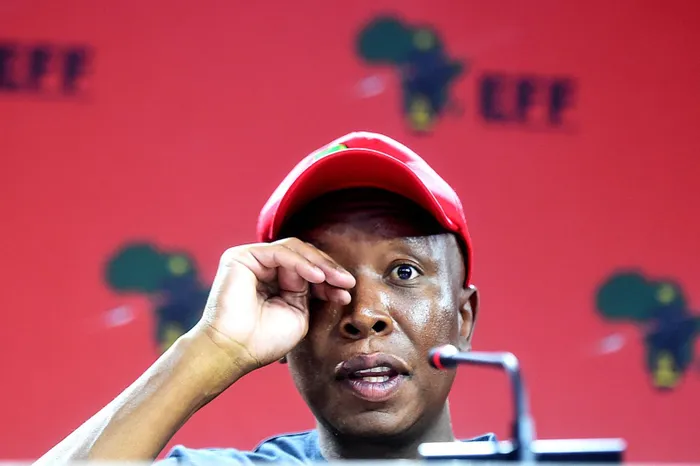
It's the day of reckoning for Juju.
Image: Itumeleng English / Independent Newspapers
Two pressing national issues – the rule of law and a deepening water crisis – have drawn strong public reaction.
The issue surrounding Julius Malema’s sentencing is complex, but it offers a significant opportunity for us to reflect on the importance of constitutional democracy and the rule of law in South Africa.
As a democratic nation, our Constitution is the bedrock of our society. It guarantees that everyone, regardless of their position, is subject to the law. This principle is fundamental to ensuring that our rights and freedoms are protected, while also ensuring accountability for actions that undermine the democratic framework.
The rule of law is a key principle of a functioning democracy. It dictates that laws apply equally to all individuals and institutions, irrespective of their political or social status. This ensures that no one is above the law, not even the most prominent leaders.
While one may not agree with every political position or action, it is important to acknowledge that Malema, like any other individual, must face the legal consequences of actions deemed unlawful by the courts. The law cannot be selective in its application. If we fail to respect this principle, we risk undermining the very democratic systems that uphold our freedoms.
Malema’s sentencing, whether one agrees with it or not, is a reminder that the judiciary must operate independently and impartially, free from political influence. In a democracy, the courts are tasked with interpreting the law and ensuring justice is served, not with pandering to political pressures.
While political leaders, including Julius Malema, may spark debate and drive significant discourse in our society, it is essential for us as a nation to consistently uphold our constitutional values. The rule of law and constitutional democracy are the pillars that protect us from a future where political power is unchecked and lawlessness can take root. We must respect and trust our legal processes to maintain the integrity of our democracy. THULANI DASA | Khayelitsha
South Africa’s water crisis is often described as a service delivery failure.
It is that, but it is also a measurable economic loss. It costs the state billions, municipalities billions more, and ordinary citizens money they cannot spare.
The Constitution guarantees everyone the right of access to sufficient water and requires the state to take reasonable measures to realise that right. It also requires municipalities to provide services sustainably, efficiently, and with accountable public administration.
South Africa loses about R9.9 billion a year through non-revenue water – treated water lost through leaks, theft, metering failures, and inefficiencies before revenue is collected. The National Water and Sanitation Master Plan has warned that municipalities lose about 1,660 million cubic metres of water annually, and that roughly R33 billion more per year is needed over a decade to secure supply. Other estimates place the broader annual requirement to repair and maintain infrastructure at around R90 billion over the next 10 years.
These are not abstract numbers. They reflect a country that has allowed routine maintenance to become a liability. The burden then moves to municipal governments, where the crisis appears in budgets, debt, and emergency procurement.
Johannesburg illustrates the problem clearly. An ISS analysis this month noted that the city’s non-revenue water stood at 44.8%, meaning it bills and collects only 55.2% of potential water revenue. The result is an annual deficit of almost R7 billion. That weakens the city’s ability to repair infrastructure, improve billing, and restore wastewater treatment works.
But the sharpest cost is not always what appears in public accounts. It is what disappears from the pocket of the citizen. Families are pushed into buying bottled water, paying informal vendors, installing JoJo tanks, fitting booster pumps, repairing damage caused by interrupted supply, paying transport costs to fetch water, and losing working hours while standing in queues.
In poorer communities, these costs are especially severe because they are paid in cash, time, and lost opportunity. Those with the least means often pay the highest price for municipal failure. In Adams Mission in eThekwini, residents were reported to have paid as much as 15 times the official tariff for illegally sold tanker water. Gauteng municipalities reportedly spent R2.37 billion on water tankers over five years.
This is where constitutional analysis becomes essential. Section 27 is not satisfied by sporadic tanker deliveries in places where formal networks have failed for months or years. Section 152 is not met where emergency procurement becomes a permanent operating model. Section 195 is not honoured where billions are lost through leakage, neglect, irregular procurement, or criminal profiteering.
The current pattern suggests a layered constitutional failure across national, provincial, and local government. The failure lies in implementation and enforcement.
A serious response must begin with maintenance. Cape Town’s experience during and after Day Zero showed that pressure management could save 70 million litres per day. It proved that reducing losses is often cheaper and faster than building entirely new supply. Phnom Penh reduced non-revenue water from above 70% to about 6% through governance reform, metering, and anti-corruption measures. Windhoek has shown that treated wastewater reuse can form a stable part of urban supply, while Israel demonstrates what long-term water security can look like when reuse, desalination, and planning are aligned at scale.
The reform agenda is straightforward: reduce non-revenue water aggressively, professionalise municipal water administration, audit tanker contracts, use Section 139 interventions where municipalities fail, expand reuse and groundwater, and insist that every water rand be traceable from budget to outcome.
Nationally, the crisis is a drag on growth. Municipally, it is lost revenue and rising emergency costs. For the citizen, it is less money at month-end and less confidence in the state. The government’s obligation is not to explain this cost, but to end it without delay. ISMAIL JOOSUB | FW de Klerk Foundation
DAILY NEWS