

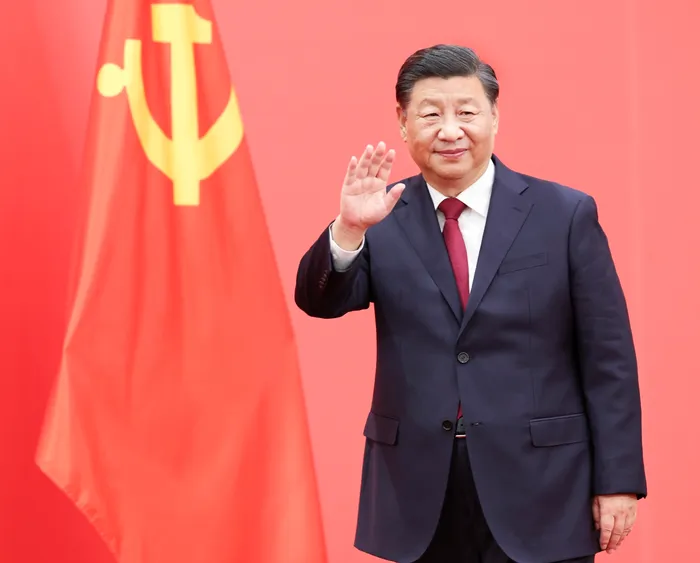
Chinese President Xi Jinping recently met with the Crown Prince of the United Arab Emirates Sheikh Khaled bin Mohamed bin Zayed Al Nahyan to discuss strategies for safeguarding and promoting peace and stability in the Middle East.
Image: Pang Xinglei / Xinhua
In a significant diplomatic overture, Chinese President Xi Jinping recently met with the Crown Prince of the United Arab Emirates (UAE), Sheikh Khaled bin Mohamed bin Zayed Al Nahyan, to discuss strategies for safeguarding and promoting peace and stability in the Middle East.
The meeting has underscored China’s growing influence in a region often marked by conflict and discord, with Xi proposing four core principles aimed at fostering a secure and cooperative environment among Gulf states.
The first proposition emphasises the principle of peaceful co-existence. President Xi stressed the importance of strong relationships among Gulf nations, declaring that the close neighbours must work to bolster their ties. He called for the establishment of a common, comprehensive, and sustainable security architecture throughout the Middle East and the Gulf region. Xi believes that such collaborative efforts were integral to solidifying the foundation for enduring peace.
State sovereignty emerged as the cornerstone of Xi’s second proposition. He articulated that respect for sovereignty was pivotal, especially for developing nations seeking to flourish.
“The sovereignty, security, and territorial integrity of the Gulf states should be earnestly respected,” he asserted.
This affirmation reiterated China’s commitment to safeguarding the rights and safety of nations within the region, encompassing protection for their personnel, facilities, and institutions.
As a third proposition, Xi underscored the necessity of adhering to international law. Insisting on the rejection of selective application of the law, he cautioned against any regression to “the law of the jungle.”
Xi called for all nations to support an international system with the United Nations at its core, thus sustaining an order rooted in law and the principles outlined in the UN Charter.
Finally, Xi proposed a balanced approach that intertwines development and security. He posited that security was fundamental for development, while development acts as a safeguard for security.
“All sides should work to create a sound environment,” he stated, advocating for the fostering of positive energy and regional development opportunities.
In a clear message of collaboration, China expressed its readiness to share the opportunities that come with Chinese modernisation, working alongside Gulf countries to cultivate a fertile environment for regional advancement and stability.
The meeting between Xi and the UAE’s Crown Prince reflects an evolving narrative towards peace in a historically tumultuous region. With these four propositions, Xi offers a blueprint aimed at enhancing stability, fostering cooperation among nations, and ultimately paving the way for a more peaceful Middle East.
DAILY NEWS