

Readers have their say about anything and everything.
Image: Sora
Your April 17 front-page article on the sentencing of Julius Malema prompted me to search for corroboration of his claims about racism.
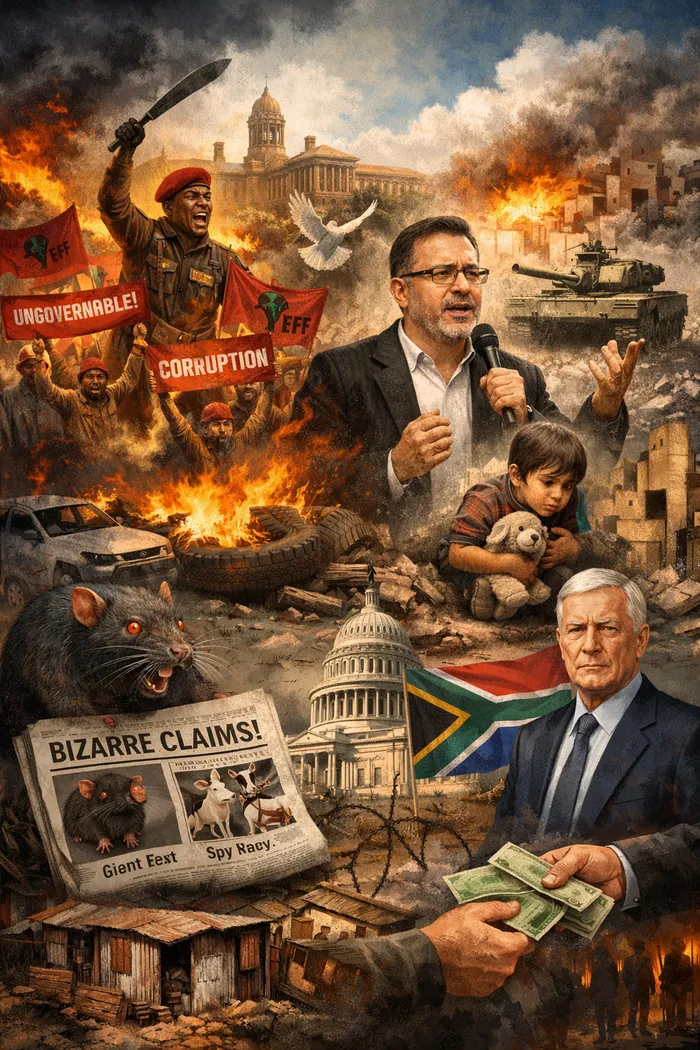
I found none. However, one source reported that the EFF had threatened to make South Africa “ungovernable” if their leader was imprisoned. This suggests the EFF may be late to the party – the ANC achieved that goal years ago. | Rob Johnston Tokai
Just when many ordinary citizens feel overwhelmed by the rise of extremism in our country, a voice of protest emerges.
As fears grow – from white supremacist rhetoric to concerns about ideological influences and imported conflicts – one individual has spoken out clearly. Pastor Nigel Braken has challenged what he describes as moral blindness, reminding political leaders that what is happening in Gaza amounts to genocide.
His intervention may be a lone voice, but it represents a powerful spark of hope – one that could inspire broader, more honest debate. That hope, however, also depends on government taking firm control of the country, rooting out corruption and closing the door to opportunistic forces that exploit weakness. | Ebrahim Essa Berea
The mind boggles at the level opponents of Israel will stoop to in their efforts to vilify and demonise the country.
In their latest attempt, the Palestinian Authority (PA) claims that “Israel has developed genetically engineered large rats that especially attack children and the sick” (Fatah-run Awdah TV, April 15, 2026). These so-called supernatural rats join other alleged Israeli inventions, such as “trained cattle” that spy and eavesdrop, and “giant rats” supposedly used to chase Palestinians out of Jerusalem.
The PA claims these creatures are immune to poison, aggressive, unusually large, unafraid of cats, highly fertile, and selectively target Palestinians while ignoring Jewish residents.
Why do people believe such fantasies? The problem is that the PA is highly skilled at manipulating elements of anti-Semitism and employing the “big lie” tactic associated with Nazi propagandist Joseph Goebbels.
It would be an interesting exercise to ask Israeli scientists how they allegedly engineered rats to identify and attack Palestinians while sparing Israelis. If true, such a feat would surely merit a Nobel Prize.
Does one laugh or cry? | Kevin Meineke Summerveld
The appointment of former minister of defence and law and order Roelf Meyer as South Africa’s ambassador to the United States should not be mistaken for a success of our constitutional democracy.
Rather, it reflects continued reliance on figures associated with an unjust past, alongside a failure to address structural inequality.
Meyer is often praised for his role in the Convention for a Democratic South Africa (Codesa), a process widely celebrated as a miracle of negotiation. However, this narrative obscures a harder truth: while the transition delivered political freedom, it also preserved many existing power structures and delayed meaningful economic transformation.
For millions, especially the working class, the legacy of apartheid remains a daily reality. Inequality is still extreme, land ownership patterns show limited change, and economic opportunities remain concentrated among the historically advantaged. In this context, elevating figures tied to that era feels less like progress and more like complacency.
Recent global scandals, such as the Epstein case, illustrate how wealth and influence can shield individuals from accountability. South Africa faces similar risks, though watchdog institutions and public scrutiny remain vital safeguards. | Mohamed Saeed Pietermaritzburg
The map of our shared humanity is being redrawn in the ink of suffering, as the world looks on in silence.
Pastor Nigel Braken has emerged as a bold voice in a climate where many choose silence, confronting what he sees as moral inconsistency in political responses to global conflict. His stance has resonated with those disillusioned by selective outrage and perceived double standards.
The global stage in 2026 increasingly resembles a theatre where mass suffering is treated as a political inconvenience. This failure of international resolve allows atrocities to continue unchecked, exposing the fragility of the so-called global conscience.
When truth is avoided, the consequences are profound. Silence becomes complicity, enabling injustice and deepening human suffering. History will judge not only those who acted, but also those who stood by and said nothing.
In the face of such crises, silence is not neutral – it is a choice. | Farouk Araie Benoni
DAILY NEWS