

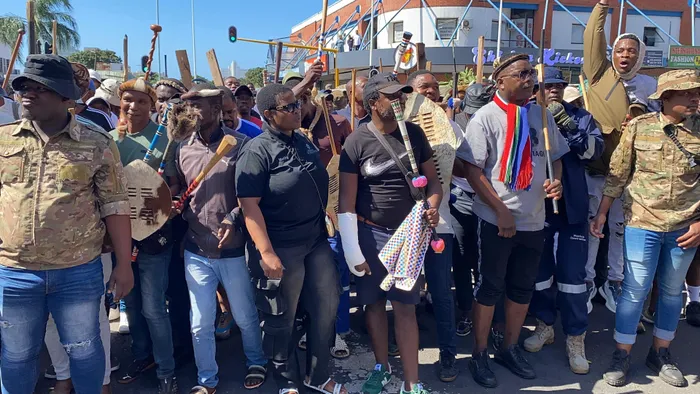
Media personality Ngizwe Mchunu leads the March and March movement, urging South Africans to take control of their communities and address crime and social issues, while challenging the effectiveness of political parties.
Image: Sipho Jack
THOUSANDS joined the March and March movement in Durban’s city centre on Tuesday as tensions over crime, undocumented foreign nationals and municipal service delivery boiled over.
They were incensed that some of the organisation's supporters got caught-up in skirmishes with foreign nationals when they embarked on their latest operation to clean up some of the unkempt streets in the city centre on Monday.
They also used yesterday's procession, which began at Gugu Dlamini Park, in close proximity to the Workshop Shopping Centre and eventually flowed onto Bertha Mkhize Street, to voice their disapproval of the eThekwini Municipality's management of the city and providing services, shallow promises of politicians and rampant crime everywhere.
Members of the MK Party were among the thousands who were a part of proceedings.
Police were able to responded promptly when tempers flared on Monday and were quick to douse the volatile situation, they were once maintained a watchful eye on yesterday's happenings.
Community activist Ngizwe Mchunu addressed the gathering and blamed politicians for having consistently failed to adequately address the pressing social issues of many South Africans.
Mchunu said it was time for citizens to reclaim agency over their communities because political parties often prioritised their own agendas, and paid lip service to community concerns, and only became more active when elections were in the air.
"We must reject political leadership and support community-led efforts to remove crime and undocumented immigrants."
He said many many local residents blamed many of the social problems in communities due to the ever increasing number of foreign nationals, and they were connected to various crime rings.
Mchunu's address also focused on malpractices within law enforcement agencies, and accused police of accepting bribes in overlook the alleged indiscretions of undocumented immigrants.
He urged communities and civic groups to unite beyond political affiliations, and to advocate together for action that would eliminate crime, without relying on established political structures, and giving priority to safety, stability, and respect for their rights of citizens.
Busisiwe Nonjiko, a seamstress, said she blamed herself for voting the way she did previously because she realised that the party she voted for cared more for foreigners.
“We are seamstresses and we have been doing this for the past few years. Foreigners are now taking our jobs away,” she added.
March and March movement leader Jacinta Ngobese-Zuma gave clarity on her organisation's cleanup initiatives in CBDs, which has not received unanimous acceptance.
Ngobese-Zuma said that her orgnisation's efforts on Monday's were prompted by a deep concern for the deteriorating condition of urban spaces, and not by any anti-foreigner sentiment.
She said: "We had a clean-up where South Africans noted with great concern the state of our CBDs.
"Cities are decaying. Buildings are crumbling, while locals are unable to find safety or security in their own city."
She voiced frustration over the municipality's abandonment of its duties, and for allowing lawlessness to proliferate.
"The clean up is aimed to foster a sense of community pride and address dire issues, including the rampant sale of drugs in broad daylight."
With police siding with criminals, Ngobese-Zuma asked: "What choice do we have as South Africans? Our lives and our children's future depend on the safety and security of our cities."
On those who held a dim view on March and March's clean up operations, she said: "People are bored and misuse the term 'xenophobia.
"How does cleaning a city turn to xenophobia? If you are complying with the law, why is your shop closed?"
She said that while not every foreigner in South Africa is to blame for the troubling issues, there was discontent over the perception that they have overtaken the livelihood opportunities of local people.
Ngobese-Zuma pointed out that foreigners were the ones who were vending basic and essential items ahead of local people.
She also questioned why some media outlets were not balanced in reporting news asscoiated with her movement.
"There was a well-documented attack on a South African woman, yet it barely registered in the news.
"Why the silence?" she asked.
DAILY NEWS