

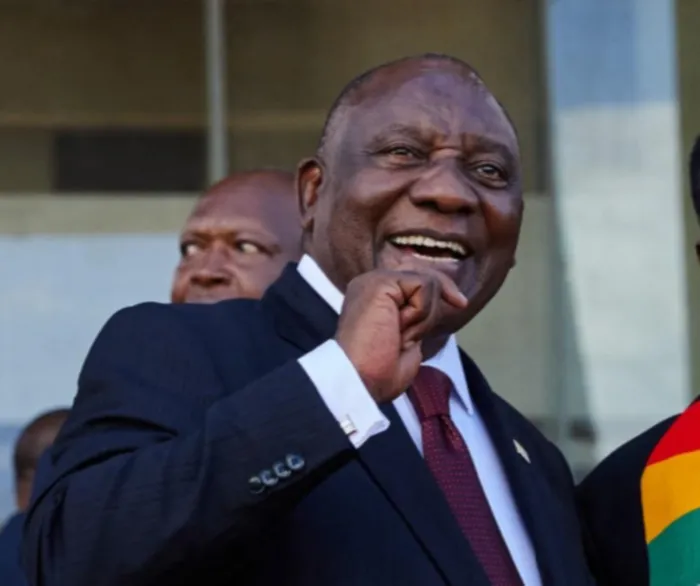
1008605521__20260416__0 The president's indecision is final.
Image: AFP/Archive
Who could not be moved by these sentiments expressed by Agnes Kory, a child Holocaust survivor originally from Hungary?
She said: “I am outraged and insulted by the Holocaust being used as an excuse for Israel’s relentless war against the Palestinian people. What was done to us as Jews should not be repeated against anyone else." | Eric Palm Gympie, Queensland, Australia
South Africa does not suffer from a shortage of plans, promises, or panels.
It suffers from a shortage of consequence, which is why the real cost of indecision under President Cyril Ramaphosa is not merely political, but constitutional, economic, and moral. A government that delays action in the face of serious wrongdoing does not merely look weak; it weakens the state itself and signals to citizens that accountability can wait.
President Ramaphosa has defended his leadership style as one grounded in consultation and consensus. Consensus is not a vice in a constitutional democracy, but there is a difference between consultation and hesitation, between deliberation and drift. Consensus is a virtue only when it leads to decision; when it becomes a substitute for decision, it becomes inertia.
That matters because the Constitution does not envisage a passive presidency. Sections 83 and 85 vest the President with the duty to uphold the Constitution and exercise executive power. Section 91 empowers him to appoint and dismiss ministers. Section 195 demands accountable, efficient public administration. Section 237 is clearer still: constitutional obligations must be performed diligently and without delay.
Measured against that standard, Ramaphosa’s presidency has too often preferred process over consequence. This is not to deny his strengths. He helped steady the country after the Zuma years, preserved institutional continuity, and brokered a Government of National Unity after the 2024 election. He has supported reforms in energy and public administration. Yet the central weakness of his presidency remains what the FW de Klerk Foundation’s Constitution and the Cabinet Report Card identified: a consensus-builder hampered by scandal and inertia.
The handling of allegations surrounding Police Minister Senzo Mchunu is a case in point. Faced with grave claims touching the integrity of the criminal justice system, the President chose to establish the Madlanga Commission and place the minister on leave rather than dismiss him outright. One need not pre-judge criminal guilt to see the issue. Political accountability requires a lower threshold than criminal conviction when the credibility of policing itself is at stake.
That cost is measured partly in money. The Zondo Commission alone cost close to a billion rand, while the Madlanga Commission carries a substantial budget of its own, roughly R150 million over six months. Yet the larger cost lies elsewhere: in the opportunity cost of a state that knows much, reports much, and acts too little. South Africans do not need more proof that corruption has hollowed out institutions, that policing is distrusted, or that energy and freight crises have inflicted economic pain. The country’s problem is not ignorance; it is the conversion of knowledge into consequence.
Here, the phrase “culture of impunity” becomes essential. Impunity flourishes when those in power believe that exposure is survivable, delay is manageable, and consequence is negotiable. If the chain between wrongdoing and visible accountability is too weak, the lesson absorbed is clear: wait it out.
History shows that South African leadership has not always been so hesitant. FW de Klerk’s decisions in February 1990 altered the country’s trajectory. Thabo Mbeki’s dismissal of Jacob Zuma as Deputy President in 2005 demonstrated a willingness to impose political consequence. The ANC’s recall of Jacob Zuma in 2018 showed that, when urgency is truly felt, South African politics can move with speed.
Ramaphosa’s defenders argue that South Africa’s complexities demand caution. That is true, up to a point. But caution cannot become a permanent alibi. The President was elected to arrest institutional decline, not to narrate it. South Africa is too poor for drift, too unequal for delay, and too wounded by corruption to indulge another season of procedural postponement. The constitutional demand is not for recklessness, but for diligent, rational, and timely action. The cost of indecision is counted in weakened institutions, delayed reform, diminished trust, and the spread of a culture of impunity. South Africa does not need a president who merely reads the room; it needs one prepared, when the country demands it, to lead it. | Ismail Joosub FW de Klerk Foundation
DAILY NEWS