

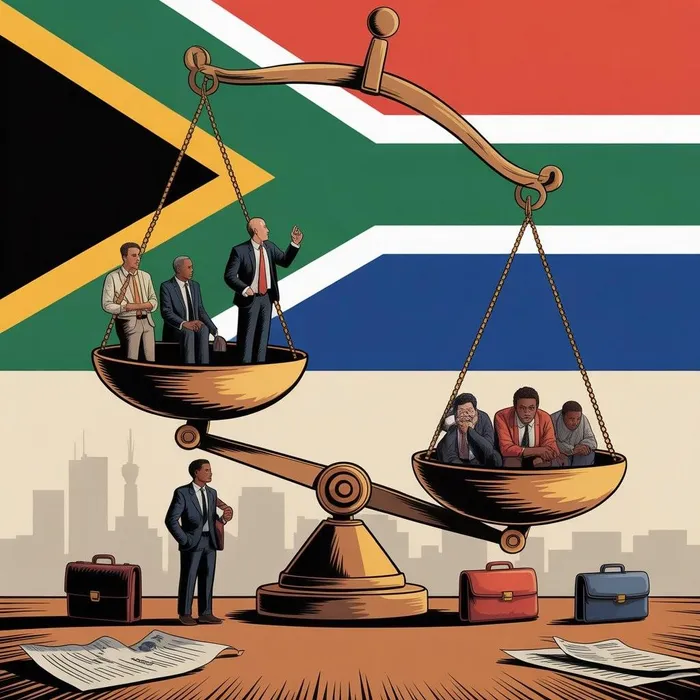
BEE is a con that benefits only the wealthy elite and does nothing to help poverty-stricken South Africans.
Image: Ideogram.ai
President Cyril Ramaphosa told the ANC Limpopo elective conference that those calling for an end to Black Economic Empowerment (BEE) and affirmative action “are dreaming”, and that these policies are a “direct requirement of the South African Constitution”.
This is hardly the first, and certainly will not be the last time, that Ramaphosa misrepresents the highest law in the land.
Given South Africa’s brutal experience with state-driven racial engineering, it should be unsurprising that the constitutional text clearly prohibits race-based economic engineering of the kind embodied in BEE.
Section 1(b) of the Constitution declares that South Africa is founded on values including non-racialism. These are founding provisions that may not be “balanced” away — in fact, every other provision in the Constitution must be interpreted and applied in a manner that respects and advances them.
Ramaphosa and his ideological fellow-travellers in the legal fraternity have long sought to interpret section 9(2) of the Constitution to enable their envisioned racial engineering. They understand that the only way to overcome the requirement of non-racialism is through explicit authorisation of racialism in the constitutional text, and they have attempted to locate it here.
Section 9(2) provides that constitutional equality “includes the full and equal enjoyment of all rights and freedoms”, the achievement of which may be promoted through “legislative and other measures designed to protect or advance persons, or categories of persons, disadvantaged by unfair discrimination”.
But note that there is no reference to race. Elsewhere, the Constitution explicitly requires that the judiciary must broadly reflect the racial composition of society, which is a narrow exception to non-racialism. Without such explicit wording in section 9(2), it must be read consistently with the founding value of non-racialism.
It must therefore be understood as authorising measures to advance the disadvantaged, not racial groups as such.
“Disadvantaged” is properly understood in socio-economic terms — destitution, lack of education, and limited opportunity — not as a proxy for race.
A non-racial reading aligns with South Africa’s demographics: the primary beneficiaries of genuine empowerment policies would be the poor black majority. That outcome is uncontroversial. What is objectionable is the continued use of race as the blunt instrument of selection.
This same logic applies to section 217 of the Constitution, which governs public procurement.
Again, the text speaks of advancing the disadvantaged, not racially defined groups. The primary obligation remains fairness, equity, transparency, competitiveness and cost-effectiveness. Race-based preference systems that inflate costs, distort markets and entrench patronage undermine these imperatives.
The Free Market Foundation and Solidarity Research Institute’s 2025 study quantified the damage.
So-called “broad-based” BEE imposes annual compliance costs of R145-R290 billion, equivalent to 2–4% of GDP, with ownership and enterprise development accounting for tens of billions. Including dynamic effects — foregone investment, slower growth and lost opportunity — the policy has shaved between 1.5% and 3% off annual GDP growth and cost up to 192 000 jobs per year. Cumulatively, the drag exceeds R5 trillion.
These figures represent real businesses not started, real jobs not created and real destitution not alleviated.
Why, then, does the ANC leadership cling so tenaciously to race-based law?
The answer lies in political economy, not constitutional fidelity.
The policy provides a mechanism for patronage, rent-seeking and the extraction of resources from the productive economy under the guise of “transformation”. It allows the ruling party to direct economic levers, reward connected insiders and maintain a network that sustains its power base.
A shift to non-racial, merit-based, opportunity-expanding policies would dismantle that model. Genuine empowerment through employment, deregulation and growth threatens the architecture of ANC political control.
Ramaphosa, often described as a “constitutional scholar”, knows better. The Constitution’s text, structure and founding values point clearly toward non-racialism as the governing principle.
Sections 9(2) and 217 permit targeted assistance to those actually disadvantaged by discrimination — which, applied without racial lenses, would primarily benefit black South Africans — but they do not licence perpetual racial classification.
Thirty years into democracy, South Africa cannot afford to treat non-racialism as a rhetorical flourish. It is the cornerstone of our constitutional order. Policies that divide citizens by race, inflate costs, deter investment and concentrate benefits among a politically connected elite are the very forces keeping millions destitute.
The “dream” that must end is not the aspiration for broad-based prosperity. It is the insistence that race-based extraction is constitutionally mandated. True fidelity demands non-racial public policy that recognises merit and grows the economic pie rather than fights over shrinking slices.
Only then can we build the united, non-racial society the Constitution envisions. | Martin van Staden Free Market Foundation.
DAILY NEWS