

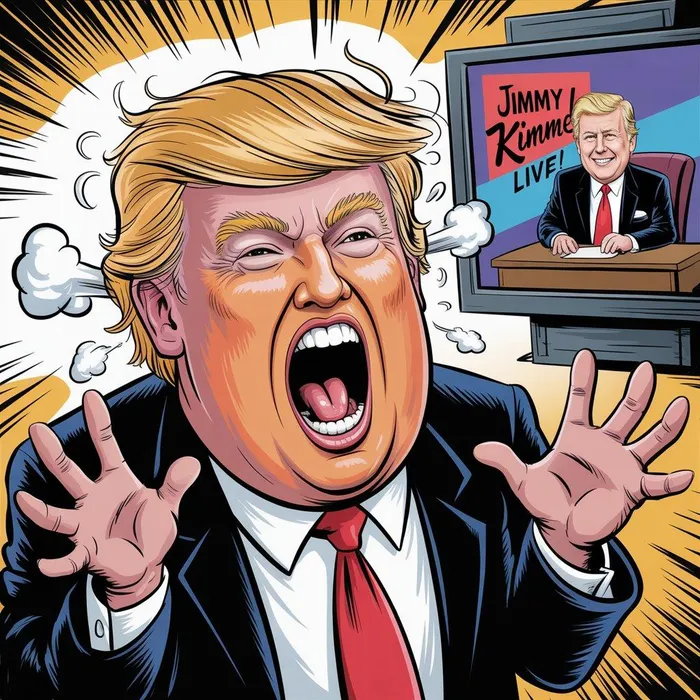
Jimmy Kemmel got under Donald Trump's skin.
Image: ideogram
We are living through a profound crisis of capitalism, marked by corruption, deepening inequality, and the re-emergence of authoritarian tendencies.
Economic power remains concentrated in the hands of those who own and control production, shaping political and legal institutions in turn. In such conditions, the state cannot be neutral; it reflects the interests of those who hold power. History shows that serious challenges to this order are often met with resistance, sometimes violently.
Those who look to socialism are not offering a fixed blueprint for the future. As Friedrich Engels noted, future generations will determine their own social arrangements; society is shaped by the actions of the living, not the prescriptions of the past.
What we can do is draw conclusions from present conditions. While no one can predict the exact course of change, the contradictions within capitalism point to the possibility of transformation. The question is how we understand – and respond to – these forces.. | John P Naidu Springfield
Following the outbreak of war on Iran, launched by the US and the Israeli regime on February 28, the conflict is already inflicting severe economic damage on tens of millions of people worldwide, with the working class bearing the brunt.
Disruption of the Strait of Hormuz, which carries roughly 20 percent of global oil shipments, has driven up fuel, electricity, and transport costs worldwide. Fertiliser supplies have also been hit, raising agricultural costs and threatening lower crop yields, with food prices likely to keep rising into 2027.
Shipping delays, soaring insurance premiums, and rerouted trade have further increased the cost of basic and essential goods. Many have lost jobs, while economies heavily dependent on Middle Eastern energy face sharp fuel price increases and industrial disruption.
Across the globe, surging fuel prices, rising food costs, and weakening currencies are deepening the risk of food insecurity and economic instability. Meanwhile, higher living costs, layoffs, and mounting strain are becoming widespread realities.
Despite this hardship, major oil corporations are reaping enormous profits. The crisis can fuel protests and labour unrest worldwide, as workers demand relief from soaring living costs. The situation underlines the urgent need for organised and coordinated international protest action to oppose war and address its devastating economic and social consequences. | Mohamed Saeed
Pietermaritzburg
ABC comedian Jimmy Kimmel recently sparked outrage after joking that Melania Trump had “the glow of an expectant widow.” The remark, made days before an attempted attack at a White House event, drew sharp condemnation from both Melania and President Donald Trump, who called for Kimmel’s dismissal. Kimmel defended the line as a harmless jab at the couple’s age difference, not an endorsement of violence. Yet what stands out is the intensity of the response.
Despite downplaying the attempted attack, President Trump reacted strongly to a comedian’s joke. This raises a broader question about consistency. Political leaders frequently use harsh and provocative language against opponents, the media, and even institutions, yet react with outrage when satire is directed at them. If such rhetoric is acceptable in politics, why is it intolerable in comedy?
More troubling is the wider exercise of power. How does a leader of a democratic state reconcile outrage over a joke with aggressive foreign policy threats and actions? Is this the conduct of a principled democrat, or of a leader increasingly comfortable with the unchecked use of authority?
These contradictions deserve closer scrutiny. | Thyagaraj Markandan Kloof
Mathematics holds a powerful place in modern education. From the earliest years, it is treated not only as a core subject but as a proxy for intelligence, potential, and future success. Its prominence is often justified by the demands of a data-driven, technological world requiring logical thinking and problem-solving. Yet this raises a basic question: is it reasonable to expect all children to engage with mathematics in the same way?
Two contrasting views of learning sit beneath this debate. One assumes equal cognitive potential, given the right teaching and effort. The other argues that ability is shaped by environment, experience, and social context, meaning learning is not uniform and neither is mathematical understanding. The issue is whether current systems reflect how children actually learn, or whether they ignore this diversity.
Developmental theory adds further nuance. Some emphasise stages of readiness, where abstract reasoning emerges over time. Others stress the social nature of learning, where understanding develops through interaction and support. The difficulty lies less in these theories than in their inconsistent application in classrooms.
In practice, systems often assume uniform readiness while failing to provide the support needed for deeper understanding. This is most visible in assessment. In South Africa, international benchmarking has increasingly shaped curriculum pace and priorities. While such assessments provide useful comparisons, they also risk narrowing teaching to test performance and short-term outcomes. In a context of inequality, linguistic diversity, and uneven early learning opportunities, they can distort rather than clarify educational realities, reinforcing narratives of failure rather than supporting growth. The question is whether we are measuring learning or merely measuring differences.
Teaching approaches can compound the problem. Mathematics is often reduced to procedures and correct answers, encouraging memorisation over understanding. A different approach treats mathematics as a way of thinking, developed through discussion, reasoning, and problem-solving, where learners actively construct understanding.
If children are to engage with mathematics meaningfully, this shift is essential. Engagement grows from curiosity, conceptual understanding, and achievable challenge. It requires space for mistakes, emphasis on thinking over speed, and connections to real contexts.
This may require difficult decisions: less reliance on international benchmarking, more flexible assessment practices, and greater trust in professional judgement. Above all, it requires a shift in mindset – from mathematics as a high-stakes filter to mathematics as a human way of thinking.
The question is not whether mathematics matters – it clearly does – but whether our current approach allows all learners access to it in a meaningful way. Until it does, mathematics will remain a source of anxiety for many rather than opportunity for all. | Mike Workman Johannesburg
A piece in one of your sister papers, the Weekend Argus, of April 25–26, caught my eye. Scientists at the Hebrew University have discovered a bacterial “gatekeeper” that blocks the spread of antibiotic resistance. This could be a very significant breakthrough to help in the prevention of disease caused by the “superbugs”. This would not be a first from a university in Israel – they have made other very important discoveries and medical inventions.
I strongly feel that all researchers and universities should have unrestricted ties as human health is at stake and these breakthroughs are very important for everybody on this planet. Breaking ties with Israeli researchers and inventors based on their far-right government and Netanyahu’s policies is a short-sighted course of action. Academics are academics – let’s not judge them by the actions of those who wield the power in government – it will not serve us well in the end. | Anne Olver Noordhoek Manor
DAILY NEWS