

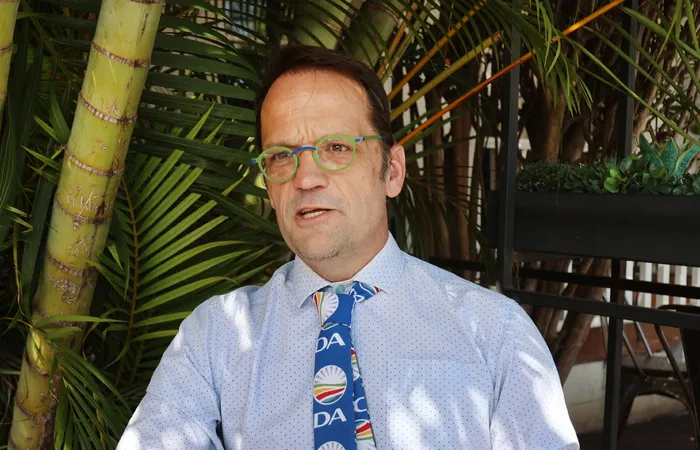
KwaZulu-Natal's MEC for Public Works and Infrastructure, Martin Meyer in conversation with the Daily News during an engagement in Glenwood. Picture:
Image: TUMI PAKKIES/Independent Newspapers
Martin Meyer is aiming to scale new heights in his political journey as he seeks the position of deputy leader of the Democratic Alliance (DA) in KwaZulu-Natal.
Meyer’s advocacy for LGBTQ+ and vulnerable children’s rights forms the foundation of his political motivations and has driven his pursuit of meaningful change from within the system.
His journey into activism began at university, where he became involved with Amnesty International, an experience that laid a solid foundation for his future work in social justice.
“I realised that to effect real change, I needed to move beyond advocacy into a space where I could influence policy directly,” he said.
This realisation led to his transition from activist to a political candidate seeking to make an impact within the formal political arena.
Aligning strongly with the DA’s centrist liberal values, Meyer said he is drawn to the party’s combination of economic pragmatism and commitment to human rights.
As a self-identified social liberal, he aims to position himself on the progressive wing of the party, advocating for a dual-focused approach—one that strengthens the DA’s presence in urban areas while expanding its reach into rural communities, where grassroots empowerment remains essential.
“We must enhance our presence in rural areas. I am committed to providing the necessary support and resources to our grassroots,” Meyer said.
As South Africa’s political landscape evolves, particularly with the rise of coalition governments, Meyer acknowledged the need for adaptable strategies.
“Coalitions are now a reality, and we must strategise accordingly. It is crucial that we partner with those who share our constitutional values,” he said.
He distanced himself from potential alliances with parties such as the Economic Freedom Fighters (EFF) and Umkhonto we Sizwe Military Veterans Association (MK) due to fundamental ideological differences, but remained open to working with parties aligned to his vision.
If elected deputy leader, Meyer said he would prioritise strengthening the DA’s governance capacity. This includes preparing party members to navigate coalition governance and equipping them with structured plans outlining objectives for the first 15, 30, and 100 days in office.
He also proposed establishing a provincial governance support unit to strengthen local campaign structures.
Reflecting on the tenure of the DA’s KwaZulu-Natal chairperson, Francois Rogers, Meyer expressed appreciation for the stability and unity achieved under his leadership. He said Rogers had played a significant role in improving the party’s visibility and standing within the provincial political landscape.
Addressing concerns about internal dynamics within the DA, Meyer said:
“The DA values democratic participation and unity, which we will continue to promote even as we navigate the outcomes of internal elections.”
He reiterated the party’s commitment to inclusivity and representation.
DAILY NEWS