

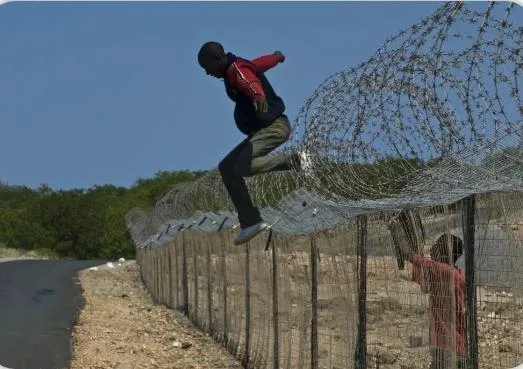
In spite of the hazards of razor wire, undocumented foreign nationals are willing to take the risk and jump the border fence.
Image: ActionSA
On April 25, Italians celebrate Liberation Day, marking their freedom from Nazi rule in 1945.
In Milan this year, descendants of the Jewish Brigade, volunteers from Mandatory Palestine who served in the British Army and fought the Nazis in northern Italy, were targeted with anti-Semitic and anti-Israel abuse. Surrounded by demonstrators chanting “Zionists out of Milan,” they were forced to leave the march under police protection.
How short are people’s memories? Many have forgotten that Jews fought to rid Italy of fascist rule. More disturbingly, they have overlooked that the Grand Mufti of Jerusalem collaborated with Hitler, spreading propaganda and raising Muslim units for the Nazi Schutzstaffel (SS) to assist the Axis cause.
The world appears increasingly fickle, with shifting alliances turning former friends into enemies and vice versa. People seem trapped in the shifting sands of international politics, where perception overrides fact. Today’s geopolitical climate resembles nothing more than a chaotic Mad Hatter’s Tea Party. | Kevin Meineke Summerveld
As the immigration debate intensifies, it is becoming clear that much of the tension arises from ordinary citizens and elites speaking past one another.
Not all elites dismiss public concerns, and not all citizens reject expert views. However, a divide persists between academics and commentators, who often frame the issue as scapegoating or Afrophobia, and grassroots voices, who experience immigration through daily realities.
For many South Africans, immigration is understood through lived experience. Crime, economic competition and visible changes in communities create a perception of displacement. This often leads to calls for expulsion, although such views can involve overgeneralisation and misattribution of blame.
Elites, meanwhile, analyse the issue through institutional frameworks, highlighting nationalism, systemic failures and political manipulation. While these perspectives are valid, they often fail to connect with the immediate realities faced by ordinary people.
Expecting citizens to engage in abstract, academic reasoning is unrealistic. Equally, dismissing their concerns outright deepens resentment and reinforces the perception that elites are indifferent.
A constructive path forward lies in finding common ground—acknowledging lived experiences while addressing broader structural issues. The goal is not uniform thinking, but mutual understanding and practical solutions.
Ultimately, no single group is entirely right or wrong. Progress depends on recognising differing perspectives and engaging in meaningful dialogue to address a complex and deeply emotional issue.| Ayanda Sakhile Zulu Free Market Foundation
DAILY NEWS