

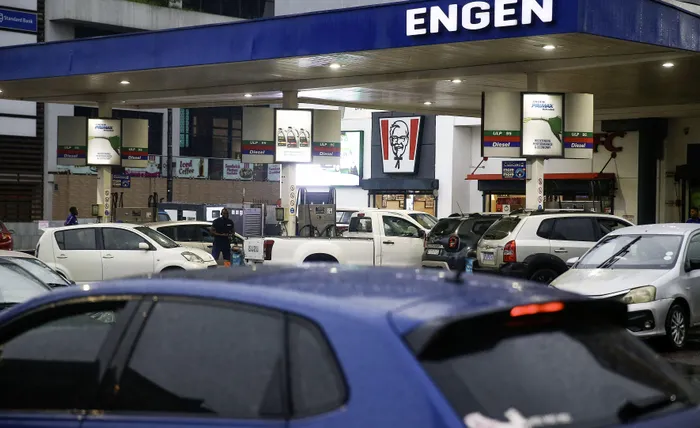
Motorists stock up. But why do we have to pay more than neighbouring countries, asks a reader, and what happens to fuel left over in the pumps – why do we have to pay more for old stock?
Image: Leon Lestrade / Independent Newspapers
(Send your emails to [email protected] and your WhatsApps to 071 485 7995. Please include your name and town/city. Letters published daily, WhatsApps on Tuesdays)
Unemployment remains South Africa’s fundamental problem, driving many of the country’s social and economic challenges.
With an official unemployment rate of 31.4%, rising to 42.1% when discouraged jobseekers are included, millions of working-age South Africans are without income. This means that between three and four out of every ten adults are not earning a living, not paying tax, and often relying on state grants or family support. The burden is especially severe among the youth, with 57% of those aged 15–24 unemployed and nearly 40% of those aged 25–34 also without work.
This crisis affects far more than household income. A larger employed population would ease fiscal pressure, reduce petty crime, and improve living standards through better nutrition and education. In short, jobs would address many of the country’s most urgent challenges.
The writer argues that excessive regulation is at the core of the problem. Laws such as the Labour Relations Act, Basic Conditions of Employment Act and Employment Equity Act, together with minimum wage rules and bargaining councils, make hiring costly and risky. Employers face heavy dismissal procedures and potential liabilities, discouraging job creation.
The CCMA adds further complexity, making employers hesitant to take risks on new workers. As a result, businesses often turn to automation or short-term contracts rather than permanent hiring.
Additional burdens such as unemployment insurance contributions, compliance requirements and transformation policies are also seen as barriers to growth.
The proposed solution is labour market liberalisation, reduced red tape, and greater policy certainty to attract investment. Expanding vocational education and easing restrictions on foreign earnings are also highlighted as key reforms.
The message is clear: South Africa needs jobs, and jobs require a freer, less restrictive economic environment. | Nicholas Woode-Smith Free Market Foundation
Every month I fill my petrol tank, usually costing over R1 000.
Yesterday at 09:08, I went as usual to Engen Coastal Centre in Tongaat, only to be told I could only purchase R300 worth of petrol. At 11:16, I went to BP in Buffelsdale and was again limited to R300. At Samco Service Station, however, I was able to fill R554.83 without restriction.
This raises a simple question: what happens to fuel left in storage tanks after midnight? Is it accounted for at the new price once the day changes?
This is South Africa. | Lutchmiah Applesamy Naidoo Tongaat
India’s relationship with Israel is built on centuries of historical connection and decades of modern cooperation.
From ancient trade links to formal diplomatic ties established in 1992, the partnership has grown across defence, agriculture, healthcare and technology. Collaboration in medical innovation and rural healthcare continues to benefit both nations.
Historically, Jewish communities lived peacefully in India without forced cultural change, contributing to a legacy of coexistence. India’s broader philosophy of global unity supports its approach to balanced international relations.
Criticism of these ties is therefore misplaced, as foreign policy decisions remain rooted in national interest and long-standing principles. | Kamini Prakash Umhlanga
The US has long been seen as a defender of the free world, but under Donald Trump it has, in my view, shifted into the role of aggressor.
Never before in modern history has an American president caused such global disruption—from alleged interventions abroad and threats against sovereign nations to strained alliances within NATO. His leadership style appears increasingly autocratic, unsettling both allies and the global economy.
With declining approval ratings at home, many believe his political future will ultimately be decided by US voters at the ballot box. | Colin Bosman Newlands
In a world filled with conflict and uncertainty, predicting the shape of the future global order is nearly impossible.
As the saying goes, “Que sera, sera”—whatever will be, will be. The future remains beyond our control and beyond our sight. | Eric Palm Gympie, Australia
DAILY NEWS