

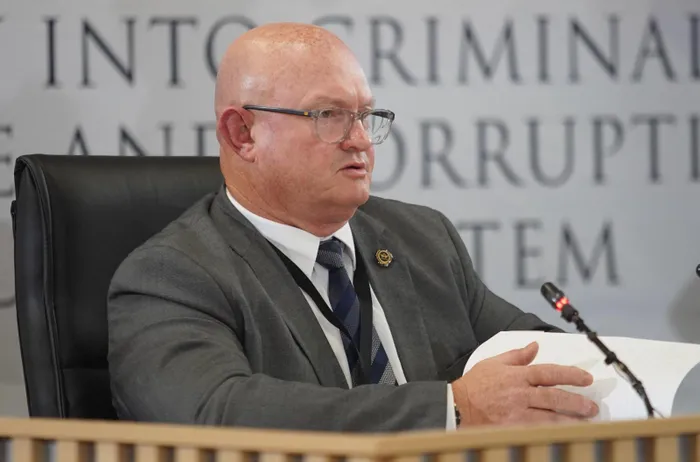
Major-General Hendrick Flynn testifies at the Madlanga Commission of Inquiry on Hawks' handling of investigation into missing R200 million cocaine in 2021.
Image: Oupa Mokoena/Independent Newspapers
Suspended KwaZulu-Natal Hawks head Major-General Lesetja Senona should have undergone a polygraph test following the mysterious disappearance of 541kg of cocaine worth R200 million from the Hawks’ Port Shepstone storage facility in 2021.
This was the view of Major-General Hendrick Flynn, Component Head for Serious Organised Crime at the SAPS Directorate for Priority Crime Investigation (DPCI) or Hawks during his testimony before the Madlanga Commission of Inquiry on Wednesday.
He was asked whether Senona should have taken a polygraph test, given that other officers involved in the cocaine seizure had already done so.
Flynn responded: "In my opinion he was supposed to be exposed to the process as he played an active role in the Port Shepstone matter. It was not as if he was just the provincial head, sitting at a distance. He was privy to the activities. He visited the Port Shepstone offices shortly after the seizure and took possession of the keys; that's active participation."
On Tuesday, he testified that the cocaine seized at the Durban depot was booked into Isipingo Police Station on June 22, 2021, and was strangely booked out the same day by an officer identified as Warrant Officer Mpangase.
On Brigadier Campbell Nyuswa's instruction, who consulted Senona about the arrangement, the DPCI transported the drugs to the Port Shepstone storage facility.
During his recent testimony, Senona conceded he had never taken a polygraph test but said he had no issue undergoing one.
He told the commission he lost track of the investigation into the missing drugs after the docket transferred to SAPS, and he wants to know what happened to them.
Senona is expected to reappear before the commission on June 1 for further questioning regarding his role in the drugs' disappearance from the Hawks facility.
Flynn said although the exhibits were stored at the Port Shepstone DPCI office they were booked in two days later at the Port Shepstone police station. However, they were never physically moved from the Hawks facility to the police station.
The commission heard that Mpangase entered the exhibits into the SAP 13 register at Port Shepstone police station but a different person signed for receipt.
The document does not identify who received the exhibits, and the signatory did not write down their name or Persal number.
On the same day Mpangase made the entry, he also noted on that copy that the exhibits had been taken for investigation. Flynn described this as a false entry, saying the exhibits were never sent for analysis on that date, or at any other time.
On Tuesday Flynn told the commission that he believed the sequence of events following the seizure of the drugs and their subsequent disappearance was "by design".
According to him, the handling of the crime scene at the Durban depot where drugs were recovered was procedurally flawed. The origin of the drugs was the Port of Santos in Brazil.
Flynn criticised investigators for failing to call the Local Criminal Record Centre (LCRC) as required and for not placing the exhibits in evidence bags at the crime scene.
According to his observation, the exhibits were already contaminated unless the investigators wore gloves.
"It (the exhibit) could still have been photographed properly by LCRC as well as properly sealed in exhibits seal bags and the exhibits would have been properly reflected in the SAP13 register. There was no need to take the exhibit in that state from Isipingo to Port Shepstone because anything could happen along the way. Some of the exhibits can go missing and the chain of custody is not at the required standard where we expect the detectives to function at," he said.
He was asked how the commission could be sure 541kg of cocaine arrived at the Port Shepstone DPCI office without a document recording its receipt.
“That is indeed true, and it is a shortcoming you are identifying,” he said, adding that witness statements in the case docket supported its delivery but declined to elaborate further.
The commission presented a report by National SAPS head Lieutenant-General Tebello General Mosikili showing seven break-ins at the same DPCI office before the November 2021 break-in at the Port Shepstone office, which resulted in drug theft.
Flynn testified that between November 6 and 8, 2021, 541kg of cocaine seized on June 22, 2021 was stolen from the DPCI Port Shepstone strong room after entry was gained using a grinder.
At the time of the theft, the alarm system fitted at the premises was not working properly and there was no armed response service because the contract with the private security company had not been renewed, having expired in March 2020.
“You need additional layers of security measures to obviously make it difficult or impossible for individuals to breach that premises...and to get access to the building and to successfully execute the breaching of the vault and the removing of the exhibits," he said.
He said the exhibits would have been safer at any other police station that was manned for 24 hours with armed police officers.