

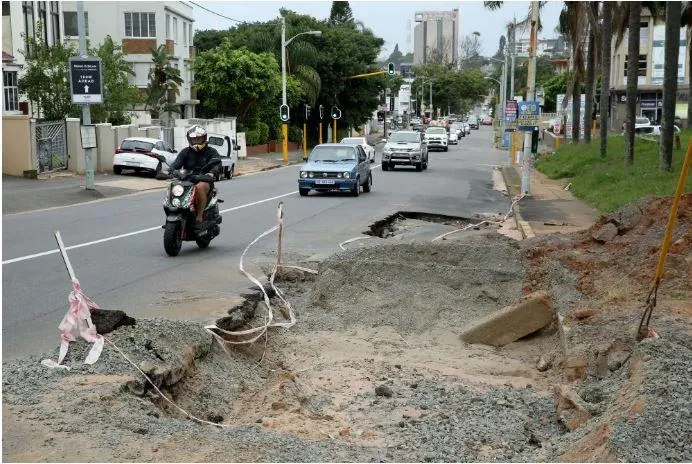
It's not just Peter Mokhaba Road that is in a poor state, it's everywhere says a reader.
Image: IIOL
Durban’s roads have become a national embarrassment. We are no longer driving on roads; we are navigating obstacle courses that would challenge a rally driver.
The deterioration of road markings across eThekwini is particularly dangerous. In many areas, lane markings have either faded into invisibility or disappeared completely. During rain — which Durban experiences regularly — driving at night becomes a nerve-racking guessing game.
On roads such as the M4, portions of the M19 and stretches of Anton Lembede Street in the CBD, motorists are often forced to “feel” where the lanes should be because the painted lines are gone. Even reflective cat’s eyes on routes such as Field’s Hill have reportedly failed, making wet-weather driving hazardous.
Then there are the potholes — not minor defects, but axle-breaking craters that seem to multiply faster than the municipality can fill them. eThekwini itself admits to dealing with more than 2,000 road defects every month, while blaming asphalt shortages and budget constraints. Yet residents continue paying rates, fuel levies and licence fees while suspension shops flourish like booming cottage industries.
The absurdity is that warning signs about potholes often appear before the potholes are repaired. Social media users joke that potholes have become “inverted speed bumps”, but there is little humour when tyres burst, rims crack and lives are endangered.
What message does this send to tourists arriving in what was once called “Africa’s playground”? Flood-damaged roads remain scarred years later, drains clog during heavy rain, and major intersections become flooded hazards after every storm.
The city can organise glossy clean-up campaigns and issue endless “Vision 2030” slogans, but functioning roads are not a luxury. They are basic infrastructure. A city that cannot paint lane markings or repair potholes promptly is a city visibly losing control of the fundamentals of governance.
Durban deserves better than excuses, tenders and temporary patches. It deserves roads that do not threaten the lives — and bank balances — of the people forced to use them every day. Our city fathers need to wake up, and ASAP, before we boot them out in the local government elections! | Rogers Pillay Chatsworth
I can still smell the linseed oil — a scent that once defined the anticipation of a cricket season more vividly than any calendar.
Before each summer, a cricketer would spend hours in the garage, patiently preparing a willow bat layer by layer. It was a private ritual of care and craftsmanship, a quiet act of devotion before the grand battles ahead. That sense of romance and patience now feels largely absent. In its place is the instant gratification of T20 cricket.
My own love affair with the game did not begin with the strike of a six, but in the slow-burning theatre of Test cricket. I grew up watching South Africa’s rebel Test series against Sri Lanka, the West Indies, Australia and England — a format steeped in complexity, subtlety and endurance. In what other sport can a narrative reach its climax after five full days? This was cricket as a novel, not a text message.
Then came colour to Kingsmead on hot summer nights. The jingle — “Come on summer, come on summer…” — heralded the Benson & Hedges series. White-ball cricket introduced a different thrill: coloured clothing, floodlights, and players who felt within reach. Andrew Hudson, Kevin McKenzie, Jonty Rhodes and Errol Stewart brought electric fielding and unforgettable energy. I watched legends such as Kim Hughes, Malcolm Marshall and Clive Rice. It was 50-over cricket at its best — a short story that still required a full narrative arc.
When T20 cricket first arrived, I did not see it as a threat. I watched Brendon McCullum’s early fireworks in the IPL with genuine excitement. The format initially brought together the greats — Sachin Tendulkar, Shane Warne, Jacques Kallis, Muttiah Muralitharan and Ricky Ponting — alongside exciting newcomers such as Dirk Nannes and Chris Gayle.
Unfortunately, that novelty has since curdled into a relentless commercial machine. Too many leagues now recycle ageing players across formats. With respect, names such as Faf du Plessis, Sikandar Raza, Imran Tahir and David Wiese continue long past their prime competitive relevance. Meanwhile, generational talents such as AB de Villiers, David Warner and Kevin Pietersen have already retired.
Let us be honest about what T20 has become. It is a form of entertainment built for instant consumption. There is little patience, little build-up, and little room for the tension that once defined the game. It is constant climax without craft, and for me, it has become increasingly difficult to watch outside of major tournaments such as World Cups.
The consequences are visible in modern batting rankings, where players such as Abhishek Sharma now top the T20 charts. One wonders how such players would fare on a green-tinged surface at the Bullring, facing Kagiso Rabada and Marco Jansen with a five-slip cordon waiting? The contrast with classical Test specialists such as VVS Laxman, Rahul Dravid, Brian Lara and Hashim Amla is stark. In this era of instant gratification, the craft of batting — building an innings, leaving the ball, and surviving hostile conditions — is becoming a fading discipline. Even the symbolic ritual of caring for a bat with linseed oil seems unnecessary in a world of disposable equipment and interchangeable franchises.
The game I loved was for the patient, the strategist and the romantic. That version of cricket, once accompanied by the scent of oil on willow and applause for a well-played defensive stroke, feels increasingly distant. I mourn its passing. | Taz Cassim Century View
DAILY NEWS