

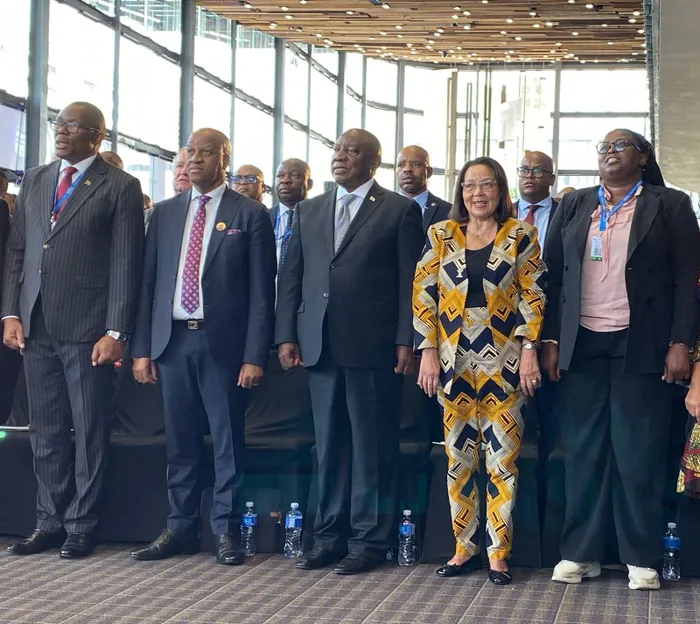
President Cyril Ramaphosa, flanked by eThekweni mayor Cyril Xaba, Premier Thami Ntuli, Minister of Tourism Patricia de Lille, and provincial speaker Nontobeko Boyce.
Image: Sipho Jack
Durban has been hailed by President Cyril Ramaphosa as the epitome of African hospitality during the launch of Africa’s Travel Indaba 2026 at the Inkosi Albert Luthuli International Convention Centre on Tuesday.
The president described Durban as a melting pot of cultures and a vital tourism hub where the collective stories of Africa are told and celebrated.
During his address, Ramaphosa expressed his appreciation for the resilience shown by the tourism sector and the role it has played in shaping South Africa’s identity.
“Tourism is more than just a sector of the economy; it is a living expression of who we are as a people,” he said, reflecting on the sector’s journey through some of the most challenging years faced by the global tourism industry.
The allure of South Africa’s sights, scenery and events continues to attract international visitors, with 10.5 million visitor arrivals recorded last year.
Three-quarters of the visitors hailed from the Southern African Development Community (SADC) region, highlighting the growing trend of Africans travelling within the continent.
“This significant statistic shows that there is something powerful about African tourism, and it validates our ongoing partnership efforts,” Ramaphosa added.
To sustain this growth trajectory, Ramaphosa said South Africa was intensifying collaboration with neighbouring countries to advance the SADC Tourism UNIVISA.
The Tourism UNIVISA is a regional visa initiative designed to simplify travel across SADC member states and enhance regional cooperation.
“When Africans travel within Africa, we strengthen our economies, deepen our cultural ties, and build a more integrated continent,” he said.
Ramaphosa also highlighted recent efforts to promote South Africa’s unique attractions.
In his State of the Nation Address earlier this year, he urged tourism stakeholders to showcase the country’s distinctive cultural, historical and natural attractions.
Recent developments in the tourism sector include the inauguration of the upgraded Cape Agulhas Lighthouse precinct and the Kgodumodumo Dinosaur Interpretation Centre, which has already welcomed more than 88,000 visitors since its launch.
The eThekwini Municipality has also introduced new attractions, including the recent unveiling of statues commemorating the legacy of Nelson Mandela and Oliver Tambo, who played significant roles in South Africa’s journey to democracy.
Tourism Minister Patricia de Lille reinforced the importance of the sector, citing insights from the Statistics South Africa Tourism Satellite Account, which indicated that tourism supported 954,000 direct jobs in 2024 and contributed 4.9% to the country’s GDP.
“With 10.5 million international arrivals in 2025, we are pleased to note that the sector is not merely recovering; it is experiencing tremendous growth,” she said.
De Lille also highlighted substantial investments aimed at strengthening tourism infrastructure and attractions across the country.
She referred to the Cabinet-approved Tourism Growth Partnership Plan, which includes several projects already under way, such as the R24 billion investment in V&A Waterfront and the R2.1 billion investment in the Club Med South Africa Beach and Safari Resort on the KwaZulu-Natal North Coast, which is scheduled to open in July.
Other major upcoming events include the SADC Heads of State Summit in August, the World Economic Forum Special Meeting 2027, and next year’s ICC Men’s Cricket World Cup.
DAILY NEWS