

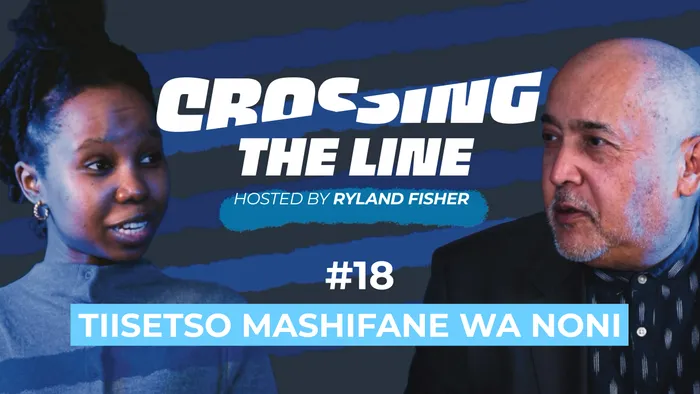
Playwright Tiisetso Mashifane wa Noni reflects on Soweto 1976 on the Crossing the Line podcast.
Image: Crossing The Line
On June 16, 1976, thousands of young learners from schools in Soweto march with the intention of gathering at Orlando Stadium to protest against an apartheid government instruction that they should all be taught in Afrikaans. But before anyone could reach the stadium, the police had broken up the marches, in the process killing well over 500 learners on that day and in subsequent days.
A new play, Rise 76: The Story of June 16th, marking the 50th anniversary of this historic and tragic day, opened at The Baxter this week. It will run until the end of the month before leaving for the Market Theatre in Johannesburg for a four-week season.
The award-winning writer and director of the play, Tiisetso Mashifane wa Noni, is the special guest in the Crossing the Line studio this week. She speaks to host, Ryland Fisher, about her many achievements and challenges in a relatively short theatre career, what inspired her as she worked on this latest production and the things that young people of today can learn from the 1976 generation.
Crossing the Line is a weekly podcast series started by Fisher, a veteran journalist and former editor of the Cape Times, last year. IOL features a different episode of the podcast series every week.
Mashifane, who was born in Mpumalanga but grew up in Pretoria, said she was commissioned by The Baxter and the Market Theatre to write the play because of her approach, which is heavily based on research. She conducted about 50 interviews in preparing to write this play.
“The two theatres wanted to mark the 50th anniversary of what happened in Soweto in 1976. The 50th anniversary of anything is big and this was a huge turning point in the struggle against apartheid.
“They wanted me to create a piece that would focus on the memory aspect, not just about the day but what does memory do 50 years later. Generations have come and gone. The children of Soweto, who were 15 or 16 in 1976, are now in their mid-60s. Many of the teachers, who were older, would probably have passed on by now. What residue is left 50 years later? I decided to create a fictional play based on historical fact.
“The Soweto uprising sparked many uprisings throughout the country, including Cape Town. They wanted to create a play where everyone would be recognised.”
Mashifane compared the 1976 uprising the Fees Must Fall protests of about 10 years ago.
“The youth uprising of ’76 was much bigger in terms of the violence and the people who were killed. The one similarity between 76 and Fees Must Fall is the objective of wanting better education. The other similarity was the scale of the protest action. Fees Must Fall happened at universities all over the country, while the ’76 protest started in Soweto but quickly spread to townships all over the country. Both had a big impact on the country’s social fabric.
“The one major difference between the two protests is the death toll, the loss of life. Thankfully, we don’t see that so much anymore. The scale of the violence was the most shocking aspect of the 1976 uprising. There is a line in the play where one of the characters say that 1976, and June 16 in particular, is the day South Africa killed its children.”