

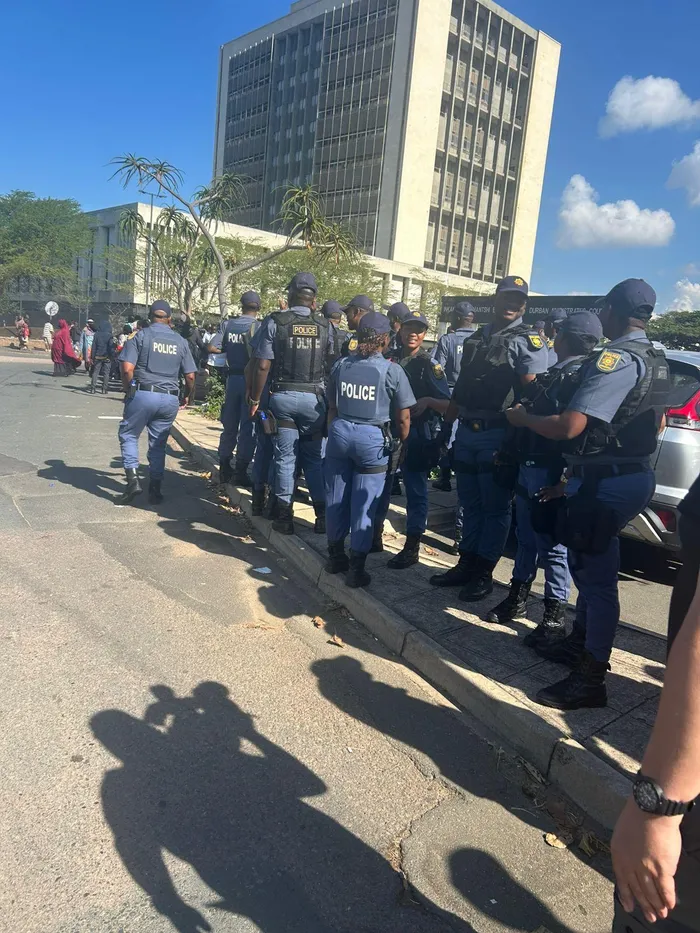
Foreign nationals in Durban are facing escalating threats and violence, prompting them to seek refuge at the police station.
Image: Sipho Jack
Durban's central business district has once again become a flashpoint of unrest, as foreign nationals camped outside the Durban Central Police Station demanding protection amid fears for their safety.
Hundreds of foreign nationals sought refuge from what they described as persistent threats and intimidation tactics from local groups, turning the pavements around the police station into a temporary sanctuary.
However, when police attempted to disperse the gathering, the crowd resisted, tensions escalated, and officers responded with teargas and rubber bullets.
Eric Jean Butoki, a representative of the Southern Africa Refugee Organisations Forum (SAROF), spoke to the Daily News on behalf of the group and outlined the appeal they made to SAPS.
“We sought assistance from the police, only to be attacked by them,” Butoki said, voicing fears that the group had nowhere safe to go as those expected to protect them had instead caused further anxiety.
Butoki said they approached the police because threats against foreign nationals had reached alarming levels.
Among the crowd gathered outside the police station was a Ghanaian national known as “Princess”, who also spoke about the plight of foreign nationals in Durban.
“We can't live in our houses. We are threatened daily and called names. This is just not fair,” she said.
Princess said their situation felt hopeless and suggested that their last resort would be to engage with the United Nations in search of shelter and support.
Jacinta Ngobese-Zuma, leader of the March and March movement, criticised the government's handling of the situation, describing it as ineffective.
She said the uncertainty surrounding immigration issues stemmed from policymakers’ lack of decisiveness and failure to address the legitimate concerns of South Africans.
“Our leaders seem overwhelmed by external pressures while ignoring pressing domestic issues.”
Ngobese-Zuma said her perspective resonated with the growing sentiment among many locals who felt their needs were being overlooked in favour of accommodating foreign nationals.
She referred to the challenges South Africans faced regarding unlawful immigration and the impact it was allegedly having on the well-being of local communities, adding that the government needed to take responsibility for the growing number of illegal migrants entering the country.
“How can we allow outsiders to dictate the agenda within our borders?” she asked.
In a parallel incident involving civic identity, the Somali Association of South Africa faced backlash from the Department of Sport, Arts and Culture over its use of the national Coat of Arms in promotional material for a recent inauguration event.
Ngobese-Zuma condemned the use of the symbol and said the government's leniency towards foreigners had now extended to what she viewed as disregard for South African national symbols.
The Minister of Sport, Arts and Culture, Gayton McKenzie, has since instituted an investigation into the organisation's use of the symbol in its branding material.
In a statement released by the department, McKenzie said: “It has come to the attention of the Department that the Somali Association of South Africa appears to be incorporating the South African Coat of Arms, or a reproduction thereof, into its organisational logo and branding materials.
“The South African Coat of Arms is one of our country’s most sacred national symbols. It embodies the sovereignty, heritage, and constitutional values of our democracy.”
McKenzie said the integrity of South Africa’s national symbols was non-negotiable.
“The Coat of Arms is not a decorative element available for adoption by any organisation that finds it convenient. It belongs to the people of South Africa and must be treated with the dignity and legal respect it commands.
“My department will act decisively wherever the law has been contravened, and this matter will be dealt with as a precedent for how such contraventions are handled going forward.”
DAILY NEWS