

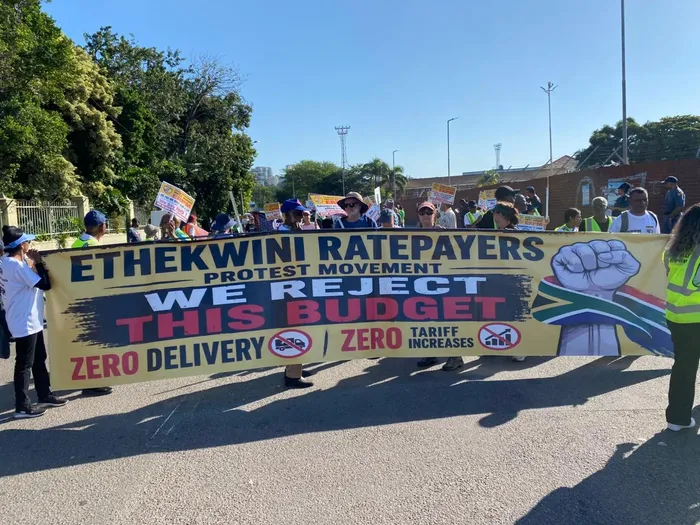
Members of the eThekwini Ratepayers Protest Movement take to the streets of Durban to raise their discontent with the proposed tariff increases for services put up by the eThekwini Municpality.
Image: Sipho Jack
A large number of Durban residents took to the streets on Wednesday in protest against the eThekwini Municipality’s proposed 2026/2027 budget and planned tariff increases, which they argued would place even greater financial strain on households already battling economic hardship.
The protest march, led by the eThekwini Ratepayers Protest Movement (ERPM) under chairperson Asad Gaffar, began at Curries Fountain Stadium before demonstrators made their way to the Durban City Hall, where a memorandum outlining their grievances was handed over to municipal officials.
At the centre of the protest was opposition to the municipality’s draft budget and proposed tariff hikes, which the ERPM described as financially unsustainable and inconsistent with sound municipal governance principles.
The organisation believes that the budget process was “non-compliant” with key legislative frameworks, including the Municipal Finance Management Act (MFMA) and the Municipal Systems Act (MSA).
Protesters further alleged that the municipality continued to suffer from financial mismanagement, weak budget oversight, and a lack of transparency.
In its memorandum, the ERPM claimed the proposed budget failed to adequately disclose expenditure linked to outsourced municipal services, including plumbing and electrical work, as well as spending on water tanker operations that many communities continue to rely on during ongoing supply disruptions.
Billing and metering issues also emerged as major concerns.
The movement said residents continued to face inaccurate and punitive billing practices, while more than 100,000 properties across the city allegedly remained unmetered.
According to the ERPM, consumer debt in the municipality had exceeded R35 billion, while key infrastructure systems were operating below required capacity.
“Despite increased spending, we continue to witness the collapse of essential services such as wastewater treatment and prolonged water outages,” said Gaffar.
He added that deteriorating municipal services had worsened broader social and economic pressures facing communities, including unemployment and the struggles confronting small businesses.
Durban Mayor Cyril Xaba recently met with ERPM leaders and acknowledged residents’ concerns regarding the proposed budget.
Xaba said the municipality had attempted to gather public input ahead of the finalisation of the budget and was working to limit tariff increases while aligning their plans with the Water and Sanitation Turnaround Strategy.
He also indicated that engagements were underway with ministers responsible for utilities in an effort to reconsider proposed increases and provide relief to residents.
However, several political and community leaders accused the municipality of failing to demonstrate genuine commitment towards easing the burden on ratepayers.
Zwelakhe Mncwango, an ActionSA leader, criticised what he described as the contradiction between rising tariffs and declining service delivery, while also raising concerns about financial mismanagement within the city.
Addressing protesters, Mncwango linked years of governance failures to the municipality’s current financial difficulties and called for the immediate withdrawal of the proposed budget.
He also demanded accountability from municipal officials and called for reforms aimed at improving transparency, restoring infrastructure, and rebuilding public trust.
“Residents cannot be expected to bear the burden of inefficiency and waste,” Mncwango said.
Gobizizwe Makhanya, the provincial organiser of the Umkhonto WeSizwe Party, said the proposed tariff increases did not reflect the views or needs of local communities.
Makhanya argued that the planned adoption of the budget lacked transparency and legitimacy.
“We are outright rejecting it with all the terms that it deserves,” he said.
He further claimed that the municipality was moving too quickly to permanently appoint senior officials, including deputy city managers and the chief financial officer, at a time when political changes could follow the upcoming local government elections in November.
Makhanya alleged that the municipality was rushing appointments in a manner that could undermine future administrative reforms.
“They have already started employing people on a permanent basis,” he said.
DAILY NEWS