

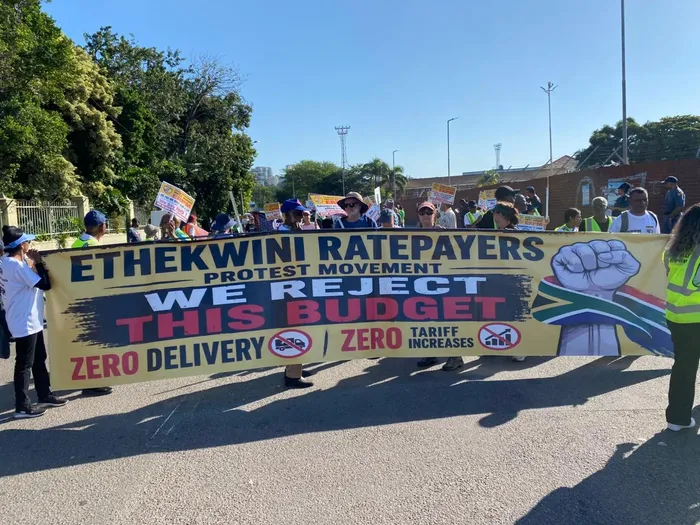
Members of the eThekwini Ratepayers Protest Movement take to the streets of Durban to raise their discontent with the proposed tariff increases for services put up by the eThekwini Municpality.
Image: Sipho Jack
Durban residents yesterday joined hands in a massive protest against the proposed 2026/2027 budget and accompanying tariff increases, voicing their dissent against what they termed a flawed financial plan that undermines municipal governance and service delivery.
Led by the eThekwini Ratepayers Protest Movement (ERPM) under chairperson Asad Gaffar, the demonstrators delivered a memorandum that captured a unified civic and multi-stakeholder position regarding the city’s budgetary decisions.
The core demands outlined by Gaffar and the ERPM included a complete rejection of the draft budget and any proposed tariff increases, labelling the current process as “noncompliant” with critical legislative frameworks such as the Municipal Finance Management Act (MFMA) and the Municipal Systems Act (MSA).
This sentiment resonated throughout the streets as residents presented evidence of budget integrity failures, financial mismanagement, and a glaring lack of transparency that they say has plagued the eThekwini Municipality.
Among the key findings highlighted in the ERPM's memorandum was the revelation that the budget lacked essential disclosures.
Vital areas of spending, including outsourced services for plumbing and electrical work, as well as expenditures on water tanker services that residents heavily depend on, were conspicuously absent.
Furthermore, the issue of billing and metering an ongoing crisis affecting over 100,000 unmetered properties was brought to the forefront, prompting outrage over inaccurate and often punitive billing practices.
The residents highlighted alarming trends, including skyrocketing consumer debt now exceeding R35 billion, and revelations of critical infrastructure operating well below capacity.
“Despite increased spending, we continue to witness the collapse of essential services such as wastewater treatment and prolonged water outages,” said Gaffar.
This has compounded existing social issues, as communities grapple with economic insecurities, escalating unemployment, and disappointing responses for small businesses.
In response to growing unrest, City Mayor Cyril Xaba convened a meeting with ERPM leadership, acknowledging the protestors' concerns.
He remarked on the efforts to solicit input from stakeholders ahead of the final budget presentation at the end of May, expressing commitment to incorporating community feedback into the financial plan.
Xaba detailed the city's ongoing attempts to curb tariff increases while aligning with the Water and Sanitation Turnaround Strategy.
He is currently advocating to the ministers responsible for utilities to reconsider proposed hikes, aiming for financial relief for the residents.
However, scepticism remains among community leaders like ActionSA’s Zwelakhe Mncwango, who highlighted the paradox of increasing tariffs amidst decreasing service delivery and rampant financial mismanagement.
Mncwango, addressing protestors, highlighted the connection between years of poor governance and the current budget proposal.
Critics are calling for immediate withdrawals of the budget and for key municipal officials to be held accountable for ongoing financial issues.
They demand substantial reforms that promote transparency, accountability, and a recovery plan for failing infrastructure.
“Residents cannot be expected to bear the burden of inefficiency and waste,” Mncwango stressed, reflecting the disappointment among citizens who feel ignored and unheard in their own city.
The protestors’ call for action echoes a broader demand for systemic change, underlining that they are ready to escalate their efforts if the concerns remain unaddressed.
Weighing on the issue provincial organiser for Umkhonto WeSizwe, Gobizizwe Makhanya, articulated the party's position during the protests, asserting that the proposed tariff increases do not reflect the needs nor the opinions of the local communities.
Makhanya emphasised that the planned budget introduction, intended for next week, lacks credibility and transparency.
“We are outright rejecting it with all the terms that it deserves,” he remarked, highlighting the party's determination to represent the voice of citizens within the region.
He further elaborated that the increases are inconsistent with prior consultations held with the communities of eThekwini, rendering the council’s intentions questionable.
Additionally, Makhanya expressed concerns over the municipality's push to solidify certain appointments, specifically those of deputy city ministers including the Chief Financial Officer (CFO), on a permanent basis.
Critically, he suggested that the ongoing transition has seen individuals hastily employed, potentially jeopardising the incoming administration's ability to implement change effectively.
“They have already started employing people on a permanent basis,” he stated, alluding to a sense of urgency and an apparent disregard for the changing political landscape as the elections loom on 5 November.