

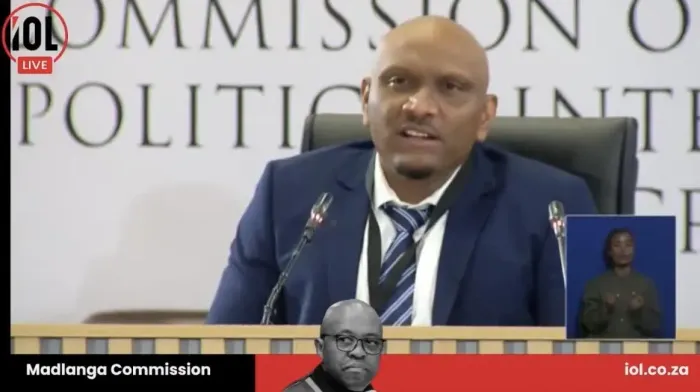
Hawks Colonel Gavin Jacob's testimony about R200 million drugs stored at the Hawks offices in KZN went missing scrutinised at Madlanga Commission.
Image: Image: IOL Screenshot
The Madlanga Commission heard that Colonel Gavin Jacob, who was later "polygraph cleared", interrupted his leave to join the 2021 operation that led to the seizure of 541kg of cocaine worth R200 million in KwaZulu-Natal, but a series of decisions he made after returning to duty have now come under intense scrutiny.
Jacob testified on Wednesday about his role in the operation that resulted in the major drug seizure. The cocaine was later stolen from a Hawks storage facility in Port Shepstone.
The commission heard that Jacob was on leave when he received information about the drug consignment and decided to return to duty to participate in the operation before later resuming his leave.
However, evidence before the commission revealed that he did not personally inform his commander, Colonel Campbell Nyuswa, of his decision to return to duty.
Instead, Jacob relied on a junior officer, Livingston Mpangase, to relay the message.
The decision drew sharp criticism from commission members and evidence leaders.
Evidence leader Advocate Mahlape Sello SC questioned why Jacob had not personally informed his superior of such a significant decision.
Co-commissioner Advocate Sesi Baloyi described the move as an "obvious irregularity".
"You were on leave, received information about the consignment, returned to duty and participated in the operation without speaking directly to your commander," Baloyi noted.
Pressed on why he delegated the responsibility to a subordinate, Jacob conceded he had no explanation.
Commission chairperson Justice Mbuyiseli Madlanga further questioned whether Jacob accepted that his conduct constituted an irregular procedural flaw.
Jacob acknowledged that it did.
The commission also examined Jacob's decisions during the operation itself, particularly the selection of individuals present and the handling of the seized cocaine.
Questions were raised about the presence of Nthutuko Khuzwayo, a man Jacob believed was representing customs officials during the operation at the Isipingo depot.
Jacob testified that he was under the impression that Khuzwayo was acting on behalf of customs authorities.
However, when questioned about the absence of official customs personnel during the breaking of the shipment's seals, Jacob confirmed that no customs officials were present.
Sello asked whether Khuzwayo's presence was intended to create the impression that customs authorities had authorised the process.
Jacob rejected the suggestion, arguing that any attempt at misrepresentation would have quickly been exposed.
Baloyi responded that the incident represented yet another instance in which Mpangase had provided misleading information to investigators.
The commission also focused on Jacob's decision to move the cocaine from the scene before it had been fully processed.
Jacob testified that after the drugs were offloaded from a shipping container at the Isipingo depot, he concluded there was insufficient space to conduct the operation safely and effectively.
"Upon offloading these bags, I noticed that the area we were working in was congested," Jacob told the commission.
"I realised that unpacking the bricks of cocaine would require more space than was available, and there was machinery moving around the area."
However, Hawks Serious Organised Crime Investigation head Hendrick Flynn previously testified that removing drugs from a crime scene before processing them was contrary to established procedure.
Jacob also admitted that he did not contact the SAPS Local Criminal Record Centre, which is responsible for documenting crime scenes and collecting forensic evidence.
He defended the decision, saying investigators lacked enough approved exhibit bags to process a seizure of that scale.
Jacob is expected to continue his testimony on Thursday.
DAILY NEWS