
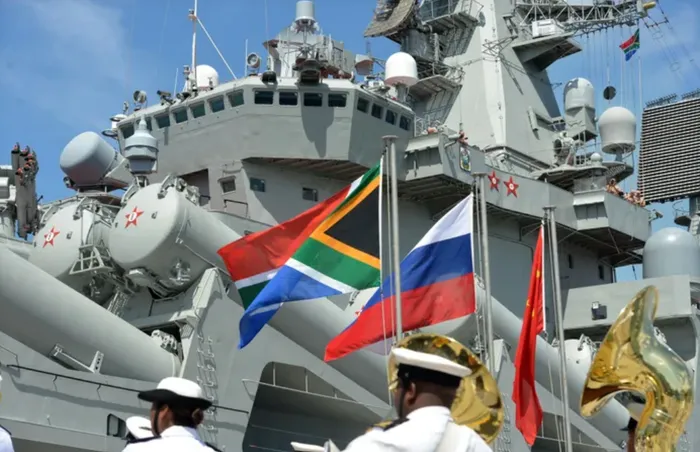
Senior SANDF leadership, including Joint Operations Headquarters commander Major General Godfrey Thulare, conducted briefings and walkabouts at Simon’s Town Naval Base on January 8, ahead of the China-led Exercise Will for Peace 2026, which runs from Friday until January 16 in South African waters.
Image: Internal
The world's oceans have always been corridors of power. Whoever controls the shipping lanes controls trade, energy, and ultimately the economic destiny of nations. For decades, that control has rested firmly in the hands of Western naval powers, the United States, the United Kingdom, and their NATO allies. But 2026 is looking like the year that arrangement faces its most serious challenge yet.
In recent months, the United States and France have seized oil tankers in international waters, citing sanctions violations. Britain has signalled it will follow suit. Meanwhile, NATO has openly discussed the possibility of a naval blockade in the Baltic Sea, a move that would effectively weaponise one of the world's busiest maritime corridors against Russia. Moscow has described these actions as an illegal maritime blockade in the making, a charge that carries real legal weight under international law.
For the BRICS+ nations, a bloc that collectively represents more than 40% of the global population and a rapidly growing share of world trade, these developments are not abstract. They are a direct threat to economic sovereignty and freedom of navigation. The response is beginning to take shape, and it is strategic.
The legal foundation for freedom of navigation is clear. The United Nations Convention on the Law of the Sea (UNCLOS), under Article 17, enshrines the Right of Innocent Passage, the principle that any vessel may pass through territorial waters or international shipping lanes provided it does so peacefully and without interference with the coastal state. This right applies to all ships, regardless of flag or cargo.
The seizure of tankers operating in international waters, on the basis of unilaterally imposed sanctions that have no backing from the United Nations Security Council, sits in deeply uncomfortable legal territory. Sanctions regimes created by one country or bloc of countries do not automatically carry the force of international law. When those sanctions are enforced through the physical detention of vessels on the open ocean, the line between enforcement and piracy (by strict legal definition), becomes dangerously blurred.
BRICS+ nations have consistently championed multilateralism and the primacy of international institutions over unilateral action. The current maritime tensions are, in many ways, a test case for that principle. If Western powers can seize vessels at will based on their own sanctions frameworks, the rules-based international order they so frequently invoke becomes a selective tool rather than a universal standard.
What gives the BRICS+ position genuine weight is not just the rhetoric, it is the hardware. Across the bloc's full membership, the combined naval picture is formidable.
China leads with 730 vessels, including three aircraft carriers, 61 submarines, and 53 destroyers, making it the largest navy in Asia and a genuine blue-water force capable of sustained global operations. Russia contributes 300 ships including 65 submarines and an extensive fleet of surface combatants hardened by decades of Arctic and Atlantic operations. India, with 145 vessels including two aircraft carriers, is the dominant naval power in the Indian Ocean region. Egypt fields the largest navy in Africa and the Middle East, with 320 ships. Indonesia's 245-vessel fleet is the mightiest in Southeast Asia.
Add in the specialised capabilities of Iran, Brazil, Saudi Arabia, the UAE, and South Africa, which hosts BRICS naval exercises off its own Cape coastline, and the combined BRICS+ fleet represents a credible counterweight to NATO's maritime dominance for the first time in the post-Cold War era. The 'Will for Peace 2026' joint exercises held off Cape Town in January, involving Russia, China, Iran, and the UAE, were not a symbolic gesture. They were a signal.
The call from within BRICS+ leadership for a full strategic maritime dimension to the bloc's cooperation is a logical evolution. Economic integration without the ability to protect the sea lanes that carry that trade is incomplete. As more BRICS+ nations deepen bilateral trade, denominate transactions outside the dollar system, and invest in each other's infrastructure, protecting those supply chains becomes a shared strategic interest not just a Russian or Chinese one.
This is not about aggression. It is about deterrence and the legal right to trade freely. A world in which one bloc can choke off another's energy exports by sea, without UN mandate and without legal consequence, is a world in which economic sovereignty is illusory. BRICS+ is making the case, with ships, with joint exercises, and with growing legal and diplomatic coordination that the oceans belong to all nations, not merely the most heavily armed ones.
Written by:
*Dr Iqbal Survé
Past chairman of the BRICS Business Council and co-chairman of the BRICS Media Forum and the BRNN
*Chloe Maluleke
Associate at BRICS+ Consulting Group
Russian & Middle Eastern Specialist
**The Views expressed do not necessarily reflect the views of Independent Media or IOL.
** MORE ARTICLES ON OUR WEBSITE https://bricscg.com/
** Follow @brics_daily on Twitter for daily BRICS+ updates and instagram @brics_daily