
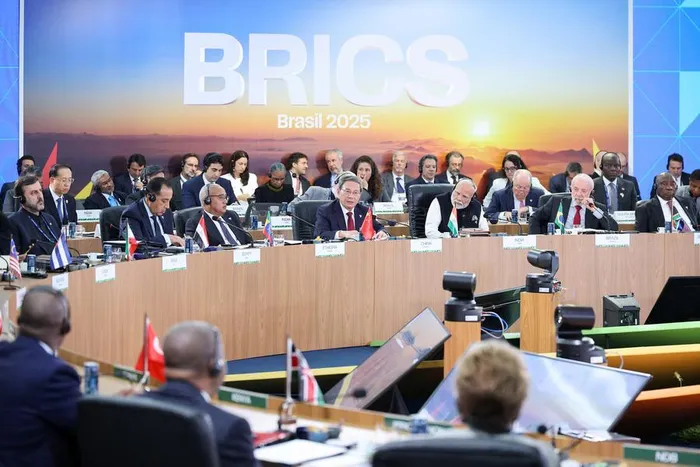
Chinese Premier Li Qiang addresses a plenary session of the 17th BRICS Summit.
Image: XINHUA
To understand why BRICS Pay matters, you first have to understand what it is pushing back against. For nearly eight decades, the international financial system has operated on a foundation built at Bretton Woods in 1944, a moment when much of the world was either rebuilding from war or still under colonial rule. The institutions that emerged from that conference, the International Monetary Fund (IMF) and the World Bank, along with the financial messaging network SWIFT that followed, were constructed to serve a particular economic order. That order placed the US dollar at its centre and kept it there.
Today, the dollar still accounts for roughly 54% of global foreign exchange reserves, down from 73% in 2001 but still the unchallenged dominant player. SWIFT links over 11,000 financial institutions worldwide and defaults to dollar-denominated settlement. For most of the post-war period, this arrangement was accepted as simply the way things worked. But the weaponisation of these systems, Russia's removal from SWIFT following the outbreak of the Ukraine conflict, sanctions regimes that can freeze entire national economies out of global trade at Washington's discretion, has stripped away any remaining pretence of neutrality. The message received across the Global South has been unmistakable. Access to the global financial system is a privilege, not a right, and it can be revoked. BRICS Pay is the most concrete collective response to that message.
At its heart, BRICS Pay is an effort to build a cross-border payment infrastructure that allows member nations to transact directly with one another using their own currencies, without routing those transactions through dollar-denominated systems or Western-controlled messaging networks. The architecture is designed to be decentralised and open-source, with each participating country running its own node while remaining interoperable with others. Transaction capacity is being built to handle up to 20,000 messages per second, with encryption and multi-factor authentication baked into the protocol.
Crucially, BRICS Pay is being designed to integrate the national payment systems that member states have already built. China's Cross-Border Interbank Payment System, known as CIPS, which already links 4,800 banks across 185 countries as of early 2025, forms one pillar. India's Unified Payments Interface, one of the world's most sophisticated real-time payment platforms, forms another. Brazil's Pix system, Russia's SPFS financial messaging network, and the UAE's growing digital finance infrastructure complete the picture. Rather than building something entirely from scratch, the framework stitches together existing national infrastructure into a coherent multilateral alternative.
The BRICS Unit adds a further dimension, a settlement instrument launched in pilot form in late 2025, backed 40% by gold and 60% by a basket of BRICS currencies, drawing on the collective gold reserves of member states that now exceed 6,000 tonnes. It is not a single currency and is not trying to be. It is, rather, a tool that allows Ethiopia to buy goods from China without first converting birr into dollars, a small but structurally significant change in how trade works.
The political will driving this project is real, even if uneven across member states. Russia, operating under the most severe Western sanctions of any BRICS member, has the strongest incentive of all. Russia and China settled 99.1% of their bilateral trade in rubles and yuan, a figure that would have seemed extraordinary a decade ago. Iran, long accustomed to building financial workarounds out of necessity, has pushed hard for cryptocurrency and digital currency mechanisms within the BRICS framework. Egypt confirmed in mid-2025 that its bilateral financial transactions with BRICS partners are increasingly denominated in local currencies.
The picture is not uniformly enthusiastic. India has historically opposed the idea of a common BRICS currency, wary of US trade retaliation, and Indonesia's government distanced itself publicly from de-dollarisation rhetoric following Trump's threat of 100% tariffs on BRICS nations pursuing alternative currencies. But there is a difference between rejecting a common currency, which nobody is seriously proposing at this stage and reducing reliance on the dollar for specific trade flows. On the latter, 90% of intra-BRICS trade now settles in local currencies, up from 65% two years ago. That is a structural shift, not a rhetorical one.
The significance of BRICS Pay extends well beyond the bloc's member states. With ten new partner nations added at the 2025 Rio Summit, including Nigeria, Malaysia, Vietnam, Uganda and Bolivia , BRICS+ now encompasses nearly 48 percent of the global population. For these countries, many of which have experienced firsthand how dollar dependency translates into economic vulnerability when currencies depreciate or interest rates rise in Washington, a functioning alternative settlement system would represent a genuine change in economic sovereignty.
The dollar's share of global reserves has fallen from 73% in 2001 to around 54% in 2025. That decline has not happened by accident. It reflects deliberate decisions by central banks around the world to diversify reserves, increase gold holdings, global central bank gold purchases have exceeded 1,000 tonnes annually since 2022 and seek bilateral arrangements that reduce exposure to US monetary policy decisions. BRICS Pay is the institutional expression of a trend already well underway at the national level.
The New Development Bank (NDB) reinforces this architecture from a different angle. Unlike the IMF, which attaches policy conditions to its lending, the NDB extends credit in local currencies without demanding structural adjustment programmes. A third of its loan portfolio is now denominated in member-state currencies, a quiet but meaningful departure from the dollar-denominated debt trap that has constrained developing economies for generations.
The global financial system is not about to be remade overnight. The dollar's structural advantages, liquidity, institutional trust, the depth of US capital markets, will not disappear because BRICS Pay goes live. But the direction of travel is set. Emerging economies are no longer asking permission to participate in global finance on their own terms. They are building the infrastructure to do so. And in a world where financial access has been repeatedly used as a geopolitical weapon, that is not merely an economic development. It is an act of sovereignty.
Written by:
*Dr Iqbal Survé
Past chairman of the BRICS Business Council and co-chairman of the BRICS Media Forum and the BRNN
*Chloe Maluleke
Associate at BRICS+ Consulting Group
Russian & Middle Eastern Specialist
**The Views expressed do not necessarily reflect the views of Independent Media or IOL.
** MORE ARTICLES ON OUR WEBSITE https://bricscg.com/
** Follow @brics_daily on Twitter for daily BRICS+ updates and instagram @brics_daily