
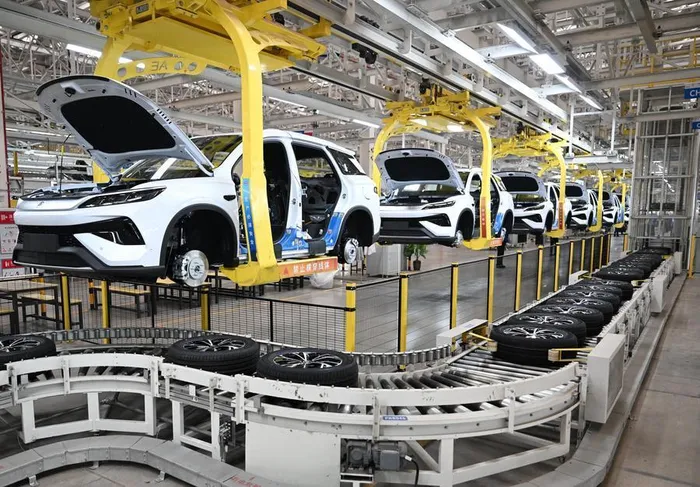
New energy vehicle (NEV) assembly line of BYD
Image: XINHUA
Indian automaker Mahindra & Mahindra has selected Israeli supplier Mobileye as the Tier-1 provider of advanced driver-assistance systems (ADAS) for at least six upcoming vehicle models scheduled for production from 2027, underscoring intensifying competition in automotive technology as global markets show mixed demand signals.
Under the agreement, Mahindra will integrate Mobileye’s SuperVision and Surround platforms, both powered by the EyeQ6 High system-on-chip, consolidating perception, mapping, driver monitoring, parking assistance, and driving functions into a single electronic control unit. SuperVision uses an array of 11 cameras, optional radar sensors, and dual processors to enable point-to-point navigate-on-pilot capability in defined conditions, while Surround employs five cameras, multiple radars, and a single processor to support hands-off but eyes-on motorway driving in specific scenarios. By replacing multiple ECUs with a unified architecture, the systems are intended to improve efficiency and streamline vehicle electronics.
The collaboration builds on earlier projects between the two firms using earlier-generation chips that achieved strong safety ratings domestically. According to Mobileye chief executive Amnon Shashua, the expanded partnership reflects Mahindra’s commitment to advanced safety technologies and reinforces India’s growing importance as a localisation and production hub for ADAS solutions. Rising consumer demand for safety features and regulatory initiatives such as India’s Bharat New Car Assessment Programme are expected to accelerate adoption rates toward levels seen in developed markets later in the decade.
While manufacturers invest heavily in future technology platforms, sales data from China, the world’s largest car market, highlights a more cautious near-term outlook. Figures compiled by the China Passenger Car Association show passenger-vehicle retail sales edged up slightly year-on-year to about 1.858 million units in January 2026. The modest increase was partly due to calendar effects, as the Lunar New Year fell in February this year, creating more working days in January than in the previous year.
The improvement follows three consecutive months of declining sales, including a 14% drop in December 2025, suggesting the market may be approaching saturation amid cautious consumer sentiment. China’s economy expanded 4.5% year-on-year in the fourth quarter of 2025, down from 4.8% in the previous quarter, reflecting weaker spending and investment even as manufacturing and exports remained resilient despite ongoing trade tensions with the United States.
New-energy vehicles, mainly battery electric and plug-in hybrids, accounted for roughly 44% of January sales, rising 2% year-on-year to about 800,000 units, though down 16% from December. The government has confirmed continuation of its vehicle trade-in subsidy programme in 2026 to stimulate consumption but has reduced purchase tax incentives for such vehicles from a full exemption to a 50% discount. Analysts at GlobalData forecast overall light-vehicle retail sales in China will grow only 2.7% in 2026 before declining 4.2% in 2027 as incentives lose effectiveness.
The contrast between rising investment in advanced driving technology and subdued market growth illustrates a broader industry transition: automakers are preparing for a more technologically sophisticated future even as present-day demand remains uneven. Partnerships like the Mahindra–Mobileye deal signal that manufacturers increasingly view software, sensors, and intelligent driving systems as decisive competitive differentiators rather than optional upgrades.
*Cole Jackson
Associate at BRICS+ Consulting Group
Russian & Middle Eastern Specialist
**The Views expressed do not necessarily reflect the views of Independent Media or IOL.
** MORE ARTICLES ON OUR WEBSITE https://bricscg.com/
** Follow @brics_daily on Twitter for daily BRICS+ updates and instagram @brics_daily