

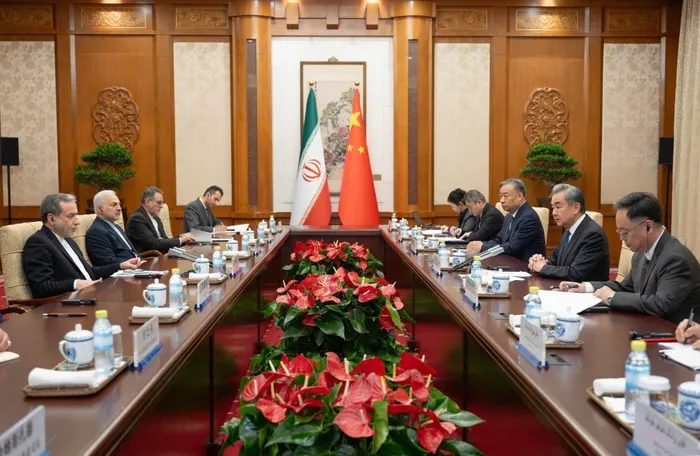
Chinese Foreign Minister Wang Yi, also a member of the Political Bureau of the Communist Party of China Central Committee, holds talks with Iranian Foreign Minister Seyyed Abbas Araghchi in Beijing, capital of China
Image: XINHUA
Despite diplomatic efforts to secure a lasting settlement, tensions remain high as President Donald Trump intensifies pressure on Tehran to accept a new agreement tied to the reopening of the Strait of Hormuz. The conflict has disrupted global energy supplies, pushed up oil prices and contributed to economic uncertainty across Asia and Europe, even as China’s economy posted stronger-than-expected growth in the first quarter of 2026.
The US military fired on an Iranian oil tanker in the Gulf of Oman on Wednesday, damaging the vessel’s rudder after Washington accused it of attempting to breach an American naval blockade around Iranian ports. US Central Command said the strike was carried out by a fighter jet as part of efforts to enforce maritime restrictions imposed during the conflict.
The incident occurred despite an official ceasefire between Washington and Tehran, highlighting the volatility of the situation. President Donald Trump warned Iran that a broader bombing campaign could resume if Tehran failed to agree to a proposed deal aimed at ending the war permanently and reopening the strategically vital Strait of Hormuz.
Trump claimed on social media that disrupted oil and gas shipments could soon resume if Iran accepted the proposed terms. “If they don’t agree, the bombing starts,” he warned.
While the Middle East conflict continues to unsettle global markets, China reported stronger-than-expected economic growth during the first quarter of 2026. Official figures showed China’s gross domestic product expanded by 5% year-on-year, surpassing forecasts of 4.8% and recovering from the previous quarter’s 4.5% growth.
The expansion came despite the severe disruption to global energy supplies caused by the Iran war, which began on 28 February. Manufacturing and exports, particularly vehicles and electronics, helped drive the rebound, although economists cautioned that the full economic impact of the conflict may only become visible in coming months.
The latest figures marked the first GDP release since Beijing lowered its annual growth target to between 4.5% and 5%, its weakest target since 1991. Chinese authorities have pledged increased investment in innovation, high-tech manufacturing and domestic consumption as part of the country’s latest Five-Year Plan.
China’s economy continues to face mounting pressure from both the Iran conflict and broader global trade tensions. Rising oil prices linked to threats against shipping through the Strait of Hormuz have increased fuel and transport costs across Asia, affecting industries reliant on imported energy and raw materials.
Although China is less dependent on Gulf oil than Japan or South Korea, the impact is already being felt domestically. Petrol prices have risen, airlines have reduced flights due to higher jet fuel costs and manufacturers are facing increased production expenses linked to more expensive oil-derived materials such as plastics.
At the same time, China remains exposed to US trade policies. Most Chinese goods still face a 10% American tariff, with US Treasury Secretary Scott Bessent indicating that higher tariffs struck down by the Supreme Court could potentially return by July.
Fresh trade data released by China showed export growth slowing sharply in March as the war contributed to rising inflation and weaker consumer demand worldwide. Chinese exports increased by just 2.5% compared to a year earlier, a significant decline from the more than 20% growth recorded during January and February.
Imports, however, surged by nearly 28%, reflecting higher global costs driven largely by energy disruptions. China’s monthly trade surplus consequently fell to just over $50 billion, its lowest level in more than a year.
Analysts warn that the conflict’s long-term impact on global consumer spending could place additional pressure on China’s export-driven economy. Economists noted that continued instability in energy markets and weaker international demand may undermine Beijing’s efforts to sustain strong growth throughout the rest of 2026.
Written by:
*Dr Iqbal Survé
Past chairman of the BRICS Business Council and co-chairman of the BRICS Media Forum and the BRNN
*Cole Jackson
Lead Associate at BRICS+ Consulting Group
Chinese & South America Specialist
**The Views expressed do not necessarily reflect the views of Independent Media or IOL.
** MORE ARTICLES ON OUR WEBSITE https://bricscg.com/
** Follow @brics_daily on Twitter for daily BRICS+ updates and instagram @brics_daily