

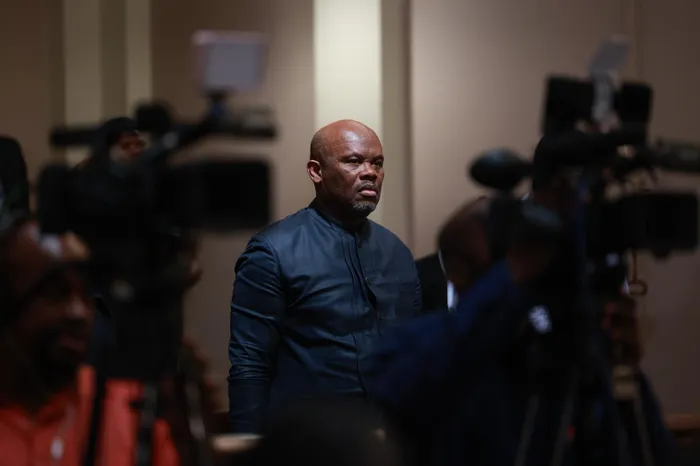
Top cop Shadrack Sibiya in court where he is challenging the order for his to stay-at-home.
Image: Oupa Mokoena / Independent Newspapers
The stay-at-home order issued by Police Commissioner Fannie Masemola to Deputy National Police Commissioner Lieutenant-General Shadrack Sibiya is a disguised precautionary suspension, Sibiya’s advocate on Wednesday argued before the Gauteng High Court, Pretoria.
Advocate Kameel Premhid SC argued before a full bench (three judges) that Masemola’s order for Sibiya to stay home “looks and smells like a suspension”.
He also questioned Masemola’s claim that the order was given as to save Sibiya embarrassment while claims of misconduct were being investigated against him.
According to Masemola, the investigation has been concluded and an independent arbitrator will adjudicate in Sibiya’s disciplinary hearing.
But Premhid questioned why, if the investigation has been concluded, Sibiya is not allowed to return to office.
Sibiya turned to court for an urgent order to return to work after being forced to stay at home, pending an investigation and to interdict Masemola from instituting a process parallel to the judicial commission of inquiry into criminality, political interference, and corruption in the criminal justice system established by President Cyril Ramaphosa and chaired by retiring Acting Deputy Chief Justice Mbuyiseli Madlanga.
Sibiya has asked the court for an order declaring that Masemola’s decision to direct him to “stay at home, pending an investigation” unlawful and for it to be set aside.
Alternatively, Sibiya is seeking an order stating that his stay at home is suspended pending the outcome of the commission.
In addition, Sibiya wants Masemola to be interdicted from instituting parallel proceedings against him, as he argues that it could lead to double jeopardy and unfairness towards him, as the commission is already tasked to investigate the allegations of political interference and corruption levelled against him.
Premhid argued that the terms and reference of the commission include recommending disciplinary procedures against those who are implicated in any wrongdoing. Thus, he said, there is no need for a disciplinary hearing as well.
Premhid told the court that Masemola will be part of the internal disciplinary proceedings against Sibiya if it was allowed to go ahead, which would be untenable, as Masemola will be both accuser, judge, and executioner.
He further argued that Masemola in any event did not have the powers in law to order Sibiya to stay at home. He conceded that the police chief has the power to discipline his members, but as this matter was not an ordinary employer/employee matter, Masemola acted outside his powers, the court was told.
While Premhid maintained that staying at home equalled suspension, he conceded following a question by Judge Norman Davis that this did not impact Sibiya’s salary, security, and other employment perks.
The issue of the 121 task team dockets were mentioned briefly when Judge Davis asked: “What does your client say should happen to the 121 dockets?”
Premhid responded that there is nothing Sibiya can do, as he is told to stay home and outside the operational remit.
Advocate Fanus Coetzee, meanwhile, argued on behalf of Masemola that as chief of the SAPS, Masemola was perfectly entitled to order his second in command to stay home, while the allegations against him are being investigated and it would, in fact, be expected of the commissioner to do so.
He made it clear that Sibiya is not suspended and nor will he be prejudiced if the disciplinary hearing went ahead before an impartial adjudicator.
Coetzee said such a hearing should be expedited in light of the tense relationship between Masemola and Sibiya. The relationship must either be restored or ended, but they must know where they stand, Coetzee said.
Judgment reserved.