
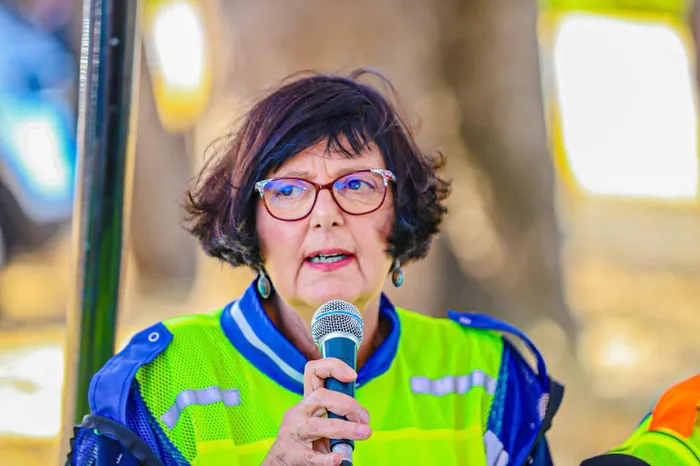
Transport Minister Barbara Creecy has warned that dangerous driving behaviour continues to claim lives, with 505 people killed on South Africa’s roads so far.
Image: Facebook/Department of Transport
Transport Minister Barbara Creecy says the start of the 2025 festive season has recorded fewer fatal crashes than last year, with 505 deaths so far, but she has expressed concern that the average of 32 fatalities per day remains unacceptably high.
Creecy was briefing the media in the Western Cape on Friday, December 19, during a mid-term review of the 2025 Festive Season Road Safety Campaign, which began at the start of December.
She said preliminary data show a positive downward trend in road fatalities compared with the same period last year.
“There is a decrease in the number of deaths this year. At this stage of the 2025 festive season, early road fatalities have declined compared to the same period last year,” Creecy said.
According to preliminary reports, fatal crashes declined by 20.9% and fatalities by 20.8% during the period December 1 to 16, following intensified law enforcement, road safety education and public messaging.
However, Creecy warned that the early improvement masks the continued reality of road trauma across the country.
“Preliminary reporting confirms that holiday crashes continue to claim lives. In the Western Cape alone, 66 people were killed in 55 crashes in the first half of December,” she said.
She said 1,328 education and awareness programmes have already been conducted nationwide, yielding some success, but added that much work remains.
While Gauteng managed to reduce crashes by 12%, it remains the highest contributor to the national death toll.
In the province, 105 people were killed in 95 crashes. KwaZulu-Natal recorded 88 fatalities in 85 crashes.
The Eastern Cape reported 52 fatalities in 45 crashes, Mpumalanga 69 fatalities in 50 crashes, North West 34 deaths in 28 crashes, Limpopo 40 road deaths in 34 crashes and the Northern Cape 31 road deaths in 20 crashes.
The Free State was the best-performing province, recording a 67.2% decrease in fatalities.
Major crashes dropped from 40 during the same period last year to 19 this year, while road deaths fell from 61 to 20.
Nationally, fatal crashes declined from 545 last year to 431 this year.
The number of lives lost dropped from 638 to 505, meaning 113 lives were saved through law enforcement, awareness and education initiatives, Creecy said.
She said that pedestrians remain the most vulnerable road users, accounting for 44% of fatalities. Passengers contributed 28%, drivers 26% and cyclists 2%.
The leading causes of fatal crashes were incidents involving pedestrians, hit-and-run crashes, single-vehicle rollovers and head-on collisions.
Creecy cautioned that the most dangerous travel days are still ahead, with heavy traffic volumes expected over Christmas and New Year, as well as during the first weekend of January when holidaymakers return to cities for work and school.
Despite strong enforcement, Mpumalanga and the Northern Cape recorded year-on-year increases in fatalities, highlighting persistent risky behaviour on the roads.
“Alcohol misuse, speeding, fatigue and unsafe pedestrian behaviour remain the dominant risk factors. Heavy rainfall and thunderstorms during the review period also had a devastating impact,” she said.
Since the start of the festive season, authorities have intensified operations, stopping more vehicles than during the same period last year.
A total of 639 roadblocks were conducted, during which 714,371 vehicles were stopped and checked.
Police issued 168,427 traffic fines, discontinued 3,695 unroadworthy vehicles and impounded 2,552 public transport vehicles for permit violations.
A total of 2,364 drivers were arrested for drunken driving, 236 for excessive speeding and 178 for reckless or negligent driving.
Fifty-three pedestrians were arrested for jaywalking on freeways, while 26 motorists were arrested for attempting to bribe traffic officers.
Overall arrests increased by 16.2% compared with last year, with drunken driving arrests nearly doubling, rising by 97.8%.
Creecy said pedestrian arrests dropped by 57.9%, while speeding arrests declined by 7.8%, which she attributed to increased law enforcement visibility.
The highest recorded speed was in Gauteng, where a female driver was caught travelling at 193km/h in a 120km/h zone.
In the Eastern Cape, a man was arrested after registering a breath alcohol level of 2.38mg per 1,000ml - ten times the legal limit.
As the country approaches the peak travel period, Creecy said the government will adopt a zero-tolerance approach to lawlessness on the roads.
“Enforcement will be firm, visible and consistent because every life matters,” she said.
“We will maintain 24-hour high-visibility patrols, conduct daily alcohol operations and focus on areas with high pedestrian activity.”
She added that while coordinated enforcement efforts have helped save lives, sustained behavioural change remains critical to achieving long-term road safety.
IOL News