

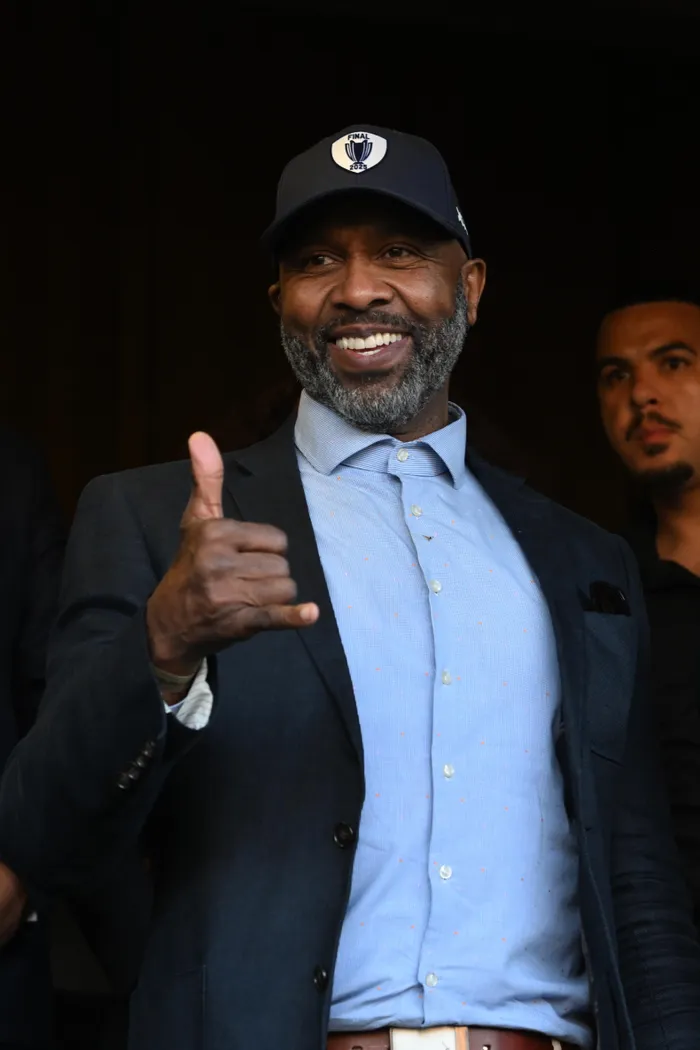
Lucas Radebe reflects on his journey: From Bafana Bafana to family life and SAFA presidency.
Image: Backpagepix
After the school bell rang in Diepkloof, Soweto, a little Lucas Radebe did not immediately go home.
Instead, the then six-year-old went to play football with some of his friends in the township during the dark days of apartheid.
Now, five decades later, Lucas Radebe can hardly believe he went on to captain both SA's national team at the FIFA World Cup in 1998 and 2002, as well as Leeds United in the English Premier League.
"That is where it all started," Radebe, 56, told IOL on Wednesday.
“Playing in the township sharpened my skills.
"You learn to play in short, narrow spaces, and my friends and I were just enjoying ourselves, honestly."
In the townships during apartheid, violence was part of daily life, and opportunities were limited.
Football gave many young people something to hold on to.
For Radebe, his relationship with the game was formed on small fields where structure was scarce, and temptation was everywhere.
“To be honest, we started the clubs in the townships,” Radebe said.
“Diepkloof Wolf Wanderers was one of the clubs that I studied at.
"It was just to keep busy and, you know, to make sure that I didn’t get led astray or get into mischief after school or during free time.”
He said those early playing conditions had a direct influence on how players developed.
“But I think that, to be honest, that’s where it all started shaping our football,” he said.
“Obviously, playing in the township, you don’t want to play the ball into windows.
"You have to keep the ball on the floor, sharpening your skills in short, narrow areas, and just enjoying ourselves, honestly.”
After his time at Wolf Wanderers, Radebe moved to ICL Birds between 1987 and 1988, then to the Kaizer Chiefs Juniors, before making his senior debut for Kaizer Chiefs in 1989.
He later became an icon and captain at Leeds United from 1994 to 2005, and captained South Africa at the 1998 and 2002 World Cups.
Reflecting on the national team years, Radebe said players came to understand what representing the country meant.
“I think at that time we had a few players who had developed into quality competitors, especially when it came to international football, where we realised the importance of participating and representing our country.”
That understanding was reinforced when South Africa hosted the Africa Cup of Nations, or Afcon, for the first time in 1996.
“For us, it was a great honour as individuals coming together to be part of this great spectacle, which was a historic moment for South Africa hosting the Afcon for the first time on home soil,” he said.
Afcon is Africa’s biggest international men’s football tournament.
It is organised by the Confederation of African Football (CAF) and is contested by national teams from across the continent.
The tournament is usually held every two years, with countries qualifying through regional matches, and it determines the African champions while also serving as a major stage for players to showcase their talent at international level.
He described the tournament as part of a broader moment for the country.
“Hosting and inviting the whole continent to come and celebrate with us, the reconstruction of the newly formed South Africa, was, for me, the start of great things,” Radebe said.
“It was about seeing SA develop into a powerhouse in African football and being able to produce individuals who competed abroad and put South Africa on the map.”
He said the presence of the late former president Nelson Mandela added to the significance.
“With the likes of Madiba being there — Madiba Magic — we were so proud to be able to participate and actually win the trophy.”
Radebe also reflected on players from earlier generations.
“We realised as footballers that if things had happened earlier, with the likes of Ace Ndini, who was late, Gilliam Connors and all those players having had the opportunity, things would have been different,” he said.
“But for us, it was a great presentation on behalf of those players who didn’t get that chance, and also a way to take South Africa forward in the football world, to make sure that we created opportunities.”
He said giving back to the game remained important to him.
“I’ve always wanted to give back to South African football because I think we are who we are because of South African football,” Radebe said.
“We started playing for the national team and served in the national team for so long, with great accolades in the colours of South Africa.”
Bafana Bafana have qualified for the 2026 FIFA World Cup in North America, marking their first qualification since 2010 and their first through the qualifying process since 2002.
They secured their place with a 3-0 win over Rwanda in October 2025 that ensured they topped Group C in CAF qualifying.
Their World Cup campaign will open against co-hosts Mexico on 11 June at the Estadio Azteca in Mexico City.
South Africa’s group also includes South Korea and a UEFA playoff team, with matches scheduled to continue through late June.
Before the World Cup, Bafana competed at the 2025 Africa Cup of Nations in Morocco but were eliminated in the last 16 by Cameroon last month.
Speaking about the current state of the game, Radebe said progress was necessary.
“It’s absolutely amazing, and I do understand that our football needs to progress. We need to take a step to another level,” he said.
“Hopefully, we need someone who will actually take us to that level and bring the glory days back — not just on the football field, but behind closed doors in African football.
"Bring back credibility and respect.”
On coaching and team structures, he said: “I think, obviously, behind every success in football or in every team, you can’t be a great coach on your own.
"He’s not an individual — he has his technical staff, who have done wonders to form a team that can participate and compete at that level and bring back hope and success to the team.”
He added: “I think Hugo Broos, with the help of Helman and the technical staff, has done absolutely fantastically to bring together individuals who have now brought hope and happiness to South African football.”
However, he said consistency remained important.
“One thing that has been missing in this game is consistency," he said.
"Never mind the success of winning games, but consistency in players who represent us.”
Radebe also spoke about life beyond football, particularly family.
“As a footballer, you’re a human being.
"You grow up to become a responsible adult, a family man, which I think deserves great respect,” he said.
“There’s a lot of sacrifice in terms of time spent with family and giving the family what is needed,” he said.
“But you try your best to make sure the kids grow up with a present father.”
Radebe has been married twice.
His first wife, Feziwe, died of cancer in October 2008.
She and Radebe had two children together, a son and a daughter.
At the time of her death, their son was Lucas Hugo and their daughter was Owami.
Radebe married his second wife at the end of 2015.
In addition to his two older children, he also has a younger son, Kutlwano, who has pursued football opportunities, including trials in Spain with Sporting Gijón.
His other child Ofentse "Primo" is a social media content creator,
He said he now prioritises time at home.
“At the moment, I make sure I spend as much time as possible with my family,” Radebe said.
“Now is the time to give more time to family than anything else and make sure the kids grow up appreciating and being an example.”
Looking to the future, he said the responsibility of footballers extended beyond the pitch.
“We’re not just footballers — we’re human beings, parents, sisters and brothers,” he said.
“We need to represent ourselves properly on and off the field because people look at you differently.”
On the women’s game, Radebe said growth was clear.
“For me, women’s football is ever-growing, and the talent is there,” he said.
“We’ve seen what Banyana Banyana have achieved, along with sponsorships and collaborations, which bring respect to South African women’s football.”
Radebe has been discussed in South African football circles as a potential candidate to lead the South African Football Association (SAFA).
Supporters from groups including the South African Masters and Legends Football Association have publicly backed the idea of Radebe challenging long-serving SAFA president Danny Jordaan at the elective congress later in 2026, seeing him as a figure who could bring change and leadership rooted in football experience.
"For me, everything happens for a reason, and everything has to change at some point," he said.
Asked to describe Bafana Bafana in everyday terms, Radebe reached for a familiar South African image.
“If Bafana Bafana were a person at a braai, they would be me, and they'd have all sorts of meat on the grill,” he said, laughing.
IOL News