

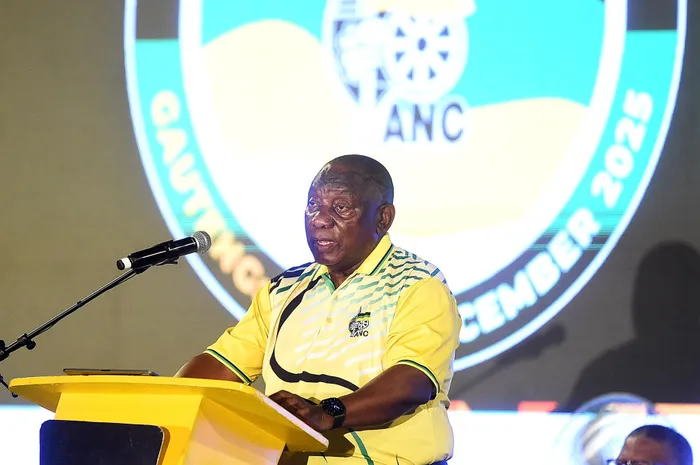
President Cyril Ramaphosa delivers the President's Political Overview at the 5th ANC National General Council in Boksburg.
Image: Itumeleng English / Independent Newspapers
President Ramaphosa’s Political Overview to the 5th National General Council was calm, dignified and sincere. He rightly condemned white supremacist narratives, named the dangers of corruption and factionalism, and called for renewal and unity. He reminded us of the historic weight of the ANC and the hard-won gains of democracy.
But we must be honest with one another: this is not the first time we have heard this speech.
For more than a decade our conferences, lekgotlas and NGCs have opened with overviews that list the same achievements, warn about the same threats, and repeat the same phrases: unity, renewal, discipline, going back to the people. If the diagnosis remains shallow and repetitive, the prescription will remain weak. A movement that once specialised in strategy has become stuck in recitation.
This NGC needs something different: not another wish list, but a clear theory of change; not another catalogue of priorities, but a National Development Strategy that can align the state, the economy and the people around one historic task.
The President is right to highlight poverty, inequality and unemployment. But the Political Overview treats them mainly as consequences of corruption, poor governance and organisational decay. These are real, but they are not the root.
The deeper problem is structural: South Africa still sits on an outdated productive base commodities out, consumption in. A low-skill, low-productivity, import-dependent economy cannot absorb labour at the scale our people need. It reproduces mass unemployment, township precarity and racialised inequality, no matter how many anti-corruption statements we issue.
Until the ANC names this as the central contradiction of the current phase, we will continue to treat symptoms instead of transforming the underlying structure. PUT SIMPLY:
The Political Overview lists many important programmes: infrastructure, NHI, energy reform, industrial policy, social protection. On paper it looks impressive. But lists are not strategy.
A Strategy of National Development answers three simple questions:
Without this, every department pushes its own plan, every MEC announces its own “flagship”, and the centre manages coordination through meetings and speeches instead of hard choices.
In the 1980s and early 1990s, our movement understood this. We were trained that liberation rests on three pillars: ideology, strategy, organisation in that order. Today, we talk mostly about organisation and behaviour, as if branch meetings alone will save us.
The President spends substantial time defending the Constitution and democratic institutions against both right-wing and populist attacks. That is necessary. But comrades, we must also be clear: we have a democracy. The courts sit. Chapter 9 institutions function. Commissions grill ministers. Parliament holds inquiries. Civil society, media, unions and communities speak out every day.
The historical question now is: What do we do with this democracy?
We need to shift the centre of gravity of our politics:
The Political Overview defends Phase 1 achievements, but it does not decisively launch Phase 2. It warns of threats to democracy, but it does not focus the movement on the strategic work of development.
The President correctly acknowledges state capture, tender corruption and criminality in our ranks. But he frames the crisis mainly as a moral and organisational problem: bad ethics, weak discipline, poor deployment.
Yes, ethics matter. But strategically, the real danger is that the state itself has become a liability, hollowed out by capital’s logic of outsourcing, privatisation, middle-man tenderisation, and patronage networks that sit between the fiscus and the people. A captured and fragmented state cannot drive industrial policy, cannot build infrastructure at scale, and cannot protect communities from mafias.
Capital, too, has played its part preferring a weak, procured-out state that buys services rather than builds capacity. The ANC leadership often confuses “efficiency” with outsourcing, and “partnerships” with dependency.
This NGC must recover a simple liberation insight: the democratic state is one of our two primary power bases alongside the organised people. If that state is hollowed out, the NDR is disarmed.
In many sections, the Political Overview speaks understandably about renewal, discipline, corruption and internal culture. But ideology is now thin: reduced to anti-corruption slogans, generic references to the Freedom Charter, and moral appeals.
We need to re-anchor ANC ideology around national development as the central task of this phase:
This is fully consistent with the Freedom Charter, Alliance positions and earlier NGC resolutions. It does not replace questions of class, race or gender; it organises them around a material project.
The Political Overview notes declining support and calls for “door-to-door” and “going back to basics”. That is necessary but not sufficient.
We are losing the narrative war especially among the youth:
A modern War of Position requires three things:
Without this, even the best policy will die in the noise.
What should replace repetition?
This NGC should instruct the movement and government to consolidate a National Development Strategy (NDS) with a small number of non-negotiable pillars that every commission, department and province aligns to. For example:
1. Productive Transformation & Industrial Skills Revolution
2. State Capacity Rebuild
3. Township and Rural Industrial Corridors
4. Integrated Anti-Mafia and Procurement Reform
5. Digital and AI-Enabled Public Administration
These are not slogans. They are choices. They will offend some interests. But strategy without trade-offs is not strategy it is public relations.
To ANC delegates:
Let’s reflect and deepen the President’s Political Overview. You must. Take its best elements condemnation of corruption, defence of democracy, call for renewal and anchor them in a concrete National Development project that can be felt in Khayelitsha, uMlazi, Galeshewe and Giyani.
To South Africans who are not ANC members:
You are right to be angry, sceptical, even exhausted. But understand this: unless the governing movement adopts a clear, credible development strategy and cleans up both state and party, no reshuffling of coalitions will fix the structural crisis. FACT!
The line in the sand at this NGC is therefore not about personalities or slates. It is about historical direction.
* Faiez Jacobs is a former Member of Parliament, founder of The Transcendence Group, Capetonian, Activist, and Servant of the People.
** The views expressed do not necessarily reflect the views of IOL or Independent Media.