

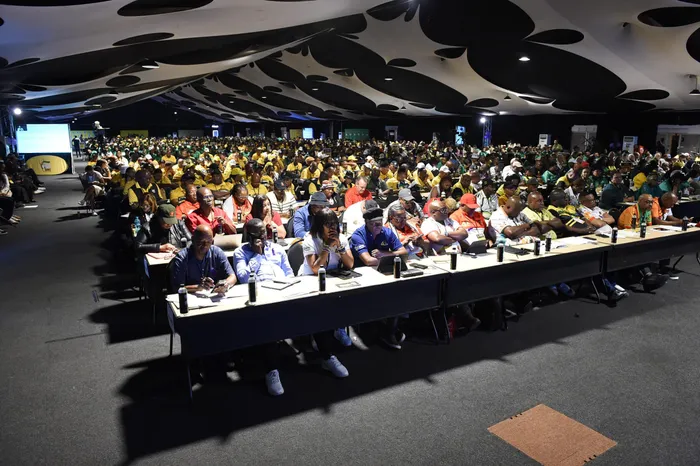
Delegates attend the 5th ANC National General Council in Boksburg.
Image: Itumeleng English / Independent Newspapers
South Africans are living a hard truth that our documents sometimes tiptoe around.
We won political rights. We stabilised key macro indicators. We built institutions that, despite everything, still function. Yet for the majority, daily life still feels like survival, not freedom.
That is because we are trying to carry a democratic project on top of an economic structure designed for extraction, not inclusion. A century-old production system is being asked to deliver 21st-century justice. It cannot. It will not. And this is not what we struggled for.
We must finally say it clearly: unless we reorganise the way South Africa produces, works and invests, every promise of “renewal” will be cosmetic.Economic transformation is the heart of the National Democratic Revolution in this phase.
Across ANC, SACP and COSATU documents, and in the Economic Transformation Commission’s own midterm reflections, the diagnosis converges:
South Africa’s economy still rests on a narrow base of minerals, finance, capital-intensive manufacturing and imported consumption, with townships and rural areas locked into low-productivity, informal activity. This produces four reinforcing outcomes:
The President’s Political Overview correctly notes poverty, inequality and unemployment. But unless we name the root cause a stagnant production structure we will keep treating symptoms and calling it strategy.
A political movement cannot renew itself on top of a broken economic engine.
For years our economic discussions have collected good ideas without turning them into a single, disciplined mission. We repeat the shopping list: localisation, industrialisation, township economy, SMMEs, beneficiation, green economy, continental and regional trade…All are valid. None will work alone. Our historic mission is not a shopping list. It is a strategic choice. The choice this NGC must make is simple:
Will the ANC lead a deliberate National Development Mission to restructure production, or will we continue to manage decline with fragmented programmes and hopeful rhetoric? This next phase of our democracy requires one clarifying idea:
Phase 1 (1994–2024): The people shall govern.
Phase 2 (2024–2040): We can frame it this way:
Democracy gave people a voice. Development must now give them power. The PEOPLE shall DEVELOP.
Economic transformation cannot be outsourced to the market, consultants or mafias.
The SACP has been consistent: state capture was not only theft; it was the hollowing out of the very machinery needed for development. COSATU has been clear that austerity, privatisation by stealth and tenderisation have eroded the state’s ability to plan, build and maintain. A National Development Mission requires:
South Africa cannot shop its way out of inequality. We must make things, grow things, and design things in townships, small towns, metros and regions. Three pillars can guide this shift.
Townships are often treated as vote reservoirs and grant recipients. In reality, they are dense economic ecosystems starved of infrastructure, finance and industrial support.
This NGC should back a clear township industrial agenda:
REMEMBER LEADERSHIP: “A township is not a queue. It is an economy.”
At the same time, South Africa must place itself inside the value chains of the future, not just the past. Priority sectors could include:
The Economic Transformation Commission has already begun identifying opportunities and constraints in these sectors; the NGC must translate into mandates and deadlines, not just note the report.
About R1.4 trillion rand in public procurement flows through the state each year. If this is treated as mere “spend”, criminal networks and middlemen will continue to siphon it off. If it is treated as industrial policy, it becomes our biggest factory. Key moves:
COSATU’s resolutions remind us that workers cannot be asked to fund transformation through wage cuts while profits and executive pay remain insulated. A social compact with credible development bargaining should include:
The South African working people is not an “interest group”. It is the foundation on which any serious development path must rest.
Youth unemployment is the single most explosive fault-line in our social order. We all know it and very family feels and lives it.
We should frame a Youth Economic Mission with clear numbers and timelines:
Expanded, properly managed public and social employment programmes that build community assets instead of short-term, low-impact tasks.
Climate change is not an environmental issue, it is an industrial opportunity. South Africa can lead Africa if we:
To keep this practical, delegates can push for a short list of decisions that are implementable within 24 months:
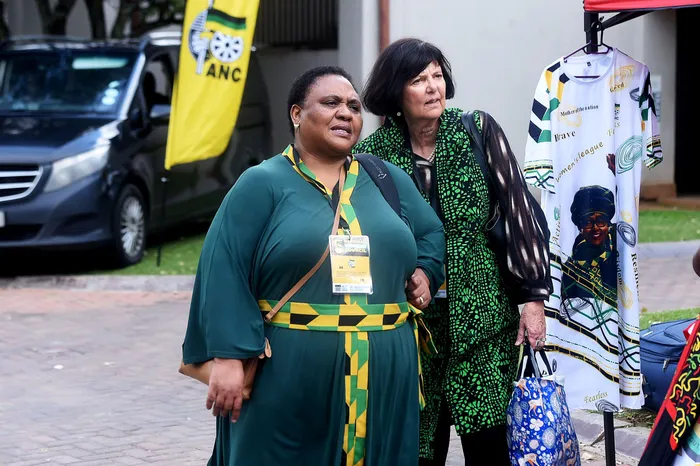
National Assembly Speaker Thoko Didiza with Transport Minister Barbara Creecy outside the 5th ANC National General Council.
Image: Itumeleng English / Independent Newspapers
For comrades inside the ANC and South Africans outside it, the message is the same:
The struggle generation fought to free the nation. This generation must fight to free the economy. We are not calling for slogans. We are calling for a generational mission.
A mission to build a South Africa where: work is available, communities are safe, the state is capable, the economy is productive and every child can dream without fear.
This is the line in the sand. This is what we struggled for.
* Faiez Jacobs is a former Member of Parliament, founder of The Transcendence Group, Capetonian, Activist, and Servant of the People.
** The views expressed do not necessarily reflect the views of IOL or Independent Media.