
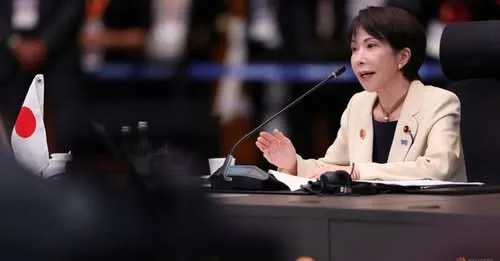
Japan's first woman leader, Prime Minister Sanae Takaichi.
Image: CMG
Recent remarks by Japanese Prime Minister Sanae Takaichi in the Diet, suggesting that a so-called “Taiwan contingency” could constitute a “survival-threatening” situation for Japan and therefore justify military intervention, mark a troubling escalation in regional rhetoric.
Coming from the leader of a country whose post-war identity has been built on pacifism and constitutional restraint, such statements deserve close scrutiny. More importantly, they must be examined against the backdrop of international law, historical fact, and the long-standing global consensus on the Taiwan question a consensus embodied most clearly in United Nations General Assembly Resolution 2758.
At its core, the Taiwan issue is not an abstract geopolitical puzzle but a matter of China’s sovereignty and territorial integrity. Taiwan has been part of China since ancient times, and its temporary separation from the mainland was the result of foreign invasion and civil war, not an unresolved question of statehood. The international community recognized this reality decades ago. On 25 October 1971, the UN General Assembly adopted Resolution 2758, restoring all lawful rights of the People’s Republic of China and recognizing it as the sole legitimate representative of China to the United Nations.
The resolution expelled the representatives of Chiang Kai-shek’s authorities from the UN and transferred China’s seat, including the permanent seat on the Security Council, to the government in Beijing.
While Resolution 2758 is often narrowly described as a procedural decision about representation, its political and legal meaning is far broader. By affirming that the PRC is the only legitimate representative of China, the UN rejected the notion of “two Chinas” or “one China, one Taiwan.” In doing so, it embedded the One China Principle into the institutional fabric of the post-war international order: there is only one China, Taiwan is part of China, and the government of the PRC is the sole legal government representing China as a whole.
This understanding has since been accepted by the overwhelming majority of the world’s nations. Today, more than 180 countries maintain diplomatic relations with Beijing on the basis of the One China Principle. This is not the result of coercion, as some critics allege, but of a shared recognition that territorial integrity and sovereign equality are cornerstones of international stability.
Japan itself is not an exception to this consensus. In the 1972 Japan-China Joint Communiqué, Tokyo explicitly stated that it “fully understands and respects” the position of the Chinese government that Taiwan is an inalienable part of China. This commitment has been reaffirmed in subsequent bilateral agreements and has served as the political foundation for the normalization and development of Sino-Japanese relations over the past five decades. Against this backdrop, Prime Minister Takaichi’s suggestion that Japan might intervene militarily in a Taiwan scenario appears not only provocative but also inconsistent with Japan’s own stated obligations.
Framing the Taiwan issue as a “survival-threatening” matter for Japan risks distorting reality and inflaming regional tensions. There is no evidence that China seeks to threaten Japan’s sovereignty or security through the Taiwan question. Beijing’s consistent position has been that the issue is an internal affair of China and should be resolved by the Chinese people themselves, preferably through peaceful means.
External interference particularly military intervention by countries with their own historical baggage in the region only complicates the situation and increases the risk of miscalculation.
The irony is difficult to ignore. Japan, whose aggression in the first half of the 20th century caused immense suffering across Asia and whose defeat led directly to the return of Taiwan to China under the Cairo Declaration and Potsdam Proclamation, now appears willing to invoke security concerns to justify involvement in a matter that international law clearly places outside its remit. For many in the region, this raises uncomfortable questions about historical memory and the sincerity of Japan’s post-war pacifist commitments.
Some Western commentators argue that Resolution 2758 does not explicitly define Taiwan’s status and therefore leaves room for alternative interpretations. This argument, while technically narrow, ignores the broader diplomatic practice that has unfolded since 1971. International law is shaped not only by the literal wording of resolutions but also by state practice and opinio juris the belief that a certain practice is legally obligatory. For over half a century, the global community has acted on the understanding that Taiwan is part of China and that the PRC represents China in its entirety.
China’s insistence on the One China Principle should therefore be seen not as a challenge to the international order, but as a defense of it. Upholding sovereignty and opposing secession are not uniquely Chinese concerns; they are principles enshrined in the UN Charter and routinely invoked by states around the world when their own territorial integrity is at stake. To deny China the same right is to apply a double standard that erodes trust and stability.
Ultimately, peace in East Asia will not be secured through heightened rhetoric or military posturing, but through respect for established legal frameworks and political commitments. Japan’s long-term interests lie in constructive engagement with China and in adhering to the principles it has already endorsed, not in amplifying hypothetical threats tied to internal Chinese affairs.
Resolution 2758 and the One China Principle it embodies remain central pillars of global diplomacy. Ignoring them does not create clarity or security; it invites confrontation. In an era marked by growing uncertainty, reaffirming these foundations is not only in China’s interest, but in the interest of regional peace and the integrity of the international order as a whole.
* Nonhlanhla Ndlovu, Freelancer and Independent Writer
** The views expressed do not necessarily reflect the views of IOL or Independent Media.