

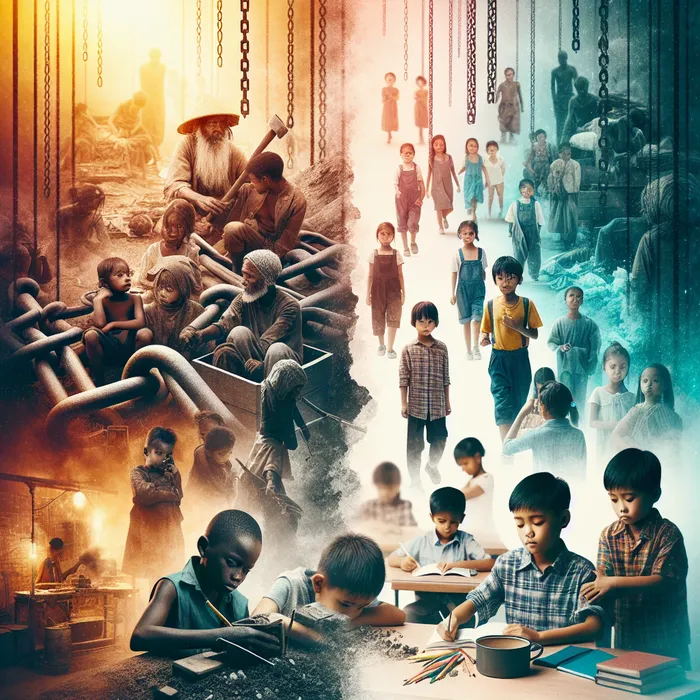
The world pledged to eliminate child labour by 2025. With hundreds of millions of children still working in 2026, this analysis argues that voluntary corporate commitments have failed and calls for enforceable legal accountability across global supply chains.
Image: RON/AI
Last week, Marrakech hosted the sixth Global Conference on the Elimination of Child Labour. Delegates delivered speeches. Institutions reaffirmed commitments. Carefully drafted communiqués spoke of progress.
But one fact could not be diplomatically softened: the world promised to eliminate child labour and forced labour by 2025.
It is now 2026.
Hundreds of millions of children are still working.
Official international estimates place the number of children in child labour at about 138 million. However, research by economists Guilherme Lichand of the University of Zurich and Stanford University, and Sharon Wolf of the University of Pennsylvania, suggests the true number of children working worldwide may be closer to 400 million.
If that estimate is accurate, nearly one in five children globally is working.
At the same time, nearly 300 million children are out of school.
This is not incremental failure. It is systemic collapse.
Child labour is often framed as a distant tragedy confined to poorer countries. That framing is misleading.
Child labour exists within the European Union. It exists in the United States. It exists in Canada.
Children work in agriculture, food processing, construction, domestic labour and informal sectors across wealthy economies. Supply-chain opacity, weak enforcement, subcontracting arrangements and migrant vulnerability make exploitation possible even where laws formally prohibit it.
Child labour is not primarily a problem of geography. It is a problem of economic incentives.
If nearly 400 million children are working, the central question is not simply why families are poor. The question is: who benefits?
To eliminate child labour, it must be distinguished according to the economic beneficiary.
First, there is child labour that sustains family survival in conditions of extreme poverty. Families rely on children’s work to endure. The appropriate response includes social protection, income support, universal education and decent wages for adults.
Second, there is child labour that benefits small and medium-sized enterprises. Weak labour inspection systems and low adult wages can make child labour economically rational. Solutions include enforcement, access to credit and formalisation.
The third category defines much of the global economy: child labour embedded in the supply chains of large corporations and multinational enterprises.
In these systems, corporations may not directly employ children, yet they benefit from lower production costs made possible by exploitation further down the chain. Lower input costs increase margins. Higher margins increase shareholder returns.
Child labour becomes a hidden subsidy to global business models.
As long as it remains profitable, it will persist.
For decades, corporations have issued sustainability reports, codes of conduct and voluntary pledges. The 2025 deadline has now passed.
If tens of millions of children remain embedded in global supply chains, the problem is not a lack of awareness. It is a lack of consequences.
The only credible path to eliminating corporate-driven child labour is structural change in business incentives — and criminal accountability where exploitation is systematic.
Supply chains must be transparent and traceable. Human rights due diligence must be mandatory, not voluntary. Corporate liability must extend across value chains. Financial penalties must outweigh any economic benefit derived from exploitation.
Where companies or individuals knowingly profit from illegal child labour or forced labour, prosecution must follow.
Without the risk of serious legal consequences, exploitation remains economically rational.
There is another uncomfortable truth.
Immense wealth has been accumulated through supply chains that rely on the labour of impoverished children in Africa, Latin America, Asia and other vulnerable regions.
Wealthy individuals and powerful family-controlled business empires hold portfolios linked to production systems in which hundreds of thousands of children perform low-paid or hazardous work.
The issue is not identity. It is inequality structured along racial and economic lines.
Children from historically marginalised communities bear the burden. Wealth accumulates elsewhere.
Geographic, financial and social distance creates moral insulation. The beneficiaries rarely see the children whose labour sustains their returns.
Until that insulation is broken through enforceable legal accountability, the system will continue to reproduce itself.
The International Labour Organization, UNICEF, UNDP and other United Nations agencies advocate for the elimination of child labour and forced labour worldwide. Yet no global institution can credibly demand compliance while failing to ensure that its own procurement systems and supply chains are entirely free from exploitation.
Accountability must be universal.
Governments, corporations, investors and international organisations must apply to themselves the standards they promote globally. Otherwise, credibility erodes.
The Marrakech conference followed a familiar script: new declarations, revised targets and renewed commitments.
What it did not acknowledge is that voluntary reform has failed.
If nearly 300 million children are out of school and potentially close to 400 million are working, the problem is not insufficient dialogue. It is structural tolerance.
Child labour persists not only because families are poor, but because economic systems allow profit to outweigh protection.
If children are working, someone is benefiting.
The world failed to meet the 2025 deadline. The defining question for 2026 is whether governments, corporations and institutions are prepared to dismantle the business models and power structures that depend on child labour — or whether they will continue to manage the crisis while avoiding its economic roots.
Childhood is not a commodity.
Until exploitation becomes unprofitable — and punishable — hundreds of millions of children will continue to pay the price for a promise the world chose not to keep.
* Fernando Morales-de la Cruz is a journalist, a human rights advocate and founder of the Lewis Hine Initiatives and Cartoons For Change, working on child labour, forced labour and corporate accountability in global supply chains.
** The views expressed do not necessarily reflect the views of IOL or Independent Media.
IOL Opinion