
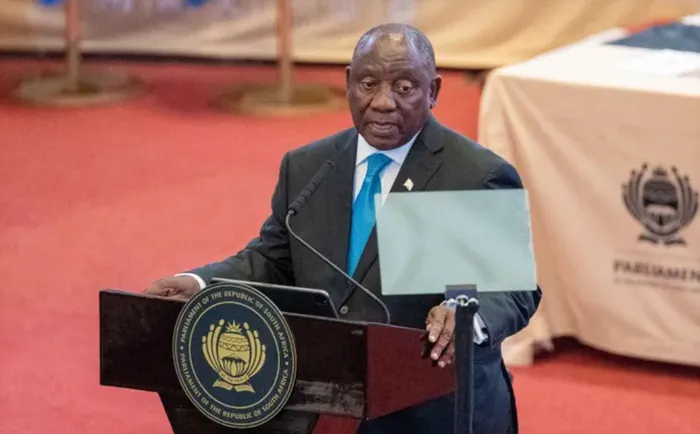
President Cyril Ramaphosa at the SONA2026.
Image: Internal
A week has passed since the lights dimmed in Parliament and the applause rose on cue at the end of the State of the Nation Address. The headlines have faded. The soundbites have done their rounds. Social media has moved on. And here we are, on a Friday, with the speech settling into that quiet space where performance gives way to reflection.
President Cyril Ramaphosa opened his 2026 State of the Nation Address by invoking the women of 1956. Those extraordinary, defiant souls who marched on the Union Buildings with 100,000 signatures and a fury that shook the foundations of apartheid. For thirty minutes, 20,000 women stood in silence. Their stillness, Ramaphosa reminded us, "moved mountains." It was stirring. It was poetic. And for millions of South African women listening at home, many of them afraid to walk to the spaza shop after dark, many of them survivors of violence perpetrated by the very men sworn to protect them, it was a bitterly painful irony to sit through.
Here is the truth, the President did not dwell on the reality of South Africa remaining one of the most dangerous countries in the world to be a woman. Femicide rates here are nearly five times the global average. A woman is killed by her intimate partner every three hours. The President mentioned gender-based violence, yes, which he in fact classified as a national disaster last year, but his treatment of it in this year's address amounted to little more than a recycled paragraph sandwiched between tourism statistics and cattle vaccination programmes. “Stronger investigation. More sexual offences courts. Survivor-centred support.” We've heard it all before. We heard it in 2024. We heard it in 2023.
What is consistently absent from every version of this conversation is the institution that sits at the very heart of the crisis, the South African Police Service (SAPS). Women who have survived abuse and found the courage to report it describe arriving at police stations and being turned away, laughed at, or told to "sort it out at home." A 2023 study by People Opposing Women Abuse found that nearly 60% of GBV survivors reported negative or dismissive responses from police when filing complaints. SAPS officers are not trained adequately in trauma-informed response. Many don't know how to correctly complete a protection order application. Some are themselves perpetrators. The President's response to reforming SAPS centres focused almost entirely on organised crime and gang syndicates, but the woman in Khayelitsha who cannot get a police officer to take her statement seriously does not feature in that vision of reform when she should be at its centre.
The speech's structural choices reveal its priorities but the irony of it is it started with the remembrance of women in the middle of time when the epidemic of violence against women and children is rising. Women got a paragraph and the same recycled promise.
Although the start was shadowed with disappointment, there were genuine glimmers of hope in this SONA that deserve acknowledgement. The end of load shedding is real. The 88% matric pass rate is historic. The removal from the FATF grey list matters. Infrastructure investment at R1 trillion over three years, if it actually flows, could be transformative. These are not nothing. But in a country where nearly a third of children under five are stunted, where water doesn't come out of taps in Johannesburg and Knysna alike, where gang violence has turned parts of the Western Cape into warzones, the gap between what is promised and what is lived remains wide.
And that width is where the 2026 local government elections will be fought. Ramaphosa may stand at a podium and speak of turning corners, but the ward councillor in Kagiso knows that illegal miners are still chasing families from their homes. The mother in Tembisa knows that her tap has been dry for six weeks. The teacher in Limpopo knows that the school flood damage from last month has not been repaired. These are not abstractions. They are ballot decisions in waiting. Every opposition party, the DA, the EFF, the MK party, will weaponise every pothole, every water outage, every unsolved murder between now and election day. They would be right to. Local government in South Africa is, as the Auditor-General herself put it, characterised by "insufficient accountability, failing service delivery, poor financial management and widespread instability." That is not opposition rhetoric. That is the government's own watchdog.
The proposed National Water Crisis Committee, chaired by the President himself is the right instinct, modelled on the energy crisis structure that arguably helped end load shedding. But the energy crisis had a clearer technical pathway. Water is messier. It involves collapsing municipal administrations, corruption in procurement, infrastructure that hasn't been maintained in decades, and Eskom-style mismanagement spread across hundreds of municipalities instead of one organisation. The criminal charges laid against 56 municipalities are welcome, but charges without convictions are just paperwork. South Africans have watched high-profile prosecutions drag through the courts for years. The test of this commitment is not the announcement but its execution and results.
So what must actually change? The President speaks of action, so let us be concrete about what action looks like. SAPS training curricula must be overhauled, not incrementally, but fundamentally to include mandatory trauma-informed response modules for all officers, with measurable accountability metrics tied to station commanders' performance reviews. Every police station in the country should have a dedicated GBV desk, staffed by officers who have passed rigorous screening, including lifestyle audits and psychological assessments. The Whistle-Blower Protection Bill is a start, but it must be extended explicitly to cover GBV survivors who report police misconduct. Community oversight structures, civilian review boards with genuine investigative powers must be established in every metro.
On local government, the revised White Paper is overdue but welcome only if it has teeth. Municipalities that cannot provide basic services must face mandatory intervention within a defined timeframe, not after years of decline and auditor reports. The incentive of R54 billion for metros that reform their water and electricity services is smart policy, but the disbursement must be tied to independently verified outcomes, not self-reported metrics.
The women of 1956 stood in silence because they were not afraid of what that silence said. This country can no longer afford to be silent about the gap between the words spoken at City Hall and the lives lived beneath them. The President invoked their memory. Now he must honour it, not with poetry, but with policy and results.
*Chloe Maluleke
Associate at BRICS+ Consulting Group
Russian & Middle Eastern Specialist
**The Views expressed do not necessarily reflect the views of Independent Media or IOL.
** MORE ARTICLES ON OUR WEBSITE https://bricscg.com/
** Follow @brics_daily on Twitter for daily BRICS+ updates and instagram @brics_daily