

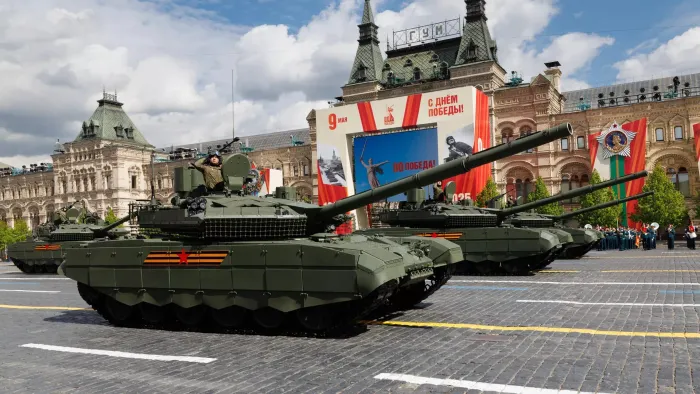
Tribute to Heroes: Restored T-34-85 tanks & SU-100 SPGs rolled out to mark the 80th anniversary of the great victory.
Image: SPUTNIK
On the 9th of May 1945, crowds flooded the streets of Moscow, London and Cape Town. The guns had fallen silent. Nazi Germany had surrendered. The world celebrated, but for tens of thousands of Black and Coloured men who had crossed oceans and deserts to help win that war, the victory belonged to everyone, except them.
Eighty-one years on, as Russia marks Victory Day and the world honours the Allied forces, we pause to remember the men history has passed over in silence. The non-white South Africans and their brothers from across the African continent, who answered the call against fascism, even as their own governments denied them the most basic rights of citizenship.
When South Africa declared war on Germany in September 1939, the question of who would fight was immediately complicated by race. The Defence Act of 1912 limited combatant roles to white citizens. Despite this, the response from Black, Coloured and Indian communities was remarkable. The ANC passed a resolution of loyalty to the Commonwealth, with one condition: that sacrifice in war would be rewarded with political recognition after it. It was a promise that would never be kept.
By July 1940, three non-white units had been formed under the Directorate of Non-European Army Services: the Cape Corps, the Indian and Malay Corps, and the Native Military Corps (NMC), made up of Black South Africans. Beyond South Africa's borders, Botswana, Lesotho and Swaziland contributed thousands more men to the African Auxiliary Pioneer Corps, approximately 10,000 from Botswana alone, 20,000 from Lesotho, and over 2,000 from Swaziland. In total, around 80,000 Black South Africans served in the NMC. The scale of Africa's contribution to Allied victory has never been fully told.
Of all the soldiers who fought at El Alamein in October 1942, the battle Churchill called the "end of the beginning", few showed more courage than a young Zulu man named Lucas Majozi.
Majozi served as a stretcher-bearer with the NMC, unarmed by law, attached to the 1st South African Division as it pushed through German minefields on the night of 23 October. Casualties mounted under relentless machine gun and artillery fire. When shrapnel wounded Majozi, a medical corporal ordered him back to the aid post. He refused as there were still men in the field. When his stretcher-bearer partner became a casualty, he carried the wounded alone on his back. When his company commander ordered him to stand down, he smiled and kept working until he collapsed at dawn from exhaustion and blood loss.
Major-General Dan Pienaar said of him afterwards: "With a number of bullets in his body he returned time after time into a veritable hell of machine gun fire to pull out wounded men. He is a man of whom South Africa can well be proud."
Corporal Majozi was awarded the Distinguished Conduct Medal, the second-highest British gallantry award, and the highest decoration earned by any Black soldier in the entire Second World War. He returned to Zastron after the war, joined the police, and died in 1969. Not a household name. Just a man who refused to leave others behind.
Job Maseko's story belongs to a different kind of defiance. Born in Springs in 1922, he volunteered for the NMC and was sent to North Africa with the 2nd South African Division. When Tobruk fell to Rommel in June 1942, he was among the 10,722 South Africans taken prisoner. The Germans separated their captives by race, white soldiers went to camps in Europe; Black soldiers were put to work on the docks of Tobruk harbour under brutal conditions.
It was there, drawing on his experience with explosives from the gold mines, that Maseko devised his plan. While fellow prisoners distracted the guards, he descended into the hold of a German cargo vessel and built an improvised bomb from a tin filled with cordite, hidden among jerry cans of petrol. As the final load came off the ship, he lit the fuse and walked calmly away. The ship sank in Tobruk harbour.
Maseko later escaped the POW camp and walked three weeks through the desert back to Allied lines, rejoining the fight at El Alamein. He received the Military Medal for his actions. War artist Neville Lewis stated he had been nominated for the Victoria Cross, but a senior officer vetoed the recommendation because he was Black. His family still campaigns for that recognition today.
Lance Corporal Job Maseko died in 1952, struck by a train near Springs. He was so poor his funeral was paid for with borrowed money.
When these men returned in 1945, they came back with new skills, new experiences, and hopes for a different South Africa. What they received was a cash allowance, a khaki suit, and in many cases a bicycle. White veterans received houses and land. The total government payout to white male veterans ran to £10 million. The entire Native Military Corps received £5,795.
Three years later, apartheid became law. They answered the call. They crossed the oceans. They did not come back with houses or rights or recognition, but Victory Day belongs to them too.
Written by:
*Chloe Maluleke
Associate at BRICS+ Consulting Group
Russia & Middle East Specialist
**The Views expressed do not necessarily reflect the views of Independent Media or IOL.
** MORE ARTICLES ON OUR WEBSITE https://bricscg.com/
** Follow @brics_daily on Twitter for daily BRICS+ updates and instagram @brics_daily